Robot knee surgery: what a 68-patient trial proves
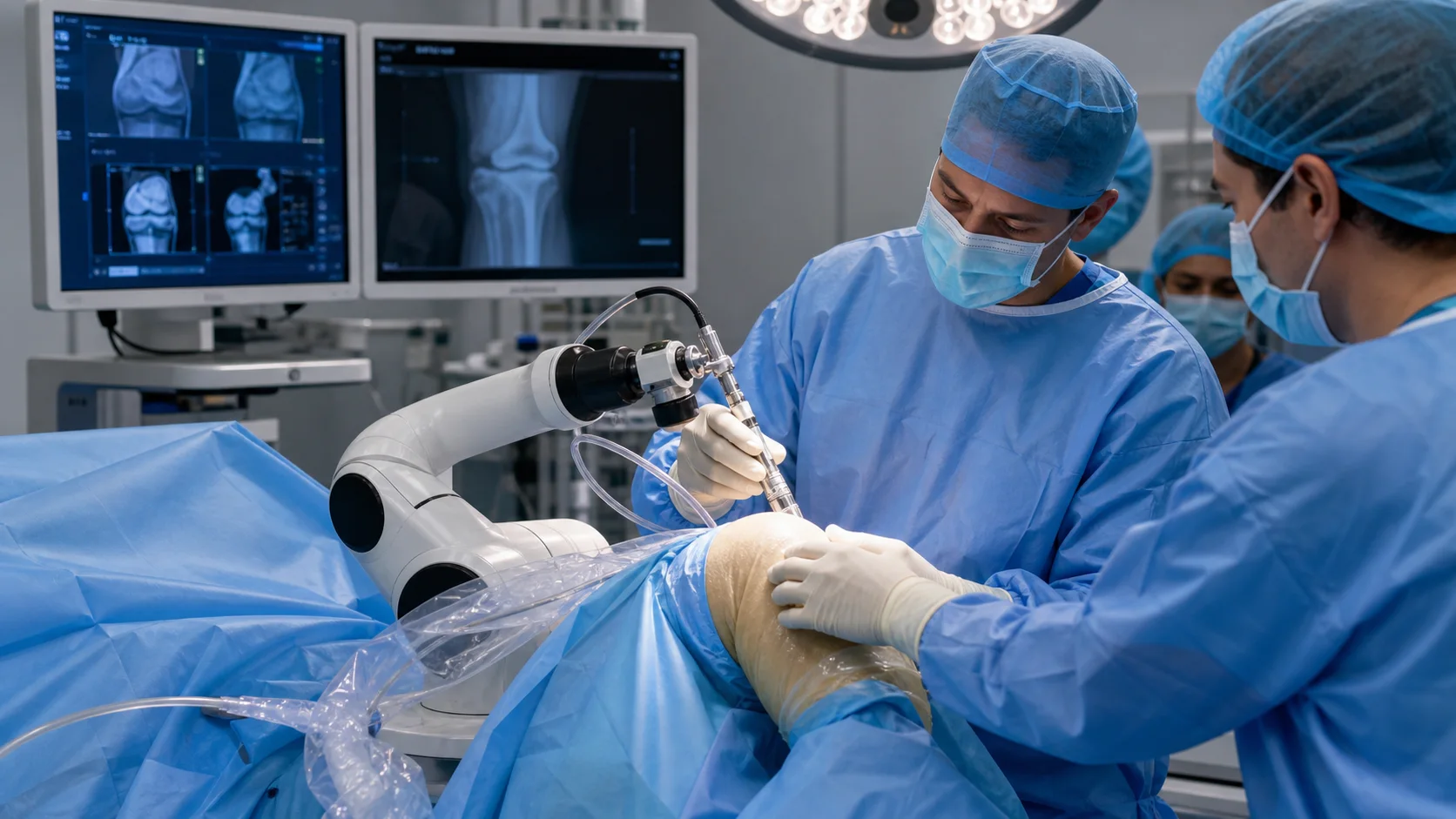
A surgical robot helped a team place knee implants more precisely in a randomized trial, but it did not operate by itself and the study does not prove a better knee years later. Researchers at Hospital Universitario Santa Cristina in Madrid randomized 68 patients undergoing total knee arthroplasty: 34 received ROSA-assisted surgery and 34 conventional manual surgery.
At three months, the robotic group had more accurate mechanical alignment, greater measured flexion and lower pain scores. Operations lasted nine minutes longer on average. The trial is useful human evidence, yet its small size, single centre and short follow-up prevent claims about implant survival, rare complications or durable satisfaction.
Evidence level
- prospective randomized human trial;
- 68 patients, split 34 versus 34;
- single Spanish centre and one experienced surgical team;
- primary comparison at three months;
- peer-reviewed publication in The Knee;
- registered as NCT07078149;
- no specific commercial or public research grant reported;
- platform assists surgeons and is not autonomous.
This is stronger than a company demonstration or retrospective hospital database because allocation was randomized and both groups were followed under the same protocol. It is weaker than a large multicentre trial designed to detect uncommon harm or long-term revision.
What ROSA actually does
The name “robotic surgery” can suggest a machine replacing the surgeon. The FDA documentation describes a more limited role. ROSA combines a robotic arm, optical tracking, software and surgical instruments. It helps identify anatomical reference axes, plan implant positioning and place a cutting guide relative to that plan.
The surgeon exposes the joint, records landmarks, makes clinical decisions and performs the operation. The arm creates guidance and controlled positioning; it does not independently diagnose the patient, select the implant or complete the procedure.
That distinction separates this study from speculative autonomous surgery robots. The 2026 trial tests robot-assisted arthroplasty under direct human control, not a system allowed to improvise an operation.
The results, number by number
Robot-assisted procedures were about nine minutes longer. The difference was statistically significant, showing that extra setup and guided workflow still carry a time cost even after the team’s learning phase.
The robotic group showed:
- less perioperative blood loss in the trial’s analysis;
- average flexion of 122.8 degrees versus 114.7 degrees;
- mechanical alignment deviation of 1 degree versus 2 degrees;
- a three-month pain score of 1.0 versus 2.0 on the study’s visual scale.
Both groups improved substantially in KOOS and SF-36 measures. Social functioning favoured the robotic group, while the publication does not establish a broad, uniform superiority across every patient-reported domain.
No complication, adverse event, revision or conversion to manual surgery was reported among the 68 patients. That is reassuring for this cohort, but zero events in a small trial does not mean zero risk. A study of 68 people cannot reliably measure uncommon complications.
Why alignment is not the same as a better life
Precise bone cuts and component alignment are valuable technical outcomes. They may reduce outliers and help a surgeon execute a plan consistently. But patients care about pain, mobility, confidence, implant longevity and the need for another operation.
A 2025 meta-analysis covering 21 randomized trials and 2,692 patients found fewer mechanical-alignment outliers with robotic assistance and operations roughly 20 minutes longer on average. It found no significant advantage in WOMAC or Oxford Knee Scores across the analysed follow-up points. Its conclusion was cautious: precision improves, while clinical benefit and cost-effectiveness still need evaluation.
The new 68-person trial adds encouraging early results, particularly flexion and pain at three months. It does not overturn the larger evidence base. A difference seen at three months can narrow, persist or grow; only longer follow-up can answer that.
Regulatory status is not an outcome guarantee
ROSA is not a preclinical prototype. FDA records classify the system as orthopedic stereotaxic instrumentation that assists total knee replacement. The cited 2024 510(k) summary concerns additional compatibility and finds substantial equivalence to a legally marketed predicate.
Clearance means the system may be marketed for its defined assistance role. It does not mean the FDA guarantees that every patient will recover faster or that robotic surgery is superior to manual surgery. Regulatory status, clinical effectiveness and hospital economics are three separate questions.
The trial itself is therefore best described as a randomized human outcome study of an authorised assistance system. It is not a drug phase, not a first-in-human experiment and not a new authorisation.
The missing economic comparison
Robotic platforms add capital, instruments, maintenance, training and operating-room time. Potential savings may come from workflow, fewer alignment outliers, shorter recovery or fewer revisions—but the present study was not designed to prove a cost advantage.
A hospital decision should examine case volume, surgeon experience, consumables, downtime and whether observed benefits exceed the cost. A patient decision belongs with the clinical team and depends on diagnosis, implant options, surgeon expertise and individual risk. This article provides no medical advice or treatment recommendation.
What a decisive next trial needs
The next evidence step is a multicentre randomized trial with hundreds or thousands of patients, predefined adverse-event reporting and follow-up measured in years. It should include revision, infection, function, satisfaction, quality of life and complete costs.
It should also separate the robot from the surrounding expertise. A platform used by an experienced team after its learning curve may outperform a new installation, while a highly skilled manual team may achieve excellent alignment without a robot.
RoboFutur verdict
The RATKA-EARLY trial gives ROSA a credible short-term signal: better technical alignment and some early patient benefits in a randomized comparison. It also records a nine-minute operating-time penalty and cannot answer long-term questions.
The honest conclusion is neither “robots win” nor “the robot adds nothing.” Assistance improved precision in this cohort; durable clinical superiority remains unproven. That is exactly the boundary a medical technology article must preserve.
✔ How we checked this
Evidence checked on August 26, 2026: peer-reviewed randomized human trial, ClinicalTrials.gov record NCT07078149, FDA 510(k) summary and a 21-RCT meta-analysis. Trial size was 68 patients at one centre with outcomes reported to three months; this is not a trial of autonomous surgery and provides no individual medical recommendation.
Information verified as of the publication or update date shown. Technology moves fast — check the sources below.
Sources
- Early clinical benefits of robot-assisted versus manual total knee arthroplasty — The Knee / PubMed
- RATKA-EARLY trial record NCT07078149 — ClinicalTrials.gov
- ROSA Knee System 510(k) summary K242864 — U.S. Food and Drug Administration
- Robotic-assisted versus conventional total knee arthroplasty: meta-analysis of 21 RCTs — Annals of Medicine and Surgery / PubMed