🧬 Health & Longevity
AlphaGenome Atlas: predictions are not diagnoses
Announced on 8 September 2026, AlphaGenome Atlas contains precomputed molecular-effect predictions for roughly nine billion single-letter substitutions in…

Medical robotics, AI-designed drugs, brain interfaces and the evidence behind longevity research.
Announced on 8 September 2026, AlphaGenome Atlas contains precomputed molecular-effect predictions for roughly nine billion single-letter substitutions in…
A 10 September 2026 OpenAI account describes César de la Fuente’s laboratory exploring genomic data for antimicrobial candidates. The team uses its own…
On 30 September 2026, Google DeepMind presented SynthID Bio, a proof of concept for identifying AI-designed proteins. The authors describe sequence and…
A study in The Lancet Oncology estimates that about 12% of new cancer cases worldwide, or 2.3 million in 2024, are linked to infections. The primary article could not be opened.
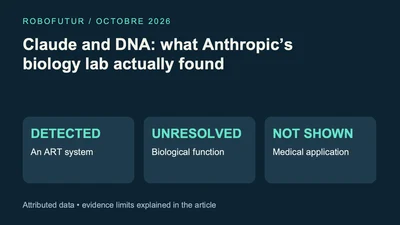
Anthropic reports an ART enzyme system associated with DNA repeats. The technical report, human lab work and the limits of the medical interpretation.
A randomized human trial of ROSA-assisted knee replacement found better alignment and some early benefits at three months, but it was small, single-centre and nine minutes longer.
A prospective study of 105 pets found that a human-trained digital stethoscope detected most dog murmurs but missed 20 of 22 cat murmurs and produced many false arrhythmia alerts.
Vicarious Surgical transferred its assets for liquidation before FDA authorization or sales. The filing shows why medical robots need long runways.
Rentosertib produced an encouraging signal in a small pulmonary-fibrosis trial. It also shows why AI cannot skip clinical evidence.
A research robot completed a complex procedure on realistic tissue models. Today's cleared surgical systems remain under direct physician control.
Alphabet-backed Calico studies the biology of aging, but its public clinical pipeline is about specific diseases—not immortality.
Early feasibility studies are testing whether people with severe paralysis can control digital devices. That is not mind reading or human enhancement.
Recent U.S. approvals show how cancer treatment is becoming more precise: a defined tumour, biomarker and treatment history—not one medicine for every cancer.
ER-100 is testing partial epigenetic reprogramming in up to 18 people with optic-nerve disease. It is a local phase 1 safety study, not whole-body rejuvenation.
CRISPR has produced an authorised treatment for blood disorders, but the procedure remains demanding and gene editing is not yet a universal cure.
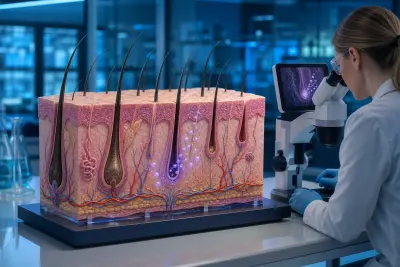
PP405 targets dormant follicles and clascoterone local androgen signalling. Both remain investigational despite encouraging company releases.
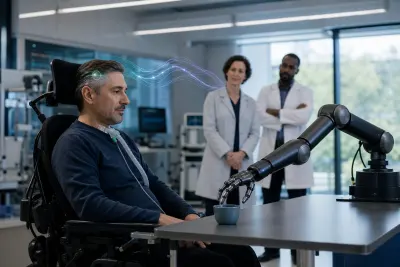
Neuralink's CONVOY tests brain-implant control of an assistive robot arm in three participants. It is an early feasibility study, not restored movement.
Orforglipron is now approved in the United States, while retatrutide remains investigational. The gap matters as unapproved versions spread online.
Drugs that clear senescent cells are being tested in people, but today's studies are small and do not prove longer life.
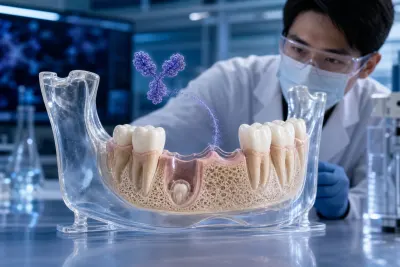
Where Toregem's TRG035 tooth-regrowth antibody really stands in 2026: real animal evidence, conflicting official trial-status pages — and no approved drug yet.
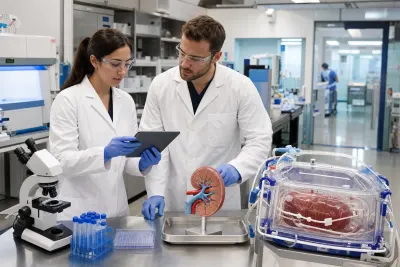
Genetically modified pig kidneys have functioned in living recipients, but rejection, infection and duration remain central questions for trials.