Autonomous Surgery in 2026: What Robots Can Really Do Without a Surgeon
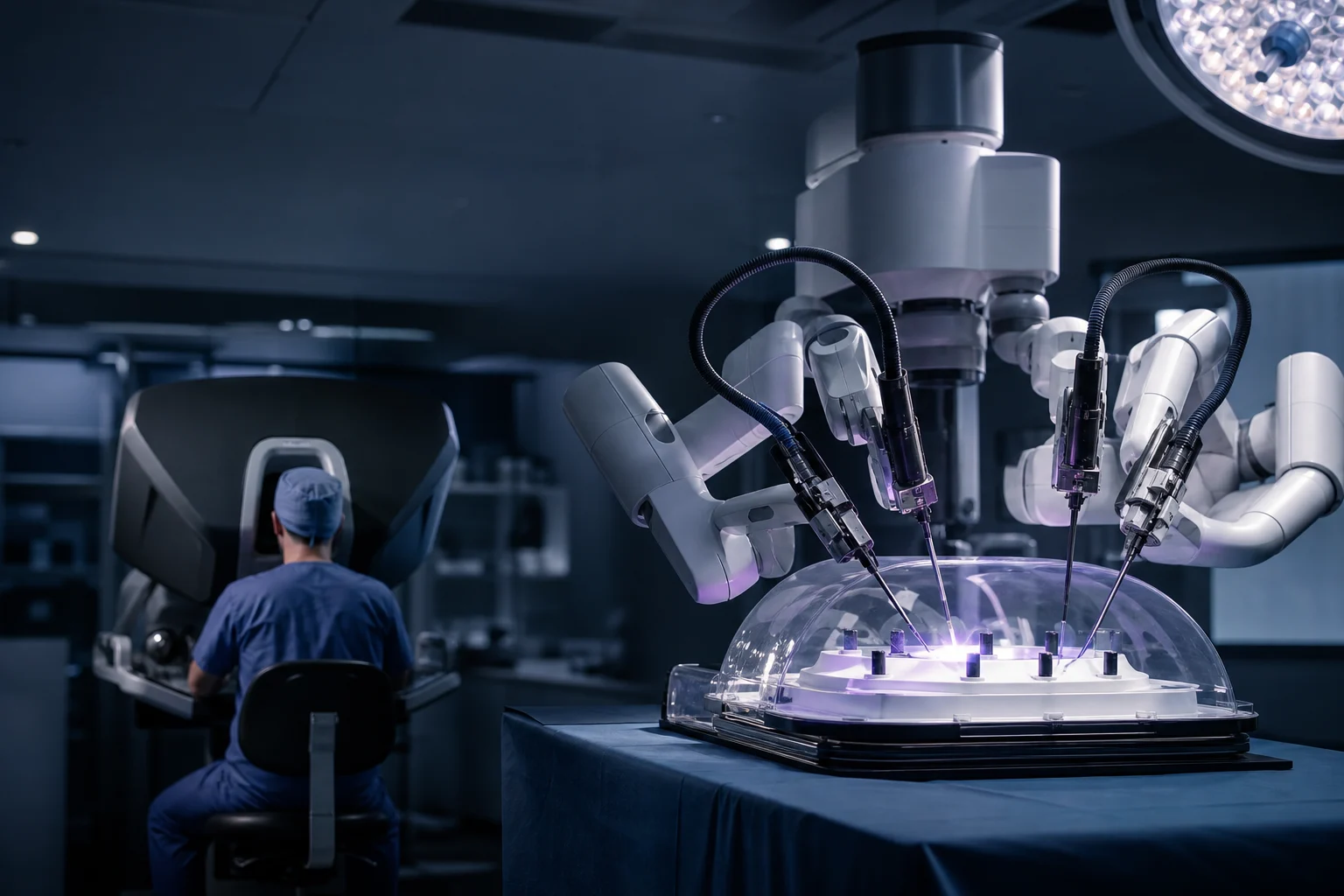
A robot watches surgical videos, receives a spoken correction and completes a long sequence of operating-room actions without a human moving its tools. That sounds like autonomous surgery has arrived. The real 2026 result is both narrower and more scientifically interesting.
Researchers at Johns Hopkins developed SRT-H, a system that performed a realistic gallbladder-removal procedure on ex vivo pig tissue. It completed eight experiments successfully, adapted to anatomical variation and followed voice instructions. This is an important autonomy demonstration. It was not surgery on a living patient.
What the robot actually achieved
SRT-H uses a hierarchy. One model interprets the procedure as a sequence of tasks; lower-level policies control actions such as grasping, clipping and cutting. The system learned from demonstrations and could recover from some unexpected situations rather than following a single rigid path.
That flexibility is the breakthrough. Operating rooms are less predictable than factory lines. Tissue deforms, anatomy varies and one imperfect move changes the next view. A useful autonomous system must recognise where it is in the procedure and respond when reality diverges from training.
The study reported successful completion in eight ex vivo gallbladders. “Ex vivo” means the tissue was outside a living body. There was no bleeding, breathing motion, whole-patient physiology or emergency conversion to manage. Eight successes support a proof of concept; they do not establish safety across hospitals, surgeons and patient populations.
Today's clinical robots are not autonomous surgeons
The U.S. Food and Drug Administration uses the term robotically assisted surgical systems, but explicitly notes that currently cleared devices cannot perform surgery without direct human control. A trained physician operates the console and remains responsible for every instrument movement.
Newer platforms can improve ergonomics, imaging, force feedback and data capture. Those capabilities may reduce strain or support precision. They do not make the machine an independent clinician.
This distinction often disappears in headlines. “FDA-cleared surgical robot” means regulators cleared a particular surgeon-controlled device and intended use. It does not mean the FDA authorised an AI to decide and execute an operation alone.
Why autonomy is harder than a perfect demo
A clinical autonomous system would have to deal with rare but dangerous events: unexpected bleeding, abnormal anatomy, a failing camera, a tool fault or a patient whose vital signs change. It must know when confidence is low and hand control back quickly.
Validation also needs more than an average success rate. Researchers and regulators need to understand failure modes, data coverage, cybersecurity, latency, sterilisation, maintenance and how performance changes between sites. Voice correction in a lab is useful; a busy operating room adds noise, accents, interruptions and competing commands.
Responsibility is another layer. The surgeon, hospital, manufacturer and software developer each control a different part of the system. Logging decisions and preserving a clear human override will be as important as mechanical accuracy.
What is likely to arrive first
Near-term autonomy will probably be bounded rather than total. A system may hold a camera, maintain a safe distance, place a suture in a defined situation or warn that a structure is at risk. The surgeon chooses the goal, supervises execution and can interrupt.
That resembles aviation: automation handles stable subtasks while trained humans manage context and exceptions. It can still be valuable. Reducing repetitive workload may let surgeons concentrate on judgement, and standardised motion could help researchers compare techniques.
The verdict
SRT-H demonstrates that imitation learning and language-conditioned control can coordinate a complex surgical sequence on realistic tissue. It advances the research frontier from isolated autonomous gestures toward procedure-level behaviour.
It does not show that a robot can safely operate on a living person without a surgeon. In 2026, the systems available in operating rooms remain physician-controlled, while autonomy belongs to tightly controlled research. The next credible milestones are animal studies, rigorous failure testing, supervised clinical protocols and regulatory review—not a hospital replacing its surgeons. Our brain-implant comparison examines another medical technology where impressive demos and clinical evidence must be kept separate.
✔ How we checked this
The autonomous research result was checked against the peer-reviewed paper and Johns Hopkins report. Current clinical status was checked with the FDA, which distinguishes cleared surgeon-controlled systems from autonomy.
Information verified as of the publication or update date shown. Technology moves fast — check the sources below.
Sources
- SRT-H: a hierarchical framework for autonomous surgery via language-conditioned imitation learning — Science Robotics
- Robot performs first realistic surgery without human help — Johns Hopkins University
- Computer-Assisted Surgical Systems — U.S. Food and Drug Administration
- da Vinci 5 — K251227 — U.S. Food and Drug Administration