AI and Humans: Five Tasks, Performance and Limits
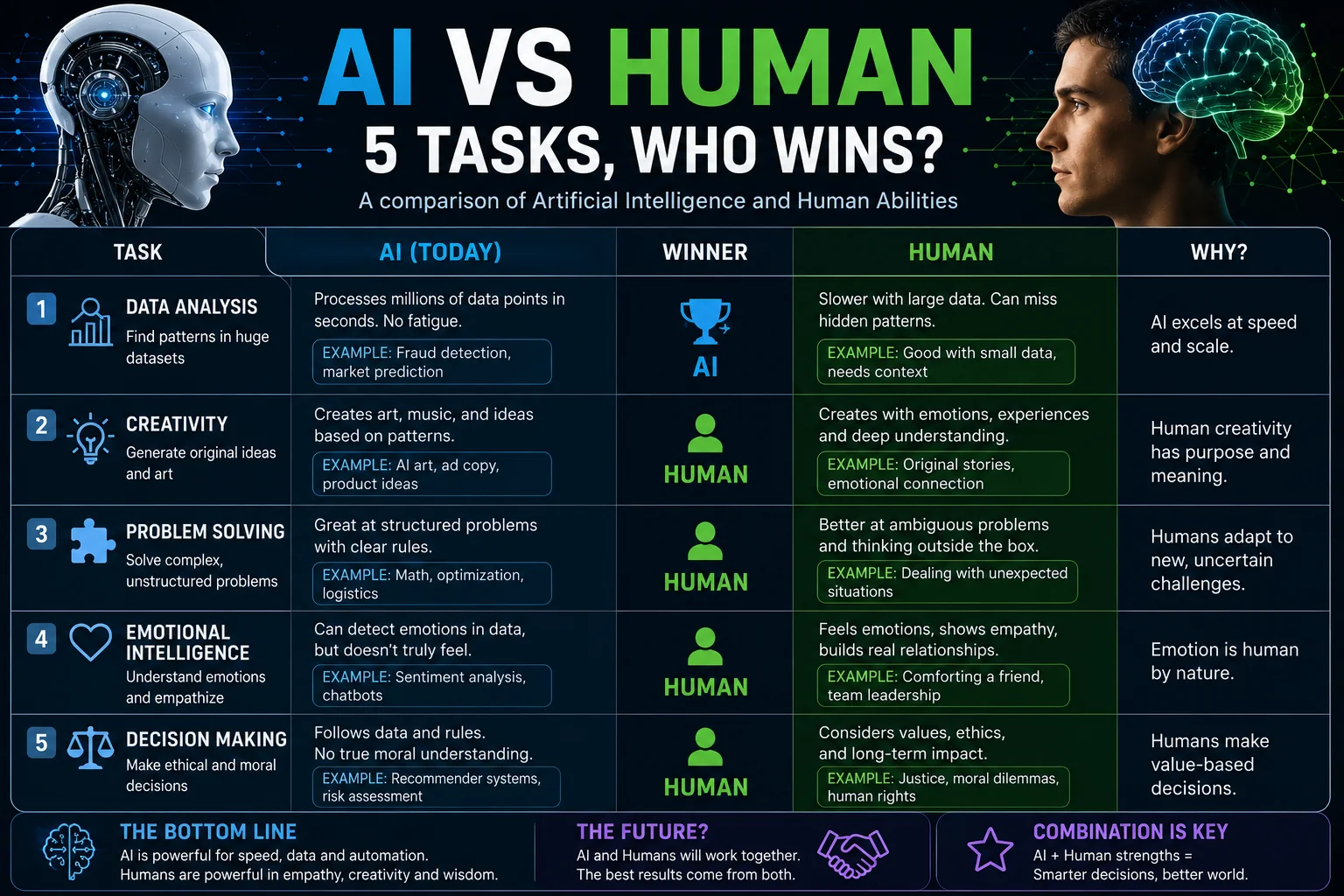
“AI versus human” is usually the wrong contest. A system can defeat the best player at one game and still fail at an ordinary request outside its training setup. Humans combine goals, social context, physical experience and responsibility; AI systems specialise, search or generate at extraordinary speed.
To make the comparison useful, we chose five defined tasks and judged the result by accuracy, scale, adaptability and accountability.
1. Playing Go: AI wins the board
AlphaGo defeated European champion Fan Hui 5–0 and Lee Sedol 4–1. Go had long been treated as a difficult frontier because the number of possible positions makes brute-force search impractical. DeepMind's system combined neural networks with search to evaluate moves and positions.
For winning a regulated game under fixed rules, AI is clearly superior to any individual player. Humans still decide why the game matters, teach its culture and create competitions. AlphaGo's victory is evidence of superhuman Go performance, not proof that the same system can manage a company or understand a kitchen.
Winner: AI for performance; humans for purpose and context.
2. Predicting protein structures: AI transforms the workflow
AlphaFold's CASP14 performance reached near-experimental accuracy for many targets, and its database now makes more than 200 million predicted structures available. That gives researchers a powerful starting point and can shorten a previously slow stage of biological investigation.
It does not replace experiments or scientific judgement. A predicted structure may not answer how a protein behaves in every cellular context, interacts with partners or responds to a drug. Scientists choose questions, validate hypotheses and interpret consequences.
Winner: AI for prediction at scale; human-led science for validation.
3. Drafting routine text: AI wins speed
For a first draft of a standard email, summary or product description, a generative model can produce acceptable text in seconds. It can also translate tone or create variants. That speed is why clerical and writing tasks show substantial exposure in labour studies.
Humans win when the text requires lived experience, confidential context, political judgement or legal responsibility. Models may invent details and can reproduce bland patterns. The best workflow gives AI a constrained brief, checks every factual claim and keeps a person accountable for publication.
Winner: AI for volume; humans for meaning and sign-off.
4. Generating short video: AI wins iteration, not truth
Current video models can turn a prompt or image into polished moving scenes, sometimes with synchronised audio. A creator can explore visual ideas far faster than a conventional shoot. Yet physical consistency, character continuity and precise control can still fail, and realistic output can mislead viewers.
A human director understands the audience, obtains permissions, verifies claims and decides what should be made. AI reduces the cost of a shot; it does not acquire rights or ethical judgement. Our Sora and Veo reality check explains the current product status and provenance tools.
Winner: AI for rapid variants; humans for intent, rights and trust.
5. Handling an unfamiliar crisis: humans retain the lead
An AI assistant can search procedures, summarise reports and propose options. In a real emergency, however, inputs are incomplete, people behave unpredictably and values conflict. A responsible decision-maker must inspect the physical situation, coordinate people and own the outcome.
This is also where benchmark confidence can be dangerous. A fluent answer may conceal uncertainty. AI can support the team, but authority should remain with trained humans and established safety processes.
Winner: humans, assisted by specialised tools.
The combined team is the real competitor
The pattern is consistent: AI excels when the task is measurable, repeatable and rich in digital data. Humans remain stronger when goals are contested, context changes, evidence is missing or accountability matters. Even those boundaries move as tools improve.
So do not ask whether AI is “smarter” in the abstract. Define the task, set a success metric, test failure cases and assign responsibility. Start with the best free AI tools if you want to run your own controlled comparison — our Kimi K3 vs Claude and GPT breakdown shows what that looks like on real, sourced benchmarks. For work planning, our 2030 jobs analysis explains why tasks change before whole occupations disappear.
✔ How we checked this
This is a task-level comparison, not a claim of general intelligence. We use documented benchmark results and identify where real-world evaluation remains context-dependent.
Information verified as of the publication or update date shown. Technology moves fast — check the sources below.
Sources
- AlphaGo: The Challenge Match — Google DeepMind
- AlphaFold — Google DeepMind
- Generative AI and Jobs index — International Labour Organization
- Veo — Google DeepMind