The 4 creepiest robots in 2026—and why they unsettle us
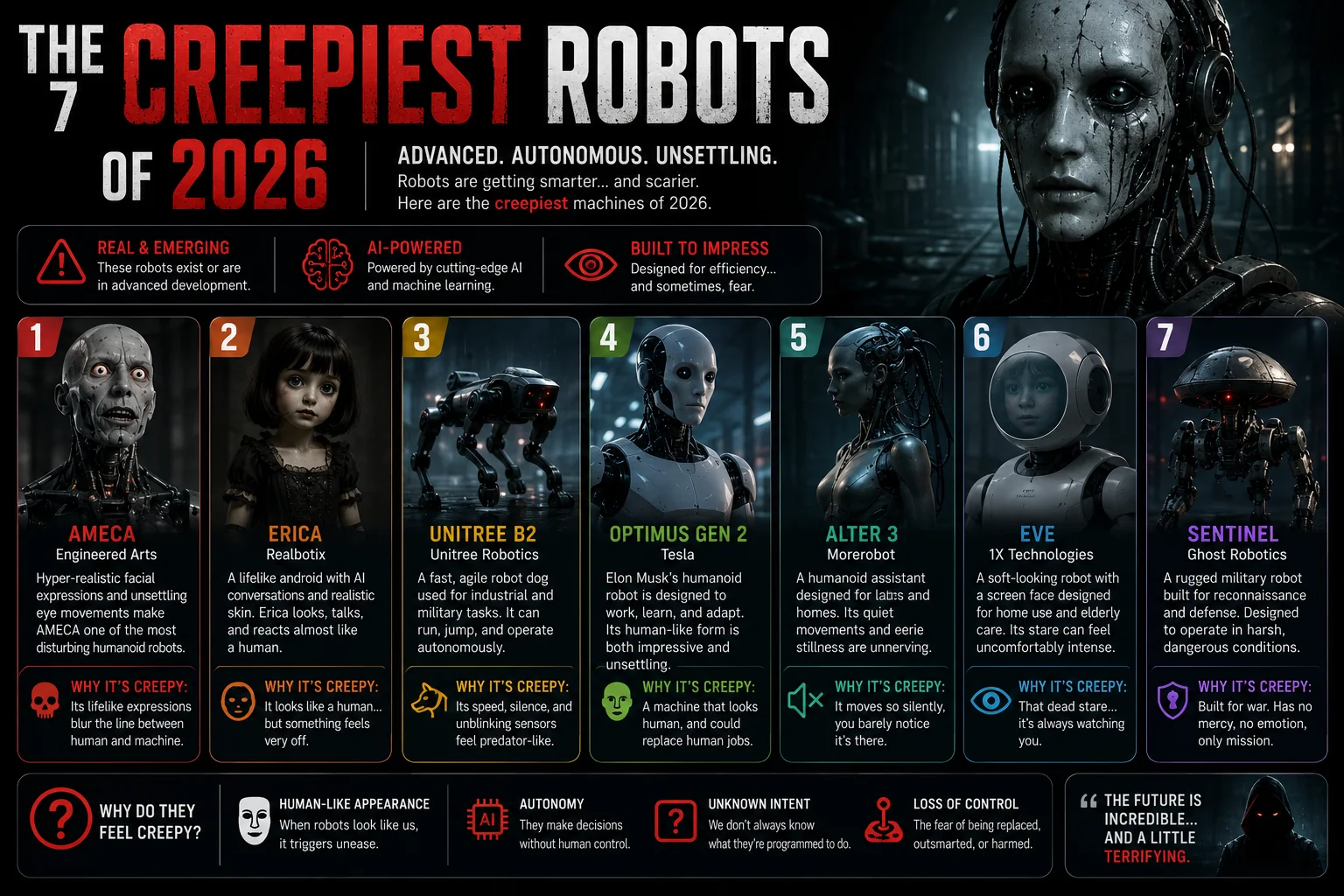
A robot is not dangerous because it looks unsettling, and a friendly face does not make a machine safe. “Creepy” describes a human reaction: we notice something almost familiar, then detect motion, timing or intent that does not fit. In 2026, four robots trigger that response for very different technical reasons.
This list is not a danger ranking. It separates verified specifications from our subjective interpretation and avoids turning a dramatic clip into a claim about consciousness.
1. Ameca: the face that watches back
Engineered Arts built Ameca for human-robot interaction. The company lists 61 actuated movements, a height of 1.87 metres and a weight of 62 kilograms. Cameras in its eyes allow tracking, while facial mechanisms produce eyebrows, mouth movement and subtle expressions. External AI systems can be integrated for conversation.
Ameca is uncanny because humans read enormous meaning into tiny facial cues. A delayed smile or gaze held a fraction too long can feel intentional even when it is generated by sensors and programmed motion. The effect says as much about our social perception as it does about the robot.
Ameca should not be mistaken for a general labour robot. It is a platform for interaction, exhibitions and research. A convincing expression is not evidence of emotion, understanding or independent goals.
2. Atlas: movement beyond a human skeleton
Boston Dynamics' electric Atlas is 1.9 metres tall, weighs 90 kilograms and has 56 degrees of freedom. Some joints use continuous rotation, so the robot can reorient its body without copying the limits of a human spine or neck. Its 360-degree camera coverage and fast, deliberate movement make it highly capable for industrial environments.
That non-human efficiency creates the unease. We recognise a torso, arms and legs, then see them choose a motion no person would use. Atlas does not need to be scary by design; its industrial optimisation breaks our prediction of how a body should move.
The verified facts are practical: Boston Dynamics publishes payload, battery and ingress-protection specifications. Claims that Atlas is a weapon, conscious or secretly autonomous require separate evidence and should not be inferred from its appearance.
3. Figure 03: ordinary chores without a person
Figure 03 looks less theatrical than Ameca, but its Helix 02 demonstrations can be more psychologically striking. Figure has shown a robot handling a dishwasher sequence and two robots resetting a bedroom. The actions are mundane, which places the machine inside a deeply familiar human space.
The unsettling part is agency: a full-size figure navigates, reaches and rearranges personal surroundings. Figure says its system combines vision, touch and proprioception for whole-body control. But the demonstrations are first-party evidence in prepared settings, not independent proof that the robot can safely understand every home.
Privacy may matter more than appearance. A home robot needs cameras and sensors to operate. Buyers should care about data access, remote assistance and security long after the uncanny feeling fades.
4. Unitree G1: acrobatics at a lower price
The G1 is smaller—about 1.32 metres and 35 kilograms—but online footage often emphasises fast, dynamic movement. Its depth camera, 3D lidar and articulated body make it a serious development platform. The starting price of $13,500 lowers the barrier for institutions and companies compared with many humanoids.
Its creep factor comes from contrast: a compact, almost toy-sized form performs movements with unexpected speed and balance. Edited videos can amplify that response. They do not tell viewers whether a sequence was autonomous, teleoperated, preprogrammed or selected after multiple attempts.
What the uncanny feeling is good for
Discomfort can prompt useful questions. Is the robot's state obvious? Can a nearby person predict its next movement? Is there a visible emergency stop? Does it signal when a remote operator is connected? Safety designers should not dismiss these reactions, because legible behaviour helps people share space with machines.
But appearance is a poor risk assessment. A faceless industrial arm can injure someone; an expressive face can be harmless theatre. Judge safeguards, task boundaries and evidence instead. Our top five humanoid comparison ranks current machines on capability, while the home robot guide focuses on privacy and real-world usefulness.
✔ How we checked this
‘Creepy’ is a subjective editorial description. Hardware facts come from manufacturer pages; emotional interpretation is clearly separated from capability claims.
Information verified as of the publication or update date shown. Technology moves fast — check the sources below.
Sources
- Ameca humanoid robot — Engineered Arts
- Atlas product specifications — Boston Dynamics
- Introducing Figure 03 — Figure
- Unitree G1 specifications — Unitree