Sora vs Veo in 2026: official status, features and what's real
AI video crossed an important threshold: a short clip can look plausible before a viewer has time to inspect it. Lighting, camera movement, speech and ambient sound can now arrive from a prompt. But the 2026 product landscape is not the rivalry many old comparisons describe.
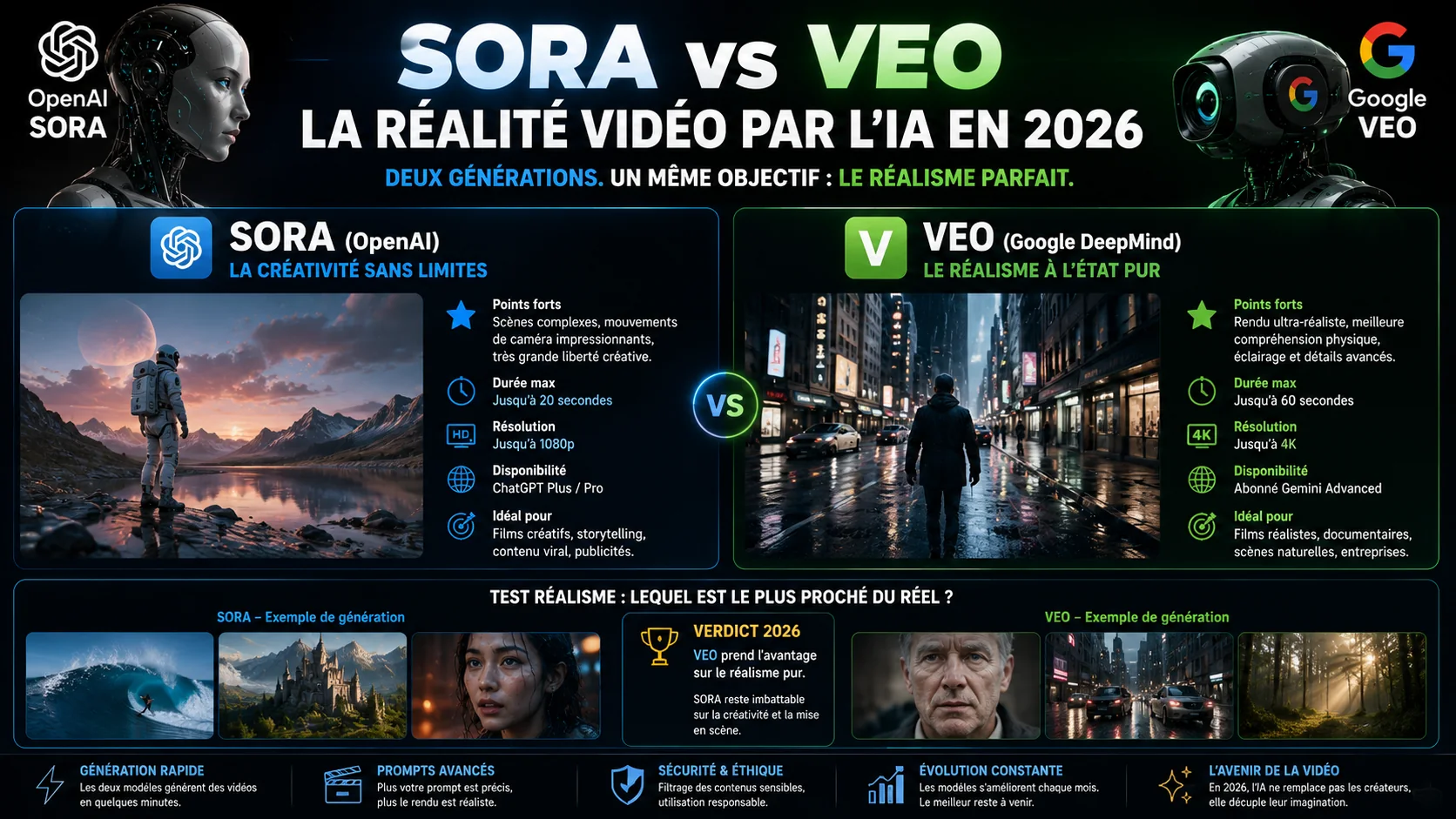
Google is presenting Veo 3.1 as its current video-generation technology, with native audio and stronger prompt adherence. OpenAI's official Sora 2 page now states that the Sora product is no longer available as of 26 April 2026. Any guide claiming both are currently equivalent consumer products is out of date.
What Veo can do
DeepMind describes Veo 3.1 as capable of generating video with dialogue, sound effects and ambient audio. Image references and editing controls can help creators preserve a visual direction across shots. The result can be strong enough for concept work, advertising experiments and social clips.
“Realistic” is not the same as physically correct. Look closely at object permanence, hand interactions, reflections, text, cause and effect, and whether a character remains consistent after a cut. A beautiful five-second result does not guarantee a coherent one-minute story.
Access also varies across Google's products, plans and regions. Check the current official interface before promising a client a particular resolution, duration or quota.
What happened to Sora
OpenAI introduced Sora 2 in September 2025 with improved physical consistency, controllability and synchronised dialogue and sound. Its launch also stressed safeguards around likeness and provenance. However, OpenAI has since marked the Sora product as discontinued.
That does not erase Sora's technical influence or old outputs. It does change buying advice: do not subscribe to a third-party service merely because it claims to provide “official Sora” access. Verify the provider, terms and current OpenAI documentation. Archived tutorials may describe controls that no longer exist.
Can you still tell what is real?
Sometimes, but visual guessing is weak evidence. Common clues—warped hands, impossible reflections, drifting details—become less reliable as models improve. Compression and reposting can also remove context from authentic footage.
Use a verification process instead:
- Find the earliest upload and the account that published it.
- Check whether reputable sources independently confirm the event.
- Inspect captions, location, date and inconsistencies across frames.
- Look for Content Credentials or C2PA metadata, while remembering metadata can be removed.
- Run a reverse-image search on key frames.
- If the stakes are high, do not share until a primary source confirms it.
C2PA credentials can record provenance and edits, but their absence does not prove a fake and their presence must be validated cryptographically. Provenance complements journalism; it does not replace it.
Rights are part of the workflow
Before publishing, confirm that you have the right to use every uploaded image, voice, face, logo and music track. Obtain consent for a recognisable person. Label synthetic media when a reasonable viewer could be misled, and follow the rules of the platform and jurisdiction where you publish.
For commercial work, save prompts, source licences, generation dates and edits. This creates an audit trail if a client or platform asks how the clip was made.
The practical verdict
Veo is a current, capable option for AI-assisted video, subject to access and usage terms. Sora is historically important but no longer an available OpenAI product as of the official notice. Neither turns filmmaking into a one-click truth machine.
Use AI for storyboards, visual exploration and clearly labelled creative shots. Use human review for factual claims, consent, continuity and final publication. Our free AI tool guide explains how to test services safely, and AI versus humans compares generation speed with human accountability.
✔ How we checked this
Product availability was checked on official pages on 18 July 2026. Model access, regional availability and limits can change; visual quality statements are task-dependent.
Sources
- Veo — Google DeepMind
- Sora 2 — OpenAI
- Creating with Sora safely — OpenAI
- C2PA specification — C2PA