Brain Implants in 2026: Neuralink, Synchron and the Reality Behind the Demos
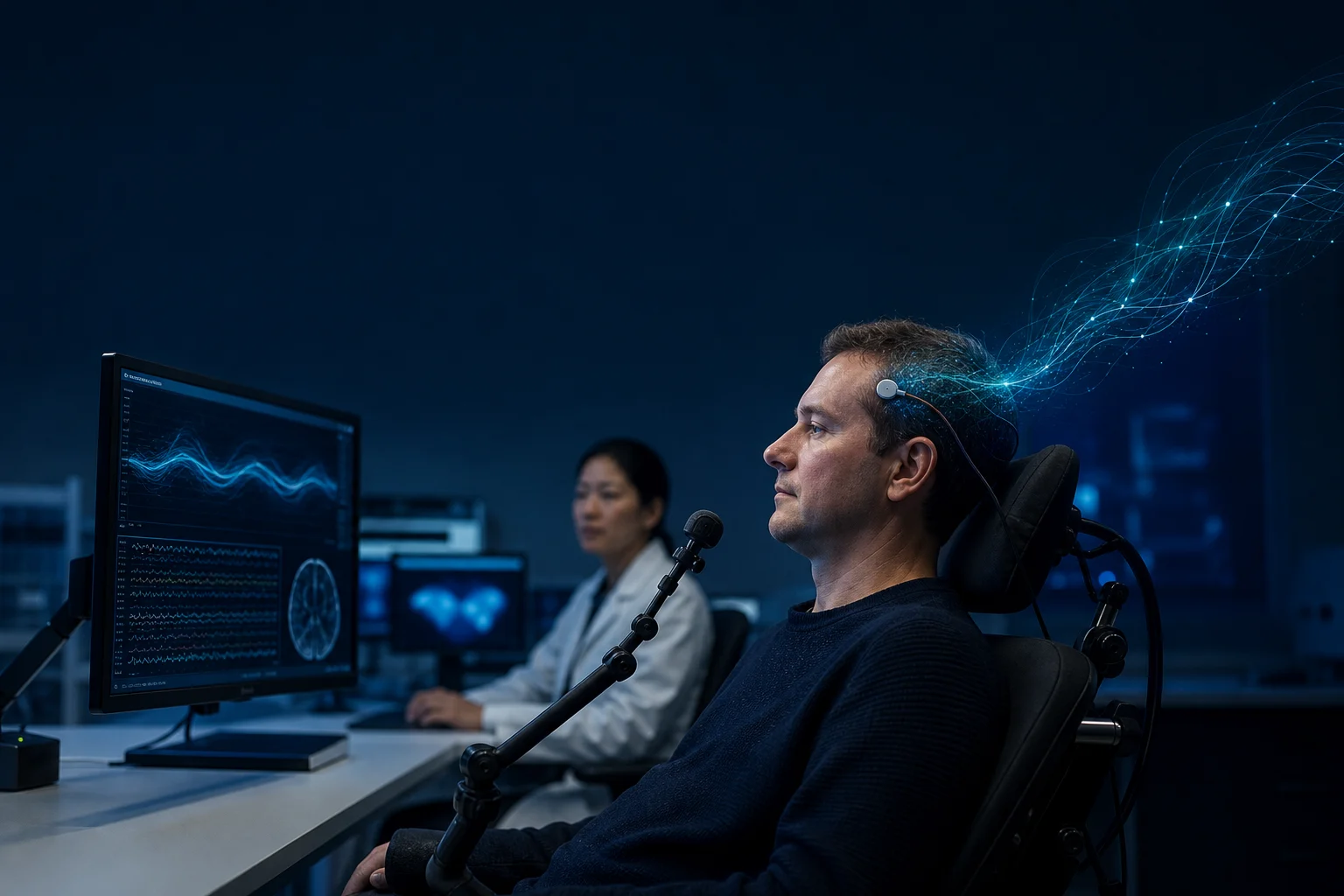
A person with paralysis moves a cursor, plays a game or sends a message without using their hands. Brain-computer interface demonstrations can look like telepathy. The clinical goal is more precise: translate patterns of neural activity into commands that restore access to digital tools.
In 2026, Neuralink and Synchron are running early feasibility studies in small groups. These trials matter because they move implanted interfaces out of laboratory prototypes and into long-term use by participants. They do not establish mass-market safety, read private thoughts or give healthy users superhuman intelligence.
Neuralink's PRIME study
The PRIME study, NCT06429735, is a first-in-human investigation of Neuralink's N1 implant and the R1 surgical robot. Its listed participants have tetraplegia associated with spinal-cord injury or amyotrophic lateral sclerosis. The main purpose is to evaluate initial safety and whether the system can let a participant control an external device.
The registry lists an estimated enrolment of 15 and a study timeline extending to 2031. That long follow-up is not a detail. An implanted device must be assessed for surgical complications, infection, signal stability, hardware failure and what happens when components or software evolve.
Public videos of participants using computers demonstrate individual capability. They do not replace aggregated results across all participants, predefined endpoints and peer-reviewed reporting.
Synchron's COMMAND study
Synchron takes a different route. Its Stentrode is delivered through a blood vessel rather than through open-brain placement of many electrode threads. The COMMAND early feasibility study, NCT05035823, enrolled six participants with severe paralysis and examines safety plus the ability to control digital devices.
Less invasive access could reduce some surgical burdens, while the vascular location may limit the type or resolution of signals compared with electrodes placed in brain tissue. That is an engineering and clinical trade-off, not a simple ranking.
The registry describes the device as investigational—not approved or cleared for general use. A completed enrolment or a successful participant demo does not change that status.
What these systems can decode
Current implanted BCIs are trained around intended movement and task-specific signals. Software learns a mapping between neural patterns and actions such as moving a pointer or selecting a character. Performance depends on the person, implant location, calibration, interface design and daily signal quality.
This is not unrestricted mind reading. A system trained to decode cursor direction does not automatically recover a person's memories, beliefs or silent inner monologue. More complex speech-decoding research exists, but it also relies on specific tasks, participants and models.
The boundary still requires strong privacy rules. Neural data can reveal health and behavioural information. Participants should know what is recorded, who can access it, how long it is retained, whether it trains future models and what happens if a company stops supporting the device.
The questions beyond a viral video
Four measures will determine whether an implant becomes useful healthcare:
- Safety: surgery, infection, vascular or tissue effects and device removal.
- Reliability: stable control at home, not just a selected laboratory session.
- Benefit: meaningful independence compared with non-invasive alternatives such as eye tracking.
- Durability: hardware, batteries, connectors, software updates and support over years.
Access matters too. Even a technically successful system can fail patients if surgery, rehabilitation and maintenance are unaffordable or available only near a few specialist centres.
Why the two approaches should not be reduced to a race
Neuralink's intracortical approach aims for rich signals and uses a robot to place flexible threads. Synchron's endovascular approach aims to reach the brain's motor areas through the vasculature. Their studies differ in implant, procedure, sample and endpoints. A raw participant count or cursor-speed clip cannot identify a universal winner.
The field benefits from multiple designs because different people may need different balances of signal resolution, surgical risk and maintainability. It also benefits from competition on evidence: transparent protocols, complete adverse-event reporting and results that other researchers can analyse.
The verdict
Implanted BCIs have crossed from theoretical promise into real, small human studies aimed at restoring digital control for people with severe paralysis. That is already a profound goal.
The honest 2026 description is “investigational assistive neurotechnology,” not telepathy or consumer enhancement. Watch the trial registries, long-term safety and complete participant outcomes—not only the most polished demo. For another example of robots crossing into medicine, read what autonomous surgical systems can really do.
✔ How we checked this
Study design, recruitment, estimated enrolment and device status were checked in the PRIME and COMMAND ClinicalTrials.gov records on 18 July 2026. Company demonstrations are not treated as clinical proof.
Information verified as of the publication or update date shown. Technology moves fast — check the sources below.
Sources
- PRIME Study — NCT06429735 — ClinicalTrials.gov
- COMMAND Study — NCT05035823 — ClinicalTrials.gov
- Implanted Brain-Computer Interface devices for patients with paralysis or amputation — U.S. Food and Drug Administration