TRG035 Tooth-Regrowth Drug: Where Toregem's Trials Really Stand in 2026
TRG035 is an experimental antibody, not an available medicine. As of mid-2026, no tooth-regrowth drug is approved anywhere in the world. Toregem BioPharma's May 2026 financing release says a phase I human trial was funded and phase II trials in Japan are next; Kitano Hospital's public trial page still describes the trial as planned, not started. Those two official pages do not match — and that gap is the real status of TRG035 in 2026.
A medicine that makes a third set of teeth grow sounds like science fiction. Japanese researchers have a plausible biological target and encouraging animal experiments. Toregem BioPharma is developing TRG035, a humanised antibody against USAG-1, initially for people born without several permanent teeth.
That is a serious regenerative-medicine programme. It is not yet an approved medicine for replacing a tooth lost to decay, and its public clinical timeline contains an inconsistency that viral stories usually ignore.
The biological idea
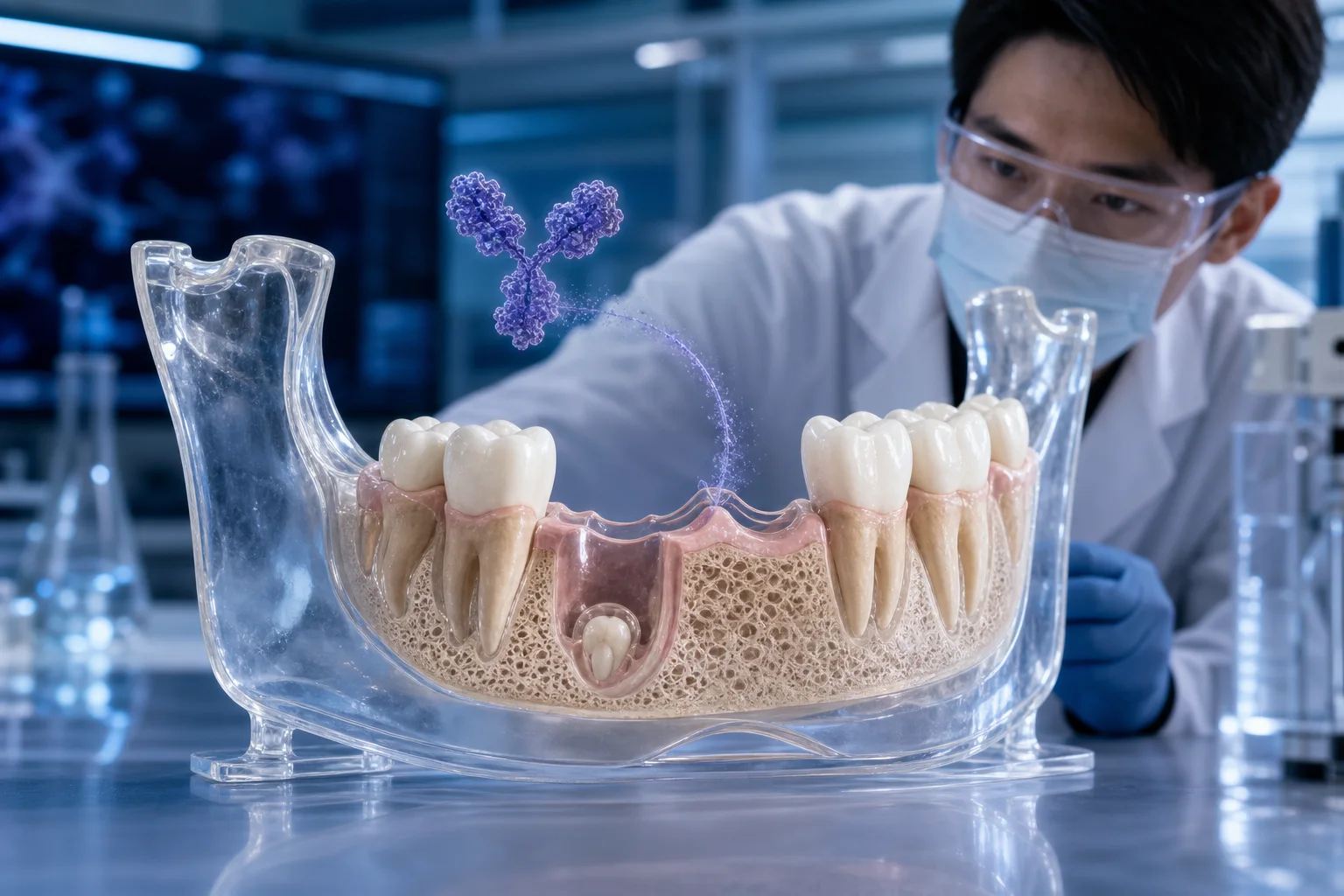
Teeth begin as developmental buds. USAG-1, also known as SOSTDC1, helps suppress signalling pathways involved in tooth formation. Researchers asked whether neutralising this brake could allow a dormant or arrested bud to develop.
In a 2021 Science Advances study, an anti-USAG-1 antibody restored missing teeth in particular animal models by enhancing BMP signalling. The result helped establish a mechanism and a candidate strategy. It did not prove safety, reliable tooth position, bite function or durability in humans.
Growing a biological tooth requires more than producing hard tissue. The tooth must emerge in the right place, form an appropriate root, connect to supporting bone and fit the bite. Uncontrolled extra teeth would be a harm, not a success.
The first intended patients
Toregem says its initial target is congenital tooth agenesis, in which permanent teeth fail to develop. This is narrower than replacing any extracted adult tooth. People with congenital absence may retain tooth buds or developmental biology that differs from an empty site after trauma or gum disease.
The company describes acquired tooth loss and oral frailty in older adults as later ambitions. Those are future indications, not results demonstrated by the current programme.
The 2026 status is publicly inconsistent
Kitano Hospital's current trial page says it is planning a clinical trial and explicitly states that this does not mean the trial has started. The page presents 2030 as a goal for delivering a treatment to patients—not a guaranteed launch date.
By contrast, Toregem's financing release dated 19 May 2026 says funds had been used for a TRG035 phase I human trial and that the company would initiate phase II trials in Japan. The company's English homepage still labels the trial as planned.
These official pages do not align. Without a clearly linked public registry record and posted results that reconcile the timeline, the responsible conclusion is not to choose the most exciting version. The programme is in clinical development according to the company, while the hospital's public recruitment information still says the trial has not started.
What evidence is still needed
An early study must first establish safety: immune reactions, effects outside the intended tissue, unwanted tooth formation and how biological activity is controlled. Researchers then need imaging and long follow-up to show whether a new tooth erupts, remains healthy and functions in a bite.
Larger controlled trials would have to define who can respond. Age, cause of tooth loss, remaining buds, jawbone and gum health could all change the outcome. Evidence in congenital agenesis cannot automatically support treatment after extraction.
There is also a regulatory manufacturing challenge. Antibodies must be produced consistently, with purity and potency verified from batch to batch. A laboratory mechanism only becomes a medicine after that chain works.
Why 2030 is not an appointment
Development targets move when recruitment, manufacturing or safety findings change. A stated aim for 2030 expresses a plan; it is not a promise of approval, reimbursement or availability in every country.
No product sold online today as a “tooth-regrowth drug” is validated by this programme. TRG035 should not be confused with supplements, dental cosmetics or unlicensed injections.
The verdict
Anti-USAG-1 research has produced real animal evidence and a credible drug-development programme focused first on congenital missing teeth. Human efficacy, long-term safety and routine availability remain unproven in the public evidence reviewed here.
The most newsworthy 2026 fact may be the gap between official pages. Until a registry and complete results clarify it, “Japan has a tooth-regrowth drug” is premature. The accurate headline is: researchers are trying to turn a developmental mechanism into a carefully targeted therapy.
The same discipline applies to the other regeneration stories we track, from hair-regrowth drugs in clinical development to the ER-100 cellular-rejuvenation trial: trial registries and posted results, not press releases, are the record that counts.
✔ How we checked this
The animal study, current hospital trial page and Toregem's May 2026 financing release were compared on 18 July 2026. Their inconsistent public descriptions of clinical status are reported explicitly rather than resolved by assumption.
Information verified as of the publication or update date shown. Technology moves fast — check the sources below.
Sources
- Anti-USAG-1 therapy for tooth regeneration through enhanced BMP signaling — Science Advances via PubMed
- Tooth-regeneration clinical trial plan — Kitano Hospital
- Toregem technology — Toregem BioPharma
- Toregem May 2026 financing and development update — Toregem BioPharma