Neuralink's Robot-Arm Trial: What CONVOY Is Actually Testing
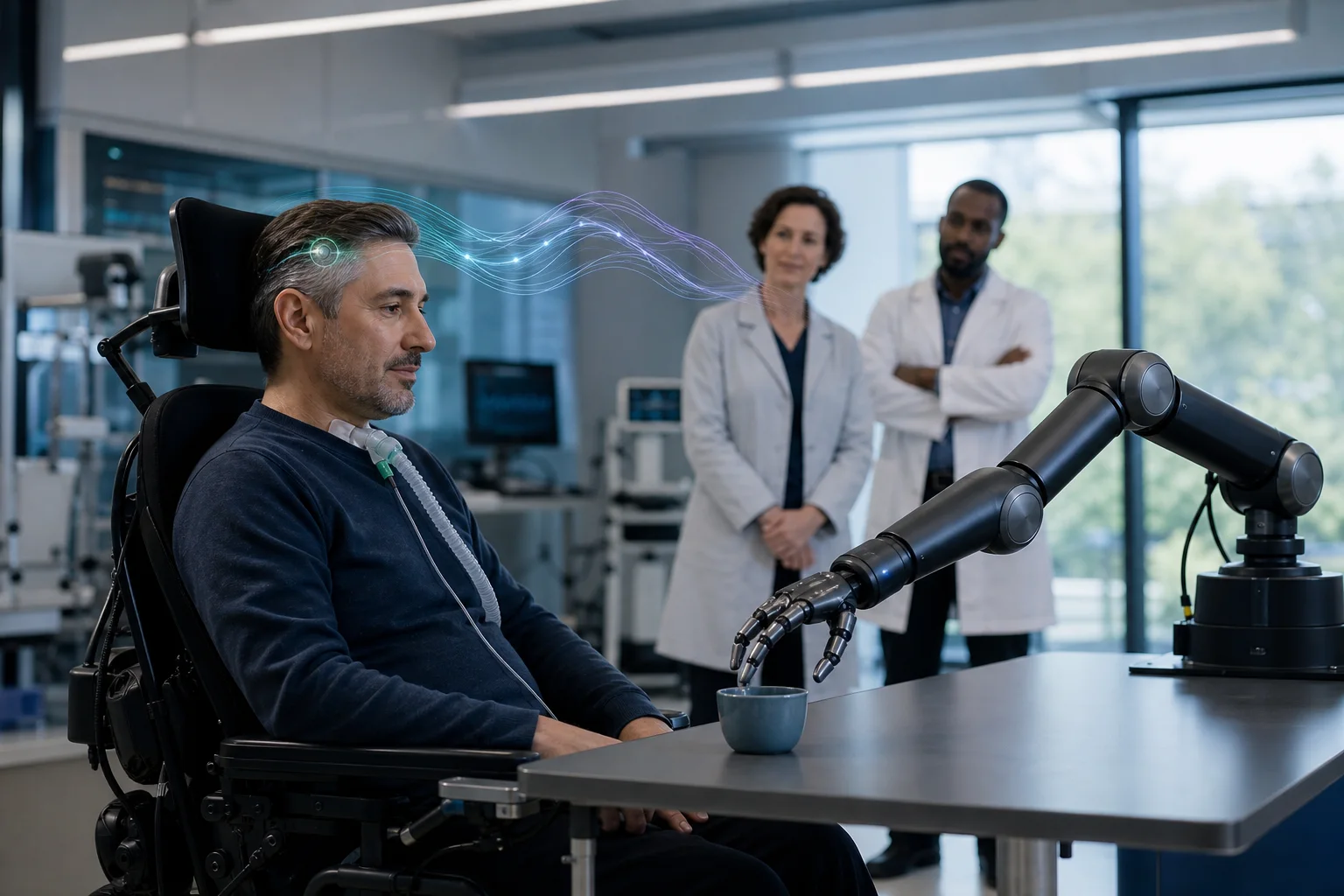
Moving a cursor with a brain implant is digital control. Reaching for a cup with a robot arm adds weight, momentum, obstacles and the possibility of physical harm. Neuralink's CONVOY study is designed to test that harder step: whether a participant already implanted in the PRIME study can use the N1 brain-computer interface to control an investigational assistive robotic arm.
It is a genuine expansion of what an implanted interface may restore. It is also a tiny early feasibility study, not evidence that paralysis has been cured or that robotic limbs are ready for routine home use.
What the registry says
CONVOY is registered as NCT06710626. Its estimated enrolment is three participants, invited from Neuralink's ongoing PRIME study. The public record describes effectiveness, consistency and safety measures around control of assistive devices such as a robotic arm. No results were posted when RoboFutur checked the registry on 18 July 2026.
The small size is appropriate for an early engineering and safety question, but it limits what can be concluded. Three carefully selected participants cannot establish how the system will perform across different injuries, homes, arm designs or years of use.
PRIME itself is a first-in-human study of the N1 implant and the R1 surgical robot. Its registry lists an estimated 15 participants and follow-up into 2031. CONVOY does not replace PRIME; it cross-enrols eligible participants who already have the implant.
Why a robot arm is harder than a cursor
A pointer moves in two dimensions and can simply stop when a signal becomes uncertain. A physical arm must coordinate several joints in three-dimensional space. It needs limits on speed, force and workspace, plus reliable emergency stops.
The system also has to decide how much autonomy sits between intention and movement. A participant might directly control every joint, select a target for the robot to reach, or combine both approaches. More shared autonomy can make tasks faster and safer, but it also changes what “brain-controlled” means.
Everyday usefulness is the real test. A dramatic laboratory reach matters less than repeatedly picking up objects of different sizes, operating from a wheelchair, recovering from a failed grasp and working without constant recalibration.
What the implant does—and does not do
The N1 implant records patterns of neural activity associated with intended movement. Software maps those patterns to commands for an external device. That is not unrestricted mind reading. A model trained to infer movement intention does not automatically decode memories or private beliefs.
Nor does the study restore biological movement to a paralysed limb. The output goes to an external robotic device. That distinction does not make the goal less valuable: reliable assistance with eating, drinking or manipulating objects could increase independence substantially.
Safety extends beyond brain surgery
CONVOY inherits the implant questions studied in PRIME—surgical risk, infection, signal stability, hardware reliability and long-term support—and adds robot-specific risks. Incorrect motion could collide with a person, spill a hot drink or apply too much force.
Good evaluation therefore needs more than task completion. Researchers must report interventions, near misses, failed commands, calibration time and how often a caregiver or engineer takes over. Software updates should be traceable because a changed decoder or motion planner can alter physical behaviour.
Neural data governance also matters. Participants should know what is recorded, who can access it, whether it trains later models and what happens if a device or company is no longer supported.
The evidence to watch
Company videos can show that one participant completed one task. Clinical evidence needs predefined outcomes across every participant, adverse-event reporting and follow-up long enough to measure reliability. Independent peer review would make the findings easier to compare with other assistive interfaces.
The most useful future metrics will be hours of independent use, tasks completed at home, assistance avoided, failure rates and participant-defined quality of life—not only speed in a selected demo.
The verdict
CONVOY is an important but narrow experiment: up to three existing PRIME participants, one investigational implant and control of an assistive robotic arm. It could show that implanted BCIs move from digital access toward physical assistance.
In 2026, the accurate label remains “early feasibility.” No public results means no verdict on safety, consistency or everyday independence yet. For the wider comparison of implanted approaches, read Neuralink, Synchron and the reality behind the demos.
✔ How we checked this
Study size, eligibility, endpoints and result status were checked in the CONVOY and PRIME registries on 18 July 2026. Individual company demonstrations are treated as examples, not aggregate clinical evidence.
Information verified as of the publication or update date shown. Technology moves fast — check the sources below.
Sources
- CONVOY Study — NCT06710626 — ClinicalTrials.gov
- PRIME Study — NCT06429735 — ClinicalTrials.gov
- Neuralink for Device Control — Neuralink
- CONVOY Study Launch — Neuralink