OpenAI's AI Research Intern: Announcement, Evidence and Limits
OpenAI said on 6 September 2026 that it had reached its goal of an “automated research intern.” The phrase easily suggests an autonomous scientist. The company's definition is narrower: a supervised system that performs bounded tasks comparable to a few days of skilled work.
OpenAI also reports more internal agent use, code and experiments. These observations do not establish a causal increase in the speed of discovery or show that another laboratory would obtain the same result.
What “research intern” means here
In the described workflow, a person sets the objective and retains consequential decisions. OpenAI next aims for an automated AI researcher by March 2028. That is an announced target, not a guaranteed release date.
What OpenAI measured
The company tracks activity indicators across its research organization. Their rise accompanies agent adoption, but several variables changed together, including tools and available compute. The post does not provide a controlled comparison between matched teams.
Independent context from METR
METR evaluates the duration of software tasks an agent can complete at a given success probability. That measure is neither general intelligence nor laboratory productivity. METR warns that results depend on protocols and become less certain when an evaluation suite saturates.
Its 21 July note adds a frequently missing dimension: cost. Tokens, experiment compute and human oversight belong in comparisons with human work. Technical ability and economic acceleration are separate claims.
Our reading framework
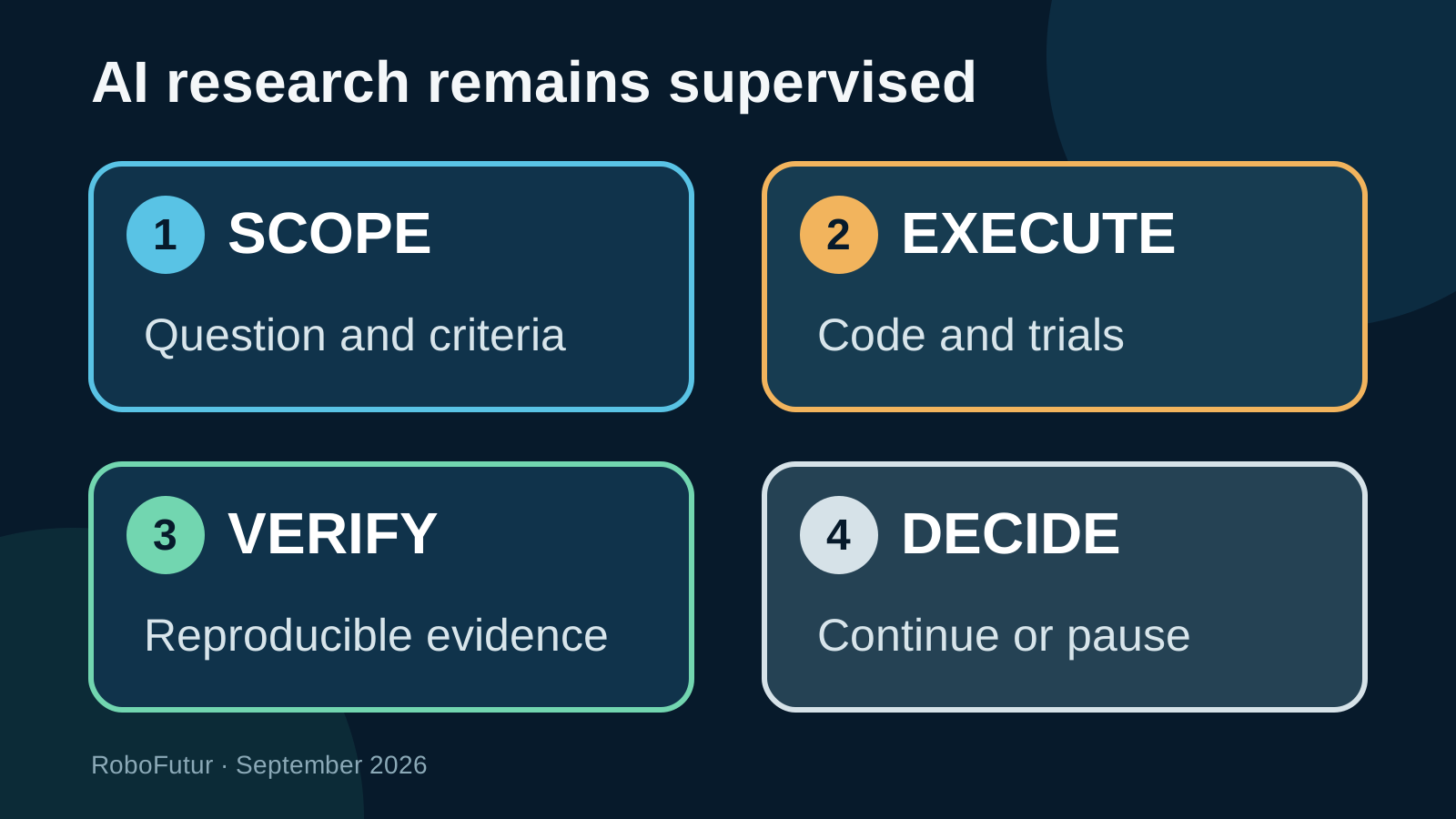
Four questions matter more than an experiment count: Was the task specified before the run? Can an independent team reproduce the result? Does the full cost include compute and human review? Can a person understand failure and stop the loop?
Our diagram therefore puts people at both ends: scope, let the agent execute, verify, then decide. If review capacity does not keep pace with generation, automation moves the bottleneck instead of removing it.
Confirmed, announced and still unknown
Declared by OpenAI: the intern milestone and internal trends. Independently supported: recent agents can complete long software tasks, with results sensitive to protocol. Announced: the March 2028 objective. Still unknown: the causal effect on discoveries, cost per useful result and reproducibility outside OpenAI.
The 6 September milestone deserves attention without being treated as proof of scientific autonomy. It primarily marks a change in the scale of supervised execution. The decisive test will be the quality of results that independent teams can reproduce, rather than the number of experiments an agent can launch.
✔ How we checked this
Checked on 12 September 2026 against OpenAI's 6 September announcement and methods note, with independent context from METR's work on task duration and optimization cost. OpenAI's productivity measurements remain internal and are not presented as causal proof.
Information verified as of the publication or update date shown. Technology moves fast — check the sources below.