GPT‑6.1 Sol: better agents still need inspectable evidence
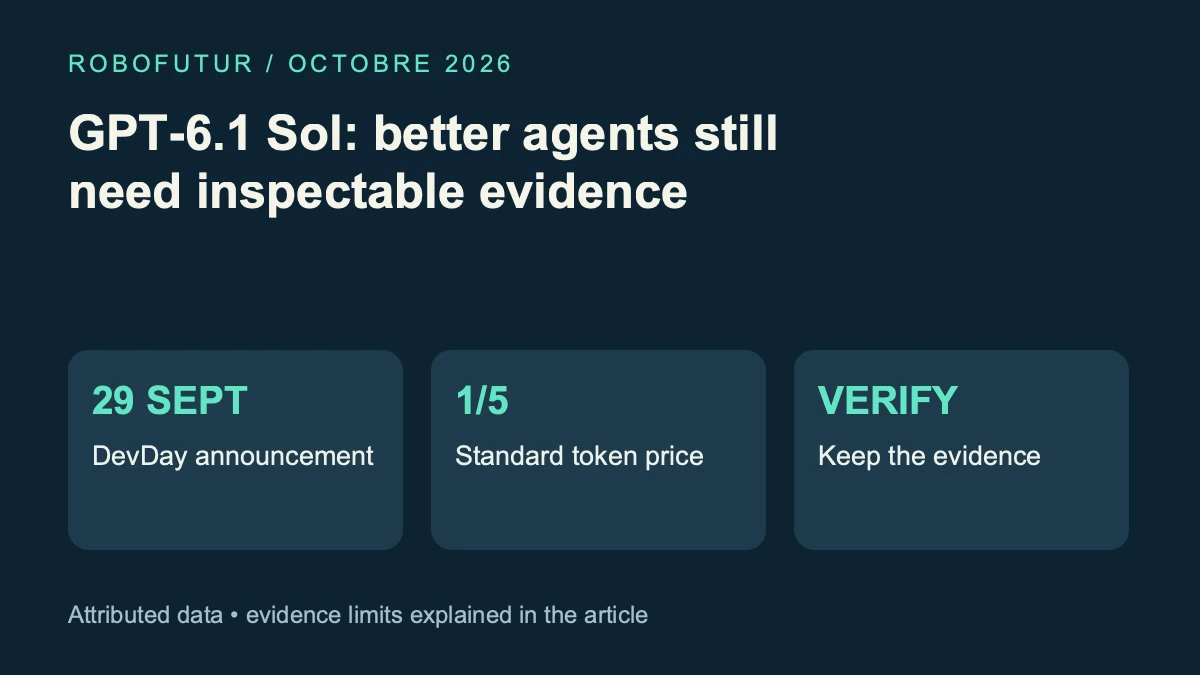
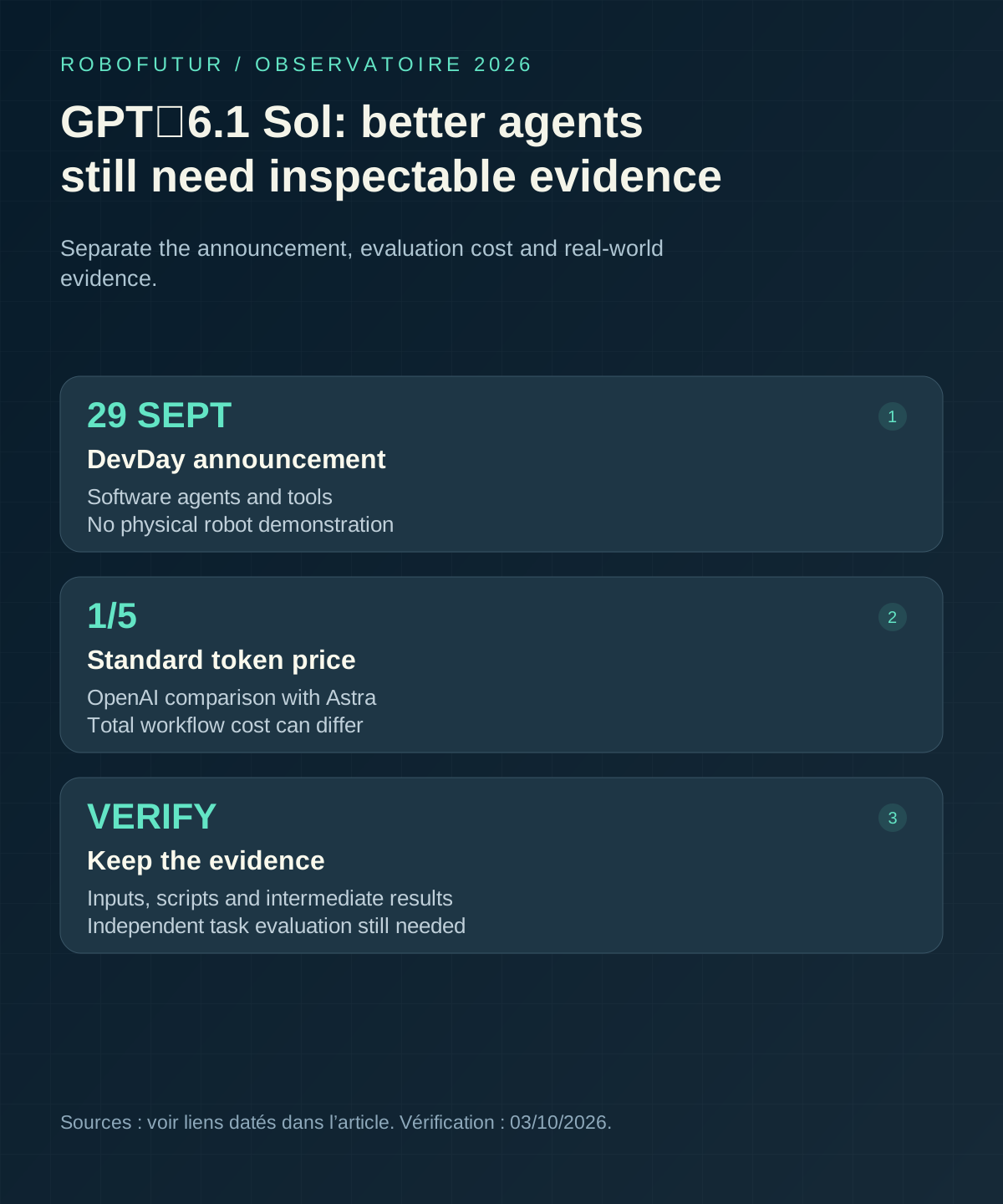
OpenAI announced GPT‑6.1 Sol at DevDay on 29 September 2026. Its relevance to robotics is software work, rather than a demonstrated physical robot controller.
What was announced
OpenAI describes improvements in coding, computer use and professional work, with access through the API and several ChatGPT plans. Its model page also reports scientific workflow evaluations. The company quotes standard input and output token prices at one fifth of Astra’s. That ratio is not a guarantee about a complete operational bill.
Compare successful tasks, not isolated requests
Our assessment is that a useful comparison starts with completed work. Retries, tool calls, failures and human review all contribute to cost. A cheap request can become an expensive workflow when it needs repeated correction. A more expensive model can be sensible for a rare task whose failure would stop a team.
A practical evaluation should keep inputs, tools and success criteria consistent. Real documents and incomplete datasets are more informative for an organisation than a polished demonstration. Record failures too: a success rate has little meaning if the rejected attempts are absent from the denominator.
Scientific output should be reproducible
Researchers should retain source data, scripts, parameters and intermediate results. A persuasive answer is not a substitute for a correct method. One useful first experiment is to ask an agent to recover a result that the team already understands, then inspect where its process diverges. New questions can follow with expert review.
Software progress and physical progress
Robot engineering involves software, simulation and logs, so better tooling may help development. Physical manipulation still needs hardware trials with documented contact conditions and failure rates. See our robot hand analysis and introduction to AI agents.
The editorial test remains simple: what task was completed, how much human intervention was needed, and how many attempts failed? A launch announcement gives teams a reason to investigate. It does not certify reliability in every workflow.
✔ How we checked this
Primary sources opened and checked on 3 October 2026. Company claims remain attributed. No RoboFutur hands-on test.
Information verified as of the publication or update date shown. Technology moves fast — check the sources below.
Sources
- GPT-6.1 Sol — OpenAI
- DevDay 2026 Recap — 29 September — OpenAI