OpenAI DevDay 2026: Dots are agents that work for you — but not in France yet

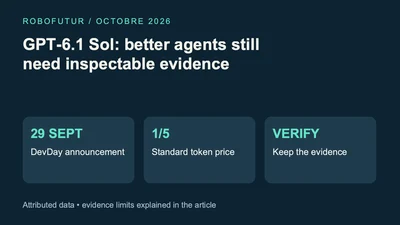
On 29 September 2026, OpenAI presented Dots, always-on agents with their own computer in the cloud, and started rolling them out in ChatGPT today — except in France. The initial rollout covers eligible markets and explicitly excludes the European Economic Area, Switzerland and the United Kingdom. With more than 20 major announcements in a single day, the count is what led the coverage; for a European reader, the exclusion is the more useful fact.
What a Dots is
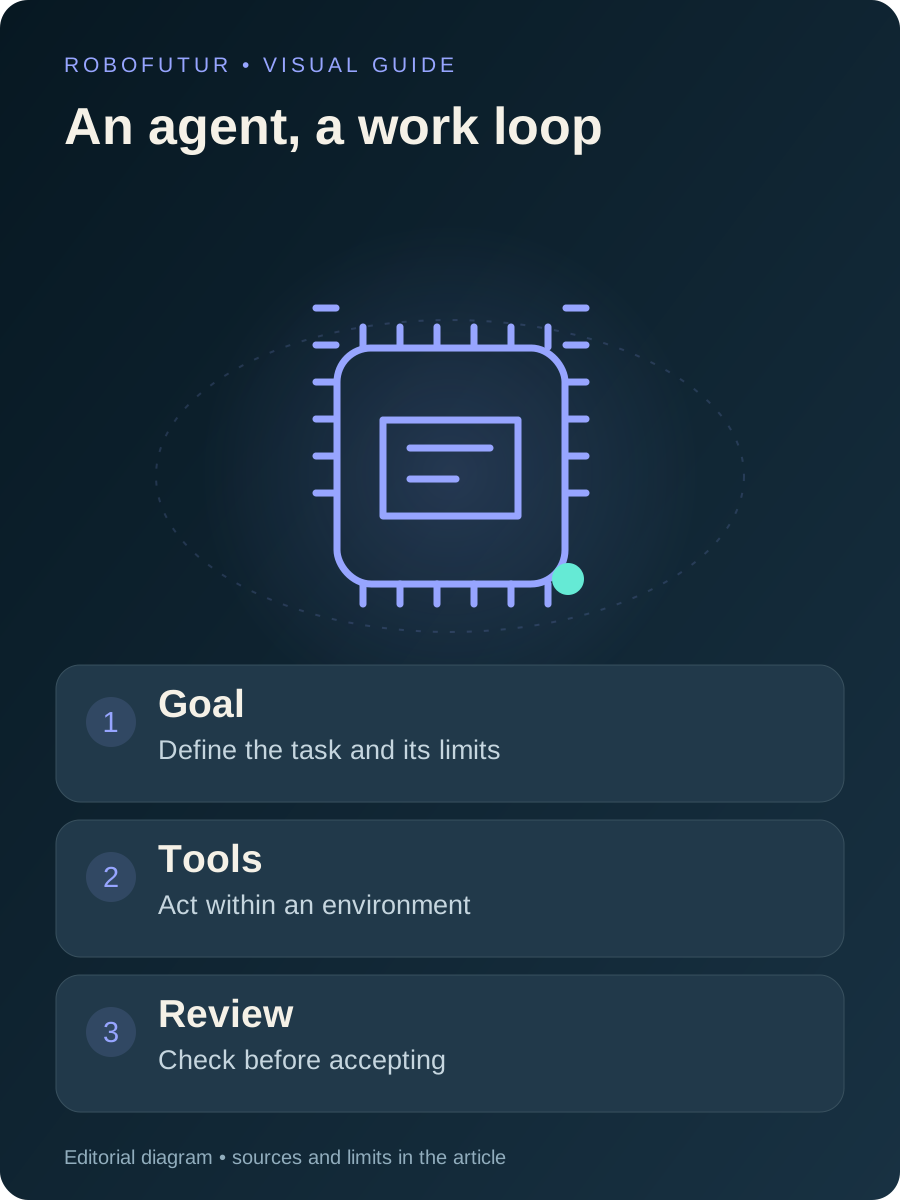
A Dots is an agent you do not have to summon each time you need something. It stays available continuously, 24 hours a day and 7 days a week, to take on ongoing work rather than a one-off question. It runs on GPT-6 Astra, the model OpenAI launched in early September 2026, ahead of DevDay.
Three things separate it from a chatbot:
- it has its own computer in the cloud, with its own browser;
- it learns from feedback over time, which makes it closer to a colleague than a tool;
- it is connected to more than 4,000 applications through the plugin ecosystem.
You write to a Dots or call it inside ChatGPT, on desktop, web or mobile. It can also write first: with progress, questions, or decisions that need you. Integration exists in Slack and Teams, and SMS is described as coming soon. You start with one primary dot, which you name and customise. OpenAI is considering, further down the line, teams of dots working together.
Our explainer on AI agents provides the baseline: most agents run inside your session and your tools. A Dots has a machine of its own, which moves the question away from conversation and towards execution.
What actually changes
The difference is not answer quality. It is duration. An agent that owns a computer and keeps working after the app is closed is no longer a tool you consult. It is a process you start.
The implications are concrete. Background work — monitoring an inbox, tracking a long task, watching a topic — can be handed to a process that comes back at the useful moment. The trade-off is direct: the more environment and access an agent owns, the harder it becomes to check what it did between two messages. That is the same problem we ran into during the agent incident involving Hugging Face.
Asked by CNBC, Sam Altman summed up the ambition in one line: Dots should let people "have a better day, be more productive, and maybe get home earlier." That is a promise about work comfort, not a measurement of hours saved.
The point for France: unavailable at launch
Rollout starts today in ChatGPT on Pro and Business Premium plans, in eligible markets. The initial rollout excludes the European Economic Area, Switzerland and the United Kingdom. France is therefore affected by an outright unavailability, not by a waiting list or a connection delay.
The first dot is included in the Pro or Business Premium subscription, with no surcharge. It is available continuously within a deep work allowance included in the plan, with extended limits during the first month.
For organisations the picture differs: Dots enters beta, including for the education and healthcare sectors, but a workspace administrator has to switch it on. It is off by default. OpenAI is also preparing "specialist dots", an enterprise preview with their own identity, access management, hardware provisioned by IT teams and deeper integrations.
OpenAI has given no date for France. Until one exists, the only correct behaviour is not to invent it.
The rest of the announcements
The remainder of DevDay 2026 is mostly about price and execution speed, along two axes:
- GPT-6.1 Sol, improving coding and computer use, with a standard token price set at one fifth of Astra's. OpenAI describes it as "Astra-level intelligence at one fifth the price." Availability described as imminent.
- The paid "Ultrafast" speed tier, up to eight times faster in Codex and six times in the API. Available with Astra, soon with Sol.
- The Agents API, in public beta: hosted execution, memory, tools, multi-agents and computer use.
- Codex Cloud, for starting or resuming a coding task from desktop, web or mobile.
- ChatGPT Space, a shared space for teams and their agents; Pages, a new document type; a new Pro 500 tier; and plugin extensions that bring whole applications into ChatGPT.
- OpenAI Private Intelligence, with zero data retention and Private Safety Processing; Decisions API in limited preview, built on Luna; and Amazon Bedrock Managed Agents, running OpenAI agents inside AWS.
OpenAI also puts ChatGPT at 1.2 billion weekly users. That figure gives the scale of the rollout, not its maturity.
The questions that stay open
Three points deserve watching. The first is control: an agent that owns a browser and 4,000 application connections cannot be governed like an ordinary conversation. The second is real cost, since OpenAI leads on token price without detailing what a continuously running agent consumes. The third is accountability: when a Dots takes an action inside a third-party application, the chain of responsibility is not yet clear. It also matters that a continuously running agent is, by definition, the hardest kind of system to switch off. Anyone evaluating it should decide in advance what it is allowed to do without asking, and what must stop for a human.
To see what a model changes on a workstation rather than in a browser, our comparison of coding and agent models is the starting point. And for the consumer version of portable computing, there are connected glasses, where the same permission question arises with a camera attached.
✔ How we checked this
Written from OpenAI's DevDay 2026 recap (29 September 2026), the Introducing Dots page, and same-day coverage from CNBC, CNET and Business Standard. The stated performance figures (up to eight times faster in Codex, six times in the API, one fifth of Astra's token price) are OpenAI's own numbers and were not independently verified. No France launch date has been announced.
Information verified as of the publication or update date shown. Technology moves fast — check the sources below.
Sources
- DevDay 2026 recap — OpenAI
- Introducing Dots — OpenAI
- DevDay 2026 conference coverage — CNBC
- DevDay 2026 conference coverage — CNET
- DevDay 2026 conference coverage — Business Standard