The hand, not the legs: the real bottleneck for humanoid robots
Between late September and October 1, 2026, two companies published information that says the same thing without ever having spoken to each other. Boston Dynamics presented a 13-degree-of-freedom robotic hand for its new Atlas. At the same time, several technical newsrooms were reporting that Tesla Optimus was running into trouble manufacturing its own hands. One is solving the problem by design. The other is suffering from it.
The conclusion nobody states openly: the lock on humanoid robotics is not walking, not balance, not autonomy. It is the hand.
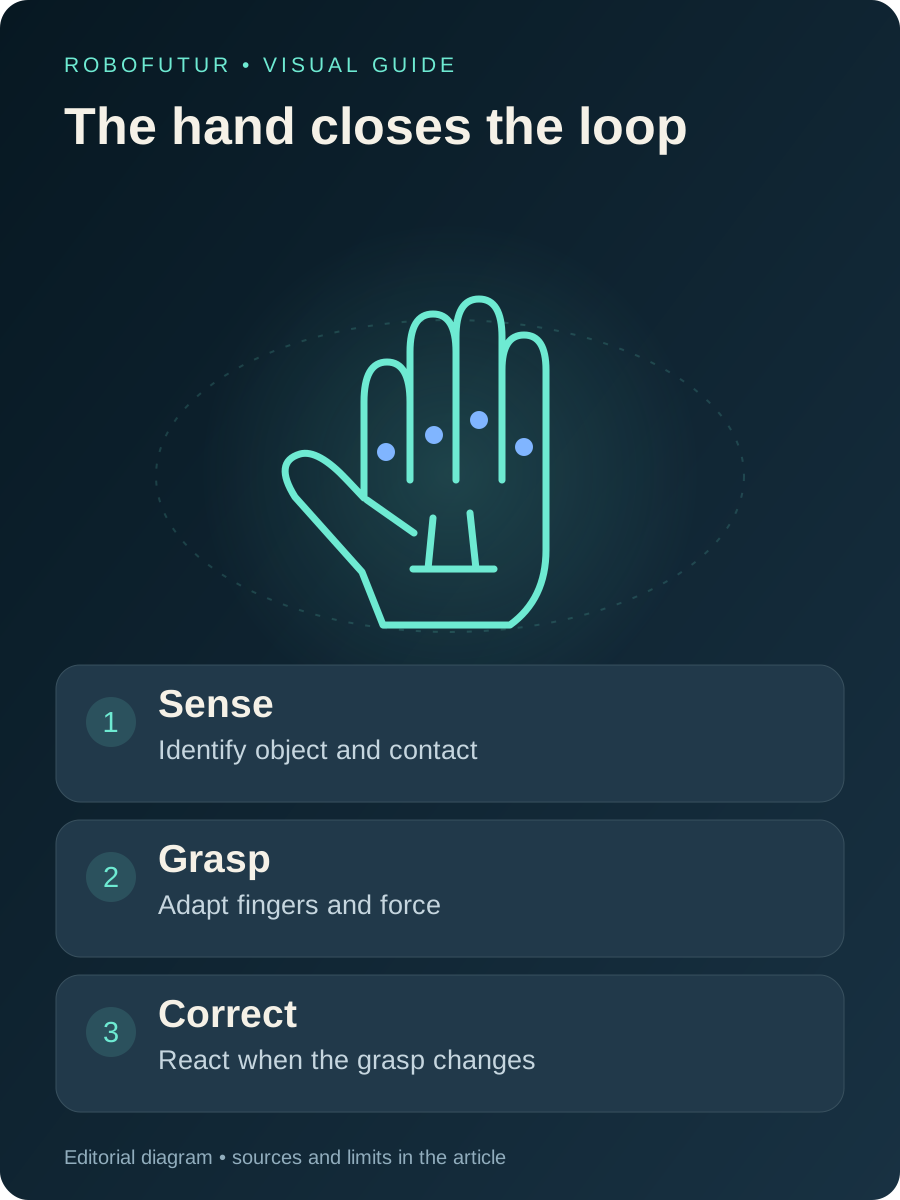
Boston Dynamics: four fingers, a deliberate choice
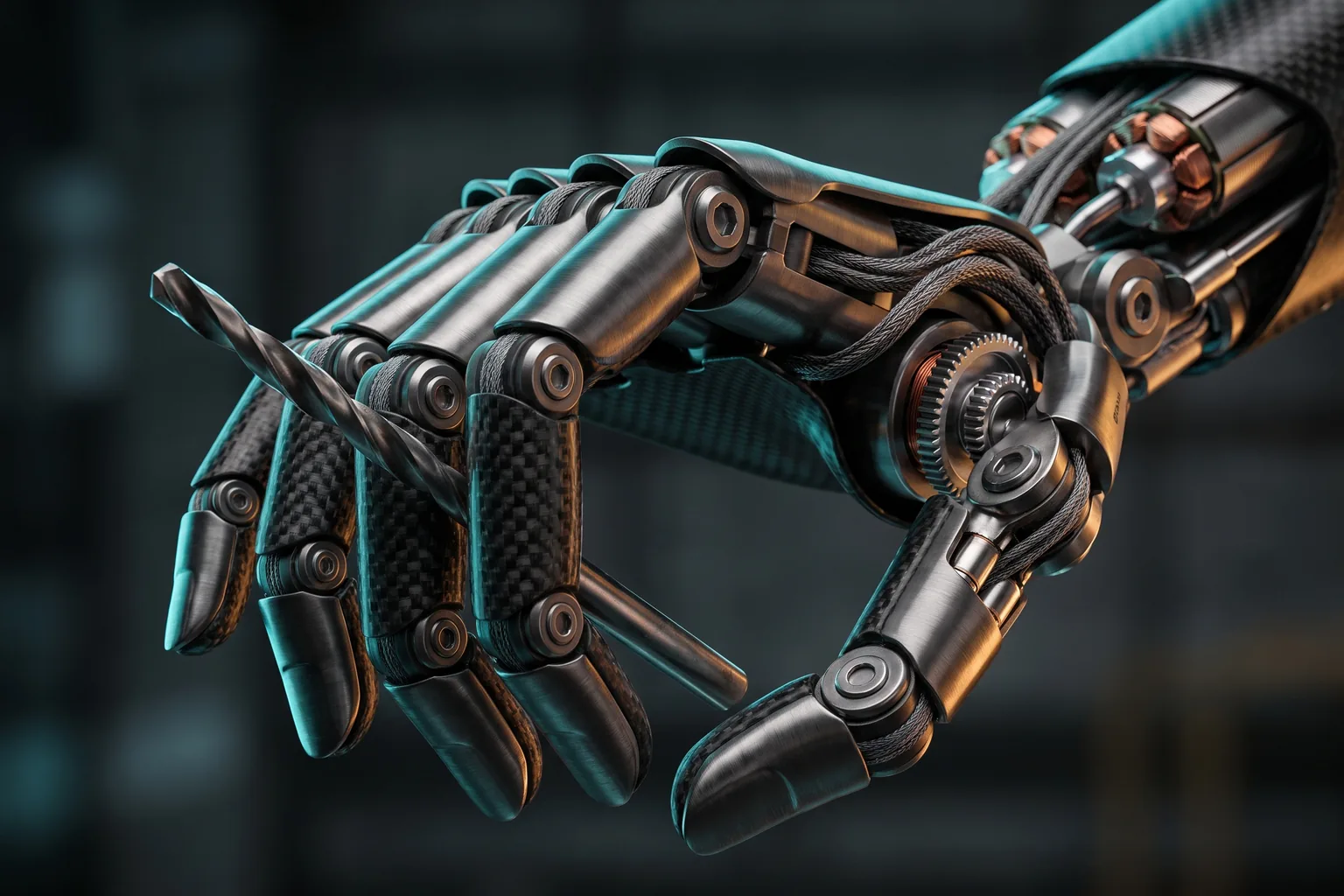
The GR3 hand announced by Boston Dynamics is not trying to imitate a human hand. It starts by refusing to.
| Characteristic | GR2 hand (previous generation) | GR3 |
|---|---|---|
| Degrees of freedom | 7 | 13 |
| Actuation | not specified | direct |
| Number of fingers | not specified | four, not five |
| Size | — | slightly larger than an average human hand |
| Strength | — | a little higher on average |
| Atlas payload | — | over 100 lb (about 45 kg) |
The move from 7 to 13 degrees of freedom is about force control, not appearance. A seven-degree hand grasps an object; it does not regulate its pressure. Thirteen direct-driven degrees decide where force goes, not merely whether the grasp succeeds.
The fourth finger is not a cost-cutting measure. It is a deliberate engineering choice: fewer fingers to actuate means fewer joints to machine, fewer sensors to calibrate, fewer tolerances to hold, and a hand that is simpler to repair. In mass manufacturing, every removed joint is one industrial problem fewer.
The grasp behaviours are named, which is rare: a pinch where a small object is rubbed against the thumb, a tripodal grasp combining force and mobility, a tool grip with trigger. Three different gestures, therefore three different mechanical configurations.
The constraint that dominates: trainable before durable
The GR3 hand is designed for high-fidelity simulation and for sim2real reinforcement learning. That is not a line in a datasheet, it is the reason the product exists.
A rigid-transmission hand cannot be trained: when the policy pushes too hard, the object slips or the joint twists, and learning stops. Boston Dynamics therefore worked on two properties: proprioceptive force sensing and backdrivability. The second means forces pass through transparently: when a human guides the hand, the hand gives way. That is what makes reinforcement-learning training possible and lets human demonstrations be reused without rewriting the physics.
The demonstrated tasks are modest, which is a sign of seriousness: reorienting an object, changing a drill bit. No spectacle.
The stated design constraints say the rest. Minimise the gap between the robot's body and human demonstrations, keep the design clean for simulation, stay mass-manufacturable and repairable at low cost. Those four requirements are not a roadmap: they are the four reasons the hand is hard.
Tesla Optimus: the same lock, seen from the inside
On Tesla's side, the period is markedly less bright. On September 25, 2026, The Verge ran the headline: "Tesla's Optimus robot is going through growing pains." Two days later, Tech Times sums up the problem in one line: hands the company cannot build, and workers it cannot train.
Every figure below is reported by secondary press. Tesla confirmed none of them.
- Production capacity is reported at roughly ten times the level reached during the T2 phase (Investing.com, September 25, 2026); the first units would potentially be "rented" rather than sold (Moomoo, same date).
- Elon Musk targets 20,000 Optimus per week. Actual output is reported in the hundreds (Gizmodo, September 29, 2026).
- Some Tesla workers refuse to train Optimus as replacements (Ars Technica).
- Musk acknowledged that the viral Optimus movements were "essentially teleoperated" (Benzinga, September 21, 2026).
- Oppenheimer considers Optimus sales revenue improbable before 2029 (Yahoo Finance Canada, September 21, 2026).
- Tesla is auditing Chinese suppliers ahead of mass production (Global Times, September 22, 2026).
- The main Optimus factory in Texas is being completed, with a mass-production target of 2027.
The last line is the most instructive. Building a factory has not solved hand manufacturing. A site does not produce a difficult part. The conversion of the Fremont line for Optimus, by contrast, is real and dated, and we tracked it in that file.
Why a hand is harder than a leg
Four reasons, and they compound.
Direct actuation. A leg can tolerate a reduction and lean on the ground. A hand holds an object between two surfaces whose friction is not mastered. Direct actuation, chosen by Boston Dynamics, removes the reduction: the torque applied at the joint is the useful torque, with no drift.
Force feedback. Walking is a position and balance problem at body scale. Grasping is a contact problem at millimetre scale. You have to measure effort, not only position, and pass it on without distorting it. That is what proprioceptive force sensing provides, and the reason Gene01's tactile skin interests hand designers too.
Manufacturability. A leg tolerates an imperfect part, because the ground hides the error. A hand does not: excessive play in one finger shows up immediately in grasp quality. The precision required on a finger joint is an order of magnitude above that of a hip joint.
Repairability. A humanoid that falls can be repaired, because leg joints are standardised and oversized. A hand wears out: contacts wear, fingers deform, sensors drift. A hand whose service requires a return to the workshop is not a spares item, it is a cost centre. That is why Boston Dynamics listed low-cost repairability among its constraints, rather than treating it as a detail.
What to watch
Three things, in this order.
Real availability of the GR3. A laboratory-grade hand is not a shippable hand. The right indicator is not the number of degrees of freedom: it is the rate at which spare hands come out of the workshop, and their lifetime before service.
Tesla confirming or denying its production figures. As long as the only Optimus numbers come from the press, they should not enter a calculation. The day Tesla publishes a verifiable cadence, the discussion changes character.
The design gap between the two approaches. Boston Dynamics chose four fingers, thirteen degrees, direct actuation and repairability. Others choose five fingers, two jaws, or no fingers at all. Without a standard, no mass market. The day a hand gripper becomes standardised, the cost drops at once and the bottleneck moves elsewhere.
The path is well known: we have seen it with Agibot's Atlas, and we will see it everywhere. How humanoid robots actually work shows just how far the hand is the last link to stabilise. For now the lesson is simple: as long as a humanoid has no reliable hand, it has legs. And it cannot work.
✔ How we checked this
Original synthesis article, built from two sets of facts verified on October 1, 2026: Boston Dynamics' GR3 hand announcement, and a series of press reports on Optimus manufacturing difficulties. Date caveat: the Boston Dynamics page carries structured data dated October 1, 2026, Google News indexed the URL on September 28, 2026, and IEEE Spectrum's analysis appeared on September 30, 2026. The text therefore says late September or early October 2026. Every Tesla figure quoted here comes from secondary press: Tesla confirmed none of them as of writing. The IEEE Spectrum, The Verge and Ars Technica pieces cited in the text could not be linked to a verified deep URL, so they are attributed by name in the body rather than listed as sources.
Information verified as of the publication or update date shown. Technology moves fast — check the sources below.
Sources
- Robot Hands for Modern AI and Real Work — Boston Dynamics
- Boston Dynamics drops pinkie on new humanoid hand — The Robot Report
- Top 10 robotics stories of September 2026 — The Robot Report