Gemini 4 Argon, Digit 5 and EmArm: the week physical AI became testable
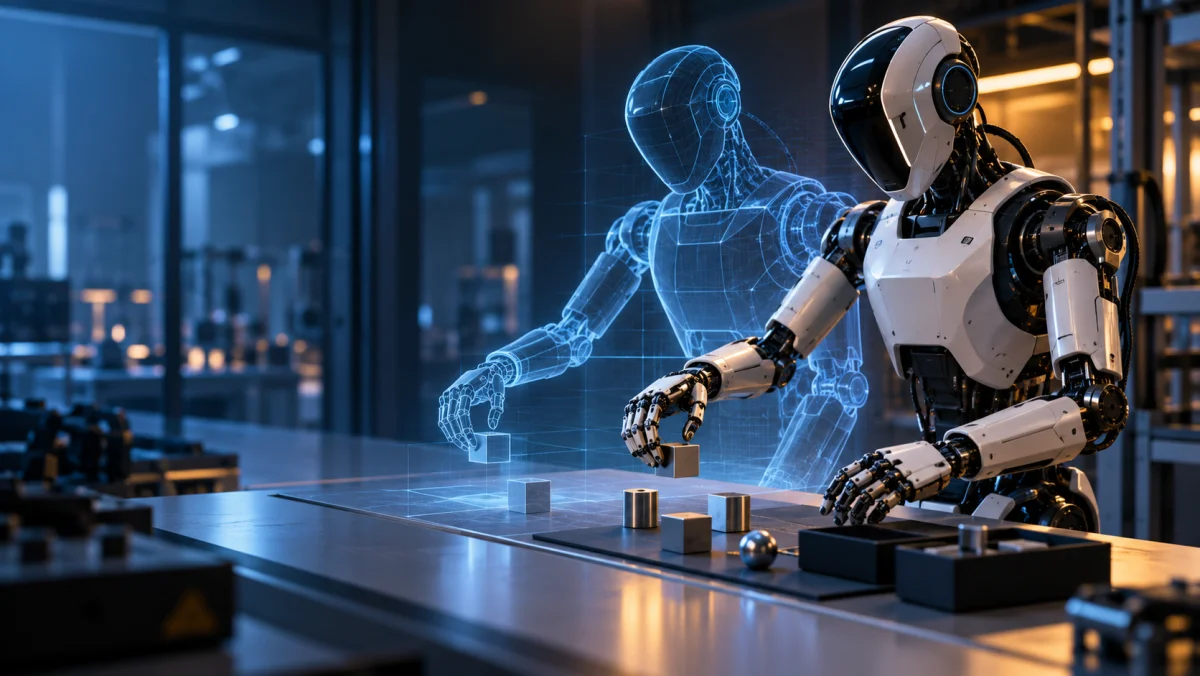
This week’s story is not one robot. It is a convergence: Google describes a model linking reasoning, simulation and action; Agility is preparing a humanoid for industrial deployments; the DOE is funding testbeds for autonomous science; and HKUST has published a robotic arm that can sense contact across much of its body.
These announcements do not prove general physical intelligence. They show the pieces needed to approach it: a measurable task, a controllable simulation, sensors that see and touch, a stop procedure, logs, and a clear separation between what was announced and what was demonstrated.
Gemini 4 Argon: closing the loop between seeing, simulating and acting
In its 13 October post, Google presents Gemini 4 Argon as a physical-reasoning model applied across the robotics stack. The post cites an 87% score on the ERQA benchmark and describes control, digital-twin reconstruction, trajectory labelling and simulation-based improvement.
The most useful example pairs a Spot robot, a foot-pedal bin and MuJoCo. The model practises in a simulated representation, checks visual references and then produces an action sequence. This is more meaningful than a voice command because it exposes intermediate checks.
It remains a Google-published demonstration. The benchmark is not a household success rate, the post does not provide a full failure denominator, and the model is not presented as a complete consumer product.
Digit 5: from prototype to industrial pilot
Agility says Digit 5 will standardise onboard compute around NVIDIA IGX Thor modules, with elements of the Halos safety platform. The company announced early access in the first half of 2027, followed by increasing availability for manufacturing, warehouse and distribution operators.
AGCO and Agility also announced a pilot at the Hesston, Kansas facility, expected in 2027. The tasks are concrete: sorting and stacking parts, and placing totes. That framing matters. A humanoid becomes measurable when a customer accepts a defined task, cadence, intervention log and business metric.
This is not a public price or proof of French availability. The RoboFutur network’s Digit 5 buying checklist keeps that distinction explicit.
The DOE wants autonomous science to be reproducible
The U.S. Department of Energy selected four robotics and automation projects for scientific discovery. MAESTRO works on self-improving laboratory infrastructure; DART studies when autonomy is reliable, transferable and scientifically valid; TRACE connects robots, instruments, agents, digital twins and data; SPIRE integrates sample handling with instruments and compute.
The vocabulary is revealing: failure atlases, provenance, capability contracts, mixed-fidelity testing and independently rerunnable evaluations. Progress is not only “the robot succeeded”. A result should be explainable, reproducible and transferable.
EmArm: when robots stop relying on vision alone
HKUST presented EmArm, a robotic arm with a soft optical tactile skin embedded in a rigid structure. Internal cameras interpret force distribution, while the Nature Sensors paper describes a loop that combines tactile information with joint position to adapt motion.
The authors report tactile fidelity up to 97.9% under five types of interference, a spatial resolution of 0.085 millimetres and a response to obstacles not detected by vision. These are research results under defined protocols, not proof of general emotion understanding or home safety.
What the announcements actually prove
They show progress on separate bottlenecks: spatial reasoning, simulation, onboard compute, cooperative safety, experimental provenance and touch. They do not show that a humanoid can perform every household chore, all day, without supervision, in an arbitrary home.
For the next announcement, ask four questions:
- What exact task was measured?
- How many trials failed?
- How much human intervention was required?
- What is the full cost per successful result?
RoboFutur verdict
The important shift is from the story of “AI that can do everything” to a stack of evidence: model, sensors, simulation, stop controls, data, repetition and economics. It is less spectacular than a viral demo, but much closer to real value.
The next meaningful metric will not be the number of robots announced. It will be the number of tasks that are documented, repeated and safely recovered when the real world refuses to follow the script.
✔ How we checked this
Checked on 23 October 2026 using primary sources from Google, Agility Robotics, AGCO, the U.S. Department of Energy, HKUST and Nature Sensors. Reported performance remains attributed to its authors; no RoboFutur test was performed.
Information verified as of the publication or update date shown. Technology moves fast — check the sources below.
Sources
- Gemini 4 Argon for Robotics — Google Developers Blog
- Digit 5: NVIDIA collaboration and announced availability — Agility Robotics
- AGCO and Agility: industrial pilot — AGCO / Agility Robotics
- Four projects for autonomous scientific discovery — U.S. Department of Energy
- EmArm: human-like touch sensing — HKUST