Figure AI made its robots jump into molten steel: a sim-to-real lesson
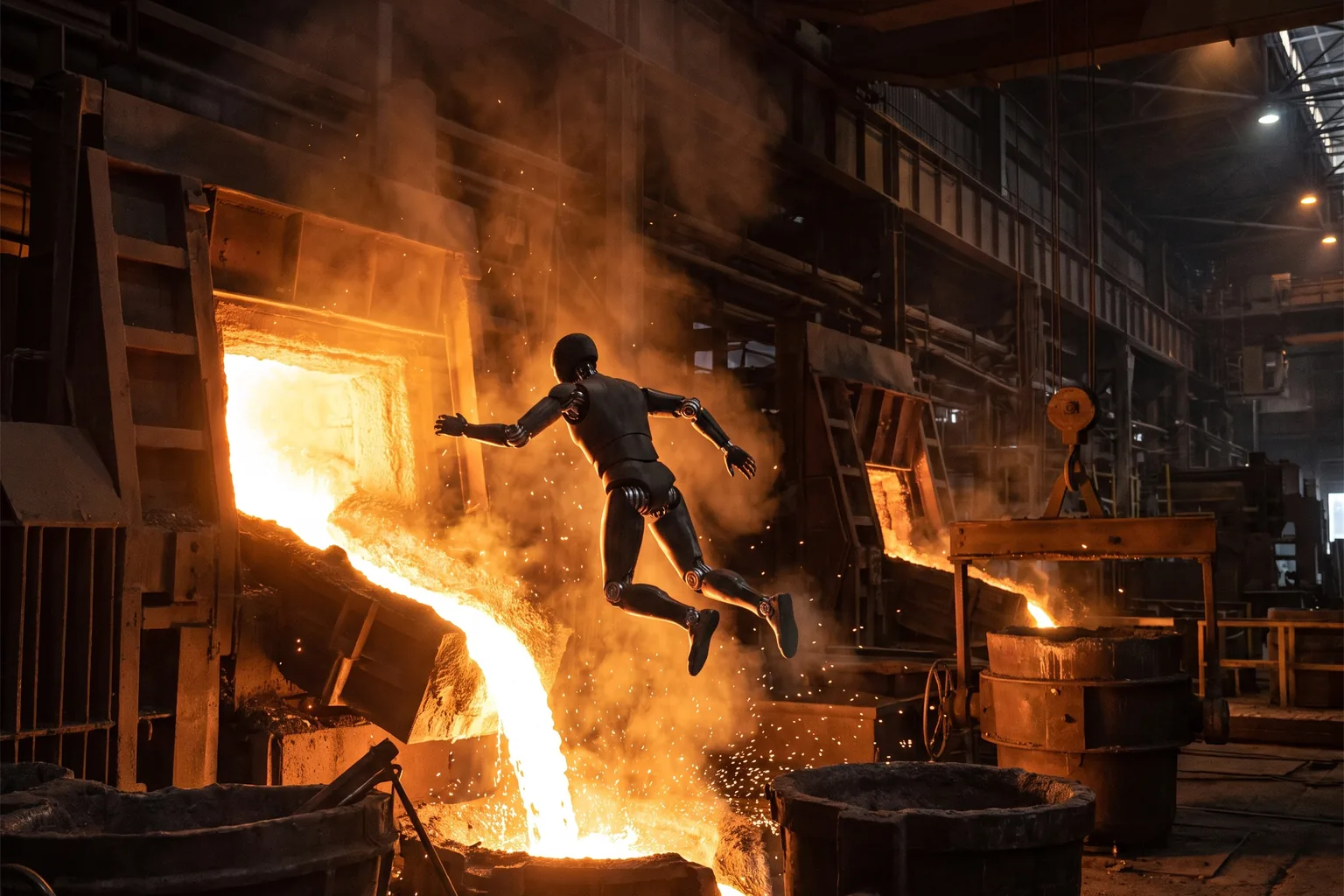
On 30 September 2026, Figure AI decommissioned its F.02 fleet by melting most of its robots in a foundry in Imatra, Finland, for one precise reason: to show that a jump policy learned entirely in simulation holds up in front of molten steel. The company says it trained a new model for the occasion, using the movement of steel ladles as its reference, at a foundry it had never visited during training.
The problem was not recycling
The F.02 is not a marginal fleet. It is the machine that carried Figure's first BMW deployment, the birth of Helix, the first home chore robot and the company's first logistics deployment. Scrapping it is an economic decision before it is a communications exercise.
Figure's stated reason is twofold: the F.02 has custom actuators and proprietary intellectual property, so dismantling it would have delayed the F.04 launch. In other words, destruction is not the project. It is the way to avoid parking the team on disassembly for weeks. A company moving an entire fleet onto new hardware has a direct interest in not spending its evenings pulling out motors.
The industrial obstacle was more prosaic. Lithium-ion batteries made the machines unacceptable to foundries in the United States and Mexico. Lithium in an electric arc furnace is not a regulatory question but a fire-risk question. That left Imatra.
The technical story: learning to jump with no factory
The heart of the announcement is not the foundry. It is the training.
On its San Jose campus, Figure fitted airbags and taught its robots to jump from the second floor. It then trained a new model in simulation, using the motion of a steel pour as its reference — the choreography of ladles and skimmers. The stated goal: make the machines leap with precision into a large container of molten steel, on an unseen site.
That is a radical transfer exercise. The simulation contains no 75-tonne electric arc furnace, no graphite electrodes, no light, no heat and no vibration. It contains a shape of flowing steel and a movement. Figure claims the movement was enough.
"We really trained robots to jump autonomously, shipped them to Finland, and had them leap into a vat of molten steel." — Figure AI
Translation does not change the scope. A jump policy that was trained in an empty simulation and behaves correctly inside a foundry is a genuine engineering result. It is also, exactly and only, evidence for a jump policy.
Twenty-four hours, six pours, twenty minutes per pour
The account is tight, and that is what makes it credible.
| Constraint on site | Value reported by Figure |
|---|---|
| Site equipment | Three graphite electrodes feeding a 75-tonne electric arc furnace |
| Time available | 24 hours |
| Number of pours | 6 |
| Usable window per pour | 20 minutes before the steel cools and forms a hard crust |
| Camera equipment and electronics | Failed in the environment |
The twenty-minute window explains the shape of the whole operation. It is not a show that can be repeated on demand: it is a sequence of attempts pinned to a physical event with a short lifetime. Line up on the ledge, wait, clear the rim — and if the pour is over, the machine stays outside.
That the metal, the electronics and the lighting gave out is itself information. An industrial environment is not scenery. It is a set of constraints that apply to the entire machine, not only to its mechanics.
What this proves, and what it does not
It proves that a general motor policy can be learned off-site and survive an entirely new domain. It proves nothing about Figure's industrial capacity, and writing it as though it did would be misleading.
A robot that jumps into a container is a robot that jumps. The same machine on an assembly line moves bins and places parts for hours. Those are different problems: the first is movement generalization at a single, non-repeating site; the second is endurance, safety and integration into a workstation, as our anatomy of how humanoid robots work sets out.
That said, the transfer is narrow in an instructive way. Simulators are full of physics, but rarely of molten metal, and a jump policy has no reason to encode any of it. The fact that it survived anyway suggests the learned control was tied to body geometry and to the ballistic shape of the movement, not to a particular room. That is exactly the property other labs want and hard to fake.
Hardware economics then apply. Building a humanoid with custom actuators costs more than a robot coming off a standard line, and the result is a fleet that cannot be economically repaired, resold or recycled locally. That cost is already on the invoice.
The rest is plain economics: Figure says most of the F.02 is gone, a few units remain in storage at headquarters, and the resulting metal bars are sold as a limited-edition object. The F.03 takes over, and that is where the useful information sits for anyone tracking the product.
A human detail, at the end
Figure says it asked the internet for advice on getting rid of the robots. Arnold Schwarzenegger suggested melting them and then joined the project. The episode is in the release. It changes nothing in the technical analysis: a simulated jump policy ending up in a Finnish furnace is a story about control research, not celebrities.
The F.02 was the fleet of firsts — first industrial customer, first chores, first logistics — and replacing it outright is precisely the sign that Figure chose planned obsolescence over redeployment. That is the normal behaviour of a company that is industrialising, and one more reason to read these releases with the same scepticism as any other: the cost and industrial reality of a humanoid depends on the production line, not on the spectacular demonstration.
✔ How we checked this
Checked on 30 September 2026 against Figure AI's announcement of the same day. The Imatra foundry details (75-tonne electric arc furnace, three graphite electrodes) come from Figure and have not been confirmed by the site operator. No independent measurement of the resulting steel bars is public.
Information verified as of the publication or update date shown. Technology moves fast — check the sources below.
Sources
- Decommissioning the F.02 fleet — Figure AI
- Introducing Figure 03 — Figure AI
- Helix 02 industrial demonstration — Figure AI
- BMW Group to deploy humanoid robots in production in Germany — BMW Group