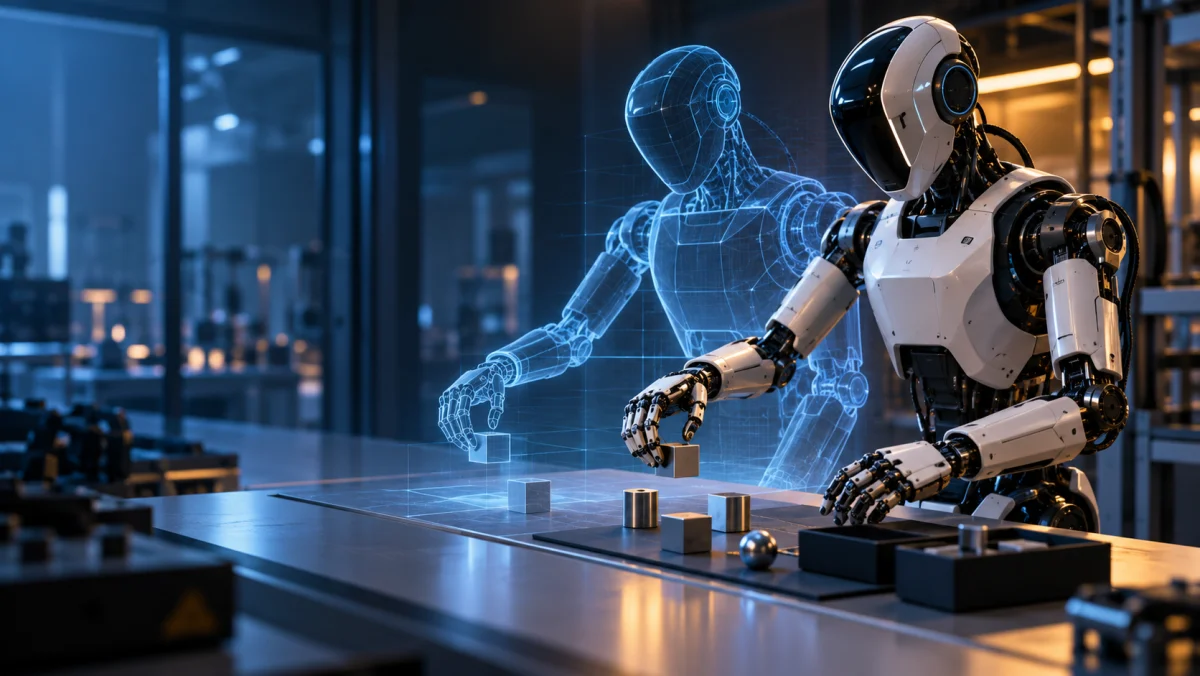
How Does a Humanoid Robot Work in 2026? Motors, Vision, AI and Limits
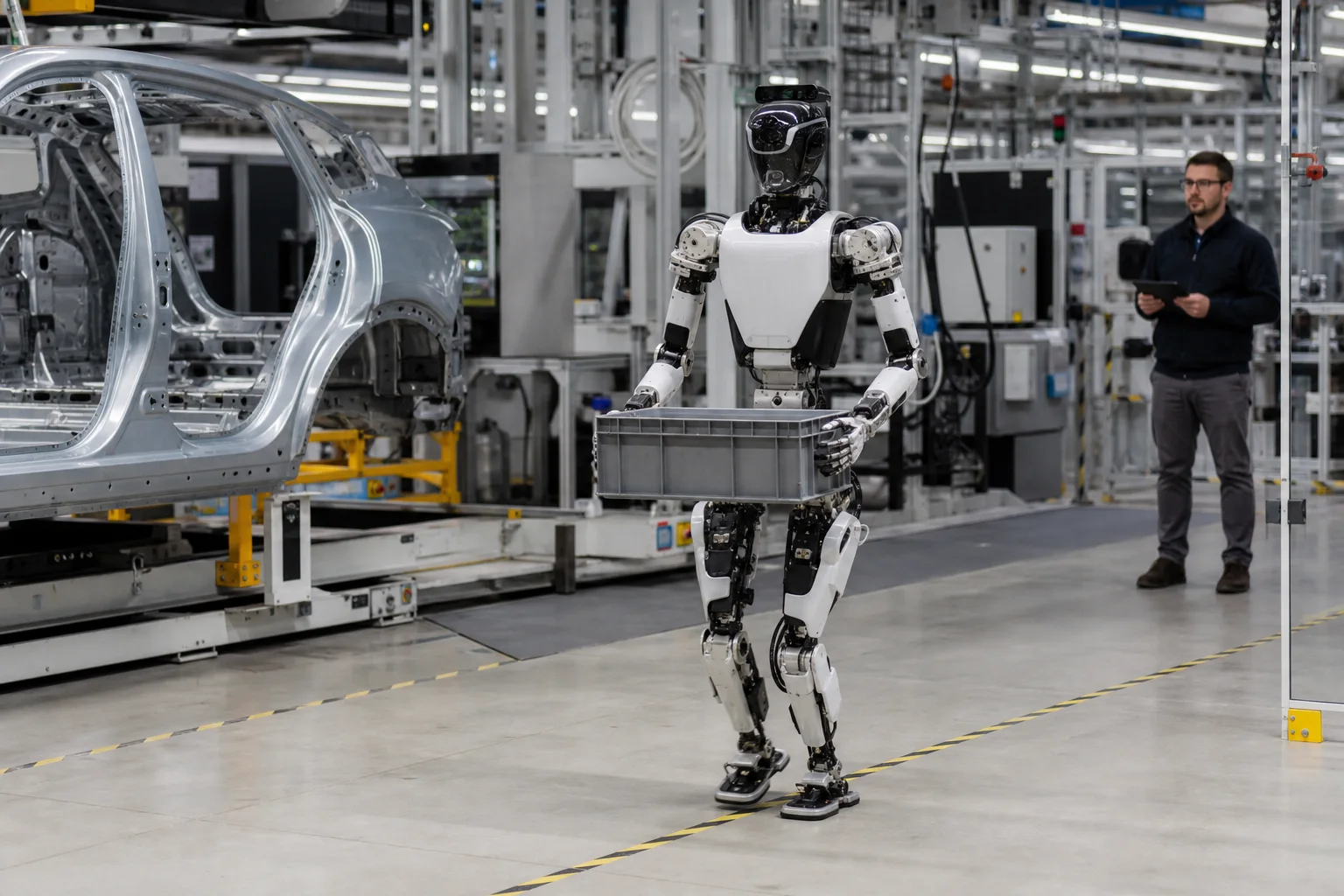
A humanoid robot is not a chatbot with legs attached. It is a complete physical chain: sensors measure the world, a computer estimates the situation, software chooses an action and motors execute it without toppling the machine. An error of a few centimetres that is harmless in an image can knock over a 60-kilogram robot.
Understanding that chain makes demonstrations easier to judge. Smooth walking does not prove autonomous manipulation, and a hand with twenty joints does not prove it can grasp an unfamiliar glass.
1. The body: structure, joints and actuators
The frame carries the load. At the hips, knees, ankles, shoulders and elbows, actuators turn electricity into motion. Most combine a motor, transmission, position encoder and sometimes a torque sensor. The controller must know the position of every joint hundreds of times per second.
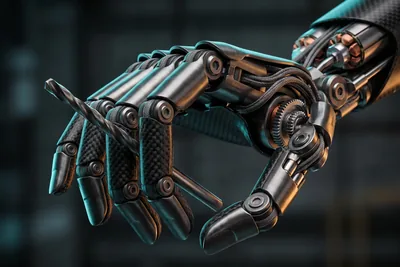
The number of degrees of freedom tells us how many independent movements are possible. It helps compare architectures, but not overall quality. One precise, durable and well-controlled joint is worth more than several fragile axes. Hands compress the problem into a small space: many motors, frequent impacts and objects whose shape was not known in advance.
2. The senses: seeing is not enough
Colour cameras, depth cameras, lidar, inertial units and force sensors provide partial views of the world. Software must fuse them to estimate the robot's pose, obstacle distance and whether an object is slipping.
A camera may be confused by glare; lidar sees geometry but not always surface meaning; an inertial unit drifts. Redundancy matters as much as resolution. In a factory, the robot must also recognise restricted areas, people and emergency stops—not just the part it must move.
3. Balance: predict before falling
Walking means continuously moving the centre of mass while keeping a recoverable support. The controller calculates trajectories, measures the difference from expected motion and corrects the ankles, knees and hips. Policies trained in simulation often complement this classical control.
Running and dancing videos demonstrate real dynamic control, but industrial value comes from repeatable motion for hours with a load and imperfect flooring. Recovering from a push is not the same skill as placing a component precisely.
4. The brain: from intent to motor command
Recent systems use several layers. A vision-language-action model may interpret “take the grey tote and place it on the conveyor.” A planner then breaks the goal into steps. Fast controllers finally turn each step into motor torques.
Google DeepMind describes Gemini Robotics as a vision-language-action model with spatial reasoning that can operate different robot forms. NVIDIA publishes GR00T as a foundation model for humanoids. This work improves generalisation, but it does not remove safety controllers or the limits of an unfamiliar task.
5. How robots learn
Three data sources dominate: human teleoperation, simulation and real demonstrations. Teleoperation captures useful movements but consumes human time. Simulation can produce millions of attempts without breaking hardware, but creates a gap with reality. On-site data is most relevant and slowest to collect.
The challenge is not just to imitate a movement. A robot must know when it is uncertain, request help and stop. Remote human assistance can be a sensible design choice, provided the customer is told that it exists.
6. Battery, heat and real uptime
Legs consume energy, computers generate heat and every gram of battery adds mass that must be moved. Published endurance therefore depends on the task. Three “typical” hours do not guarantee three hours of continuous material handling.
Manufacturers compensate with autonomous charging, swappable batteries or several robots in rotation. To judge a deployment, look at productive time, interventions, failures per cycle and maintenance—not only advertised battery life.
What remains difficult
Open environments combine everything robots handle poorly: soft objects, children, pets, cluttered stairs and ambiguous instructions. Factories and warehouses move faster because tasks, objects and traffic zones can be controlled.
The right test is not “can it do this once?” but “can it repeat it, detect an error and remain safe?” Our 2026 humanoid comparison applies exactly that standard.
For the component-level evidence, see why robotic hands remain a bottleneck. Our Jetson edge-compute dossier separates an announcement from hardware available to buy; the MoveIt and PickNik dossier covers the motion-planning software layer.
✔ How we checked this
We separate capabilities described in technical publications, manufacturer demonstrations and performance verified in operations.
Information verified as of the publication or update date shown. Technology moves fast — check the sources below.
Sources
- Gemini Robotics brings AI into the physical world — Google DeepMind
- NVIDIA Isaac GR00T N1: An Open Foundation Model for Humanoid Robots — NVIDIA Research
- NVIDIA Open Humanoid Robot Reference Design — NVIDIA
- Unitree G1 specifications — Unitree Robotics