GENE.01's Tactile Skin: What the Humanoid Has Proved
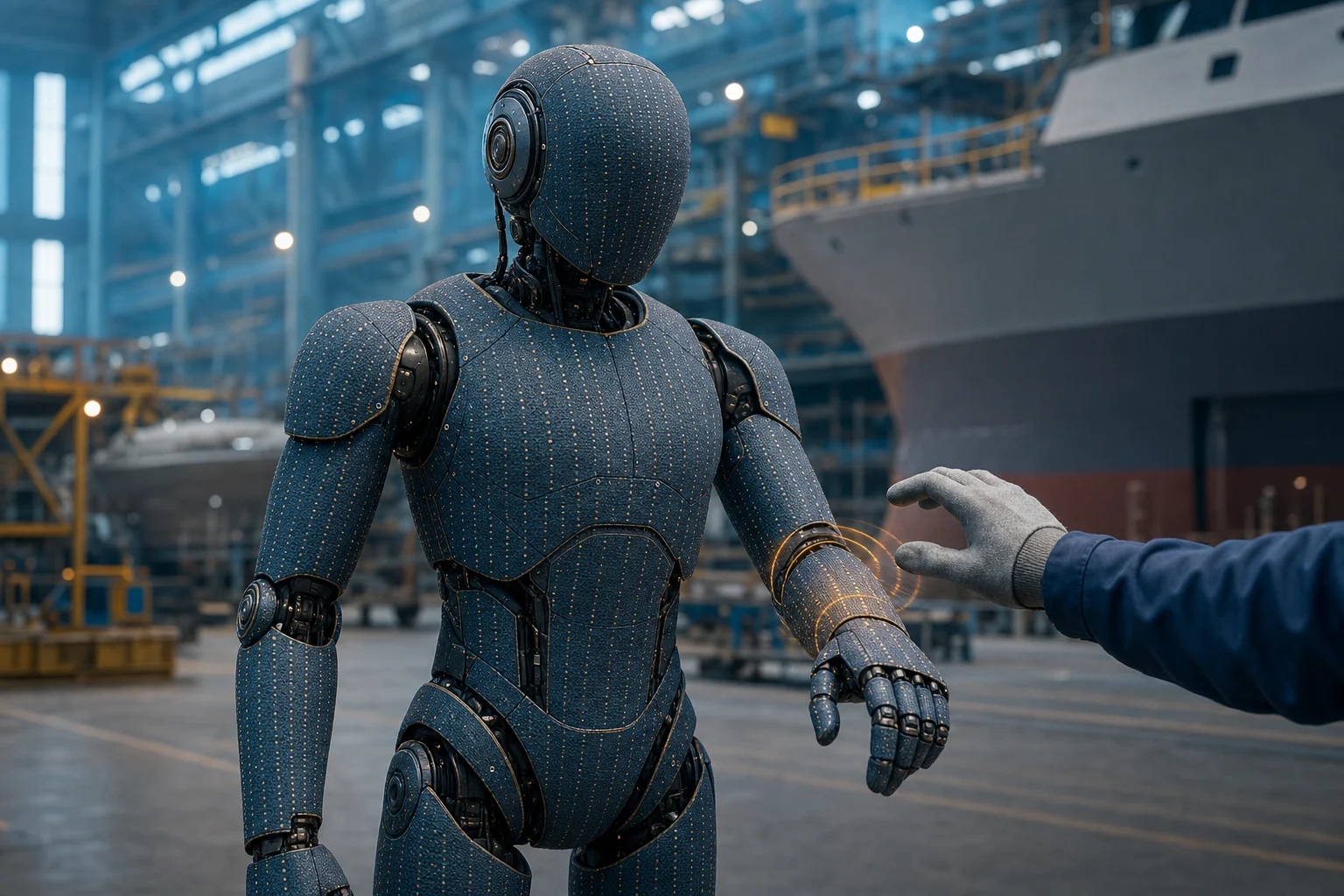
Generative Bionics says GENE.01 has moved from the design concept shown at CES in January to a functioning humanoid platform in six months. The Italian company presented the new version on 20 July and scheduled its US debut for AMD's Advancing AI event on 22–23 July. Its most interesting feature is not walking or a human-shaped shell. It is a distributed skin that the company says detects touch, proximity, force and temperature across the robot's body.
That could address a real weakness in humanoid robotics. Cameras can show a robot that a person is nearby, but they do not directly measure a hand touching an arm, the pressure on a panel or the heat of a surface. A machine intended to share a shipyard or factory with people needs information at the point of contact. Yet a launch demonstration is not a safety case. As of our 22 July check, Generative Bionics had not published a complete specification sheet, an independent performance test, a safety certification, a price or a commercial deployment count.
What is confirmed, and what is announced
GENE.01 exists as a physical platform and has been shown moving and manipulating objects. Generative Bionics describes it as fully functional; la Repubblica reported seeing the machine and relayed that it walks, grasps and navigates. The company says the sensor layer covers the whole body and can detect four types of physical signal: direct touch, nearby objects, applied force and temperature.
The company also says it will publish the robot's digital model for developers to simulate applications. That is potentially useful: a common robot description can let a laboratory test reach, collision geometry or software integration before obtaining the hardware. But an open digital twin is not the same as open hardware, and it does not independently prove that the physical sensors perform as advertised.
The six-month development schedule, the claim of full-body coverage and the response quality remain announced by the company. Public material does not provide sensor density, accuracy across the body, failure rates, environmental limits or a standardised comparison with another robot. There is also no public evidence yet that GENE.01 can perform a full production shift autonomously.
Why skin adds information that cameras miss
Vision is strongest before contact. It estimates where people and objects are, but occlusion, glare and a tool hidden behind an arm can make that estimate incomplete. Tactile sensing starts where vision becomes uncertain. It can indicate that a surface has been touched, where force is building and whether a grip is slipping. Proximity sensing may add an earlier warning, allowing a robot to slow before contact rather than react afterwards.
Separate research helps explain why this architecture matters without validating GENE.01 itself. A 2026 arXiv paper on GenTact-Prox describes modular, 3D-printed tactile and proximity units fitted to a Franka robot arm. In that experimental setup, five units were used to map the space near the arm and support collision-aware control. The researchers reported detection at up to 18 centimetres under their test conditions. That was a laboratory system on a different robot, not a peer-reviewed test of Generative Bionics' product.
Force data may also improve teaching. A video can show the path of a hand, but not always how firmly it presses or grips. If a worker demonstrates a task while the robot records motion and contact forces, the training signal becomes richer. Whether that produces reliable autonomous behaviour still depends on data quality, control software and repeated validation.
The shipyard is a hard first test
Generative Bionics is adapting the platform with Fincantieri for shipyard work, with welding identified as an initial direction. This is a development partnership, not evidence of an operational fleet. Shipyards contain reflective metal, variable lighting, tight spaces, heat, dust and large components. Welding adds process hazards and protective requirements. A tactile skin that works in a clean demonstration must also tolerate wear, contamination and maintenance.
The project therefore has two separate questions. Can the robot perform a useful industrial task with acceptable speed and quality? And can it remain predictably safe when people, tools and materials enter its workspace? Whole-body sensing may help the second question, but it cannot answer it alone. Emergency stopping, speed and separation monitoring, mechanical compliance, risk assessment and task-specific controls still matter.
What evidence should come next
A convincing next release would include sensor coverage and resolution, latency, force ranges, temperature limits and test methods. It should report false positives and missed detections, not only a successful video. Industrial buyers will also need duty cycle, payload, battery or power strategy, ingress protection, repair procedures and compatibility with recognised robot-safety standards.
The Fincantieri work can become valuable evidence if it produces a defined pilot: named task, supervised hours, intervention rate, incidents, task quality and comparison with the existing process. Until then, “designed for safe collaboration” describes an engineering goal, not a certified outcome.
Verdict
GENE.01 offers a credible answer to an important problem: humanoids need body-level awareness, not vision alone, when they work near people. The physical robot and the smart-skin concept are confirmed as a public prototype. Its sensing performance, industrial endurance and safety are company-announced and not independently validated. The right milestone is no longer another polished walk. It is a measured shipyard pilot that shows when the skin detects danger, when it fails and how the whole system responds.
Touch can serve other machine shapes: TU Delft’s tactile drone hand addresses a specific grasping problem. The robotic-hand bottleneck dossier provides context on dexterity, training and endurance.
✔ How we checked this
Checked on 22 July 2026 against Generative Bionics' announcement, independent reporting from The Robot Report and la Repubblica, and separate tactile-skin research. Capabilities without a public test protocol remain company claims; no safety certification, deployment count or commercial price was found.
Information verified as of the publication or update date shown. Technology moves fast — check the sources below.
Sources
- Generative Bionics introduces GENE.01 — Generative Bionics / PR Newswire
- Generative Bionics unveils humanoid robot with full-body tactile sensing — The Robot Report
- Generative Bionics accelera: l'umanoide Gene.01 punta alle fabbriche — la Repubblica
- Design, Mapping, and Contact Anticipation with 3D-printed Whole-Body Tactile and Proximity Sensors — arXiv