This drone perches by touch: TU Delft’s tactile hand explained
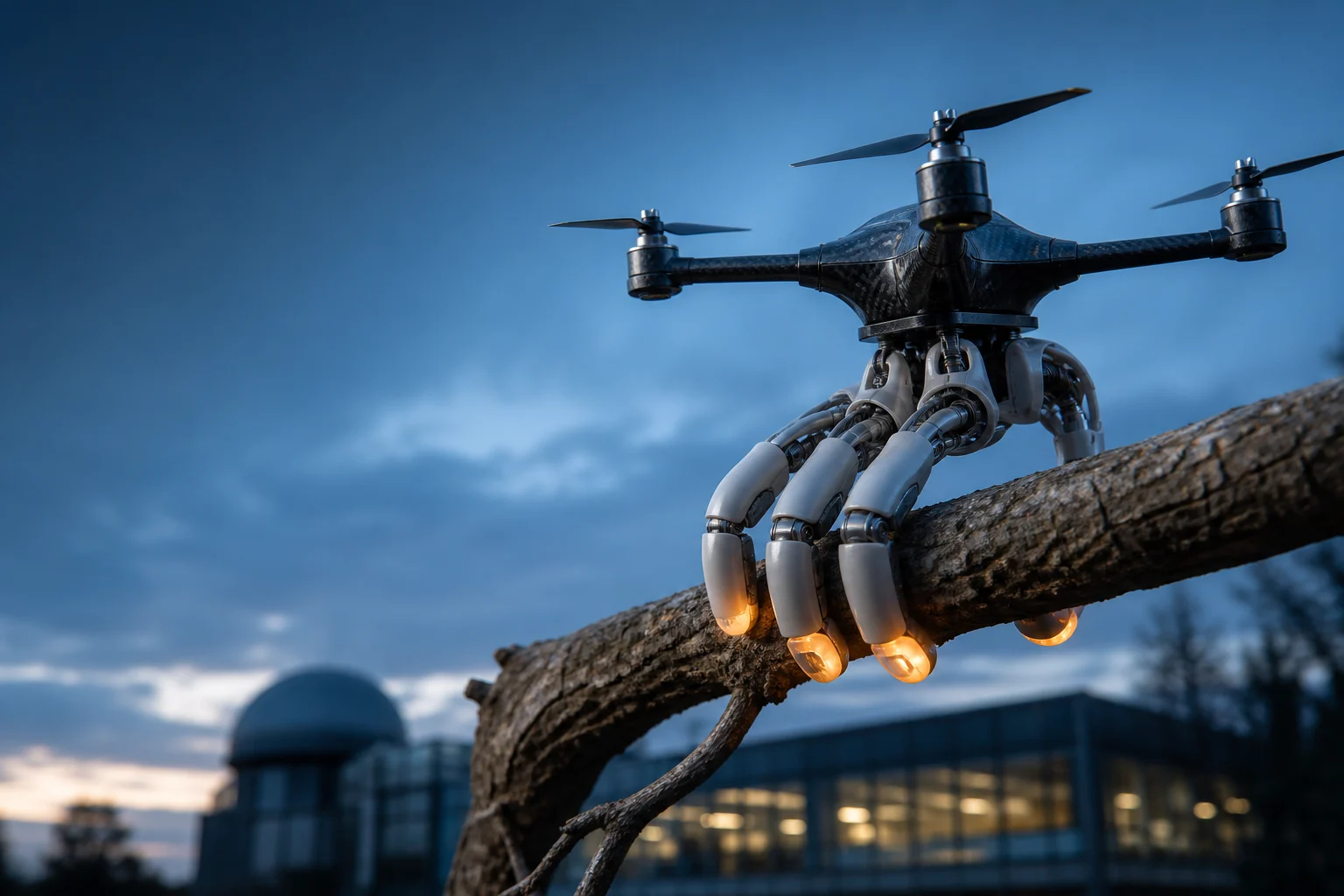
A drone can now use contact as information instead of treating it only as a collision. A team at TU Delft’s BioMorphic Intelligence Lab equipped a micro aerial vehicle with a compliant anthropomorphic hand. Nine tactile sensors detect where the machine touches a branch or structure, allowing the drone to correct its position and orientation before it validates the grasp.
The study, published in npj Robotics on August 22, 2026, is impressive without embellishment. In simulation, the method exceeded 99% success across the tested ranges and tolerated an initial position error of up to 0.6 metres. The physical prototype completed all 26 reported trials. It is not yet an autonomous forest drone ready to buy: the environment, targets and errors remained controlled.
Key points
- The hand uses three fingers, nine binary touch zones and compliant phalanges.
- Springs naturally close the fingers; the motor is mainly needed to open them.
- The drone searches for contact, aligns itself, validates stability and then switches off its rotors while hanging.
- The above-99% result comes from Monte Carlo simulations, not thousands of outdoor flights.
- Physical validation consists of 26 attempts on cylindrical and T-shaped targets.
The problem: the camera loses the target just as the hand approaches
A small drone typically flies for only tens of minutes. Hovering to monitor a bridge, listen to a forest or observe an area spends nearly all of its energy on propulsion. Perching could turn the vehicle into a temporary fixed sensor that is quiet and far less power-hungry.
Existing systems can already attach with claws, magnets, suction or adhesives. Each imposes conditions: metal for a magnet, a clean surface for an adhesive, or a known geometry for some grippers. More importantly, a vision-only approach becomes fragile when the gripper blocks the camera’s view of the target during the final movement.
TU Delft’s proposal reverses that logic. Vision or another system can bring the drone close; touch finishes the job. The first contact does not trigger a blind grasp. It gives the controller a new reference.
A deliberately simple hand
The hand is not trying to reproduce all human dexterity. It has three fingers with three phalanges each. Capacitive sensors on the phalanges return binary contact information rather than a detailed pressure map.
That simplicity reduces mass, computation and wiring. One tendon opens each finger, while torsion springs return it to a naturally closed pose. A silicone layer adds friction and compliance. After capture, the mechanics hold the vehicle without continuously powering the hand actuator.
This is a form of embodied intelligence: useful behaviour comes partly from the mechanism’s geometry and elasticity rather than software alone. The same principle appears in research on tactile skin for humanoids: a sensor matters when it changes a movement decision.
How touch guides the perch
The controller moves through several states. The drone takes off, explores the estimated target area in a figure-eight pattern while opening and closing its fingers, and responds to the first touch. It backs away slightly, returns beneath the target and progressively closes the hand.
If one finger touches first, the vehicle adjusts its lateral position or yaw. It considers the grasp stable only when the expected lower pads detect contact and tendon tensions have equalised. The rotors can then stop. If tracking error exceeds a safety threshold, the drone aborts, returns to a safe hover and restarts the search.
That loop is the real advance. The system does not merely have sensitive skin: it converts each contact into a measurable trajectory correction.
What the results prove
The researchers first compared the tactile strategy with a direct feed-forward approach in the Genesis simulator. Sets of 100 trials varied position error, rotation, inclination and target size. Within the documented ranges, the tactile approach maintained more than 99% success with a position error of up to 0.6 metres; the direct baseline was limited to roughly 0.1 metres.
The method also tolerated more rotational error and target radii up to 0.15 metres in simulation. It failed on very thin objects, below a radius of 0.02 metres, because too few sensors could confirm a stable grip. A larger search pattern improves robustness but increases the time required to perch.
The team then ran 26 physical trials. Targets were cylindrical or T-shaped, and their initial positions and orientations were deliberately corrupted. All 26 reported trajectories converged on the target and ended in a perch. In one documented run, first contact occurred at around 15 seconds and grasp confirmation at around 35 seconds.
That is stronger evidence than a single promotional clip because the protocol, trajectories and data are public. It is still a small controlled series. As with any robot, our proof checklist separates an experimental success from operational endurance and an industrialised product.
What the study does not prove yet
The drone starts with a rough target area, the object must fit inside the hand, and the surrounding search volume must be free from unexpected obstacles. A moving branch in dense foliage, wind or rain adds false contacts, motion and wet surfaces that the 26 trials do not cover.
The hand also consumes part of the payload budget. A complete energy balance is still needed: energy spent searching, mechanism mass, energy saved while resting and reliable take-off after a long perch. The authors present no commercial product, certification or outdoor exposure duration.
Finally, “vision-free” describes the published tactile phase, not an entire mission without perception. Selecting the right branch, avoiding cables or people and navigating to the site will still require other sensors and safety rules.
Why the research matters
A drone that can settle on unprepared structures could support long-duration infrastructure inspection, environmental listening, canopy observation or temporary communications relays. Endurance is not the only gain. By learning to exploit contact instead of avoiding it at all costs, aerial robots can interact with a world that was not designed with landing pads.
The most important result is therefore not a photogenic hand hanging from a branch. It is an architecture in which compliant mechanics, tactile sensing and closed-loop control reinforce one another. The decisive next test will leave the laboratory’s clear volume: more trials, moving or partly occluded targets, wind and a full measure of the energy saved.
TU Delft has published a credible and reproducible prototype, not a finished product. But the idea is powerful: to remain useful in the air for longer, tomorrow’s drone may need to know when to stop—and feel where it puts its hand.
✔ How we checked this
Checked on August 23, 2026 against the open-access npj Robotics paper, its supplementary data and videos, and TU Delft’s project description. Success rates above 99% come from simulation; physical validation covers 26 controlled trials.
Information verified as of the publication or update date shown. Technology moves fast — check the sources below.
Sources
- Aerial tactile perching via an anthropomorphic hand with embodied soft tactile receptors — npj Robotics / Nature
- Feely Drone experimental data and code — BioMorphic Intelligence Lab
- Drones with the Sense of Touch Act upon Their Surroundings — TU Delft