Waymo reaches Singapore in 2028: what France can read from the global timetable
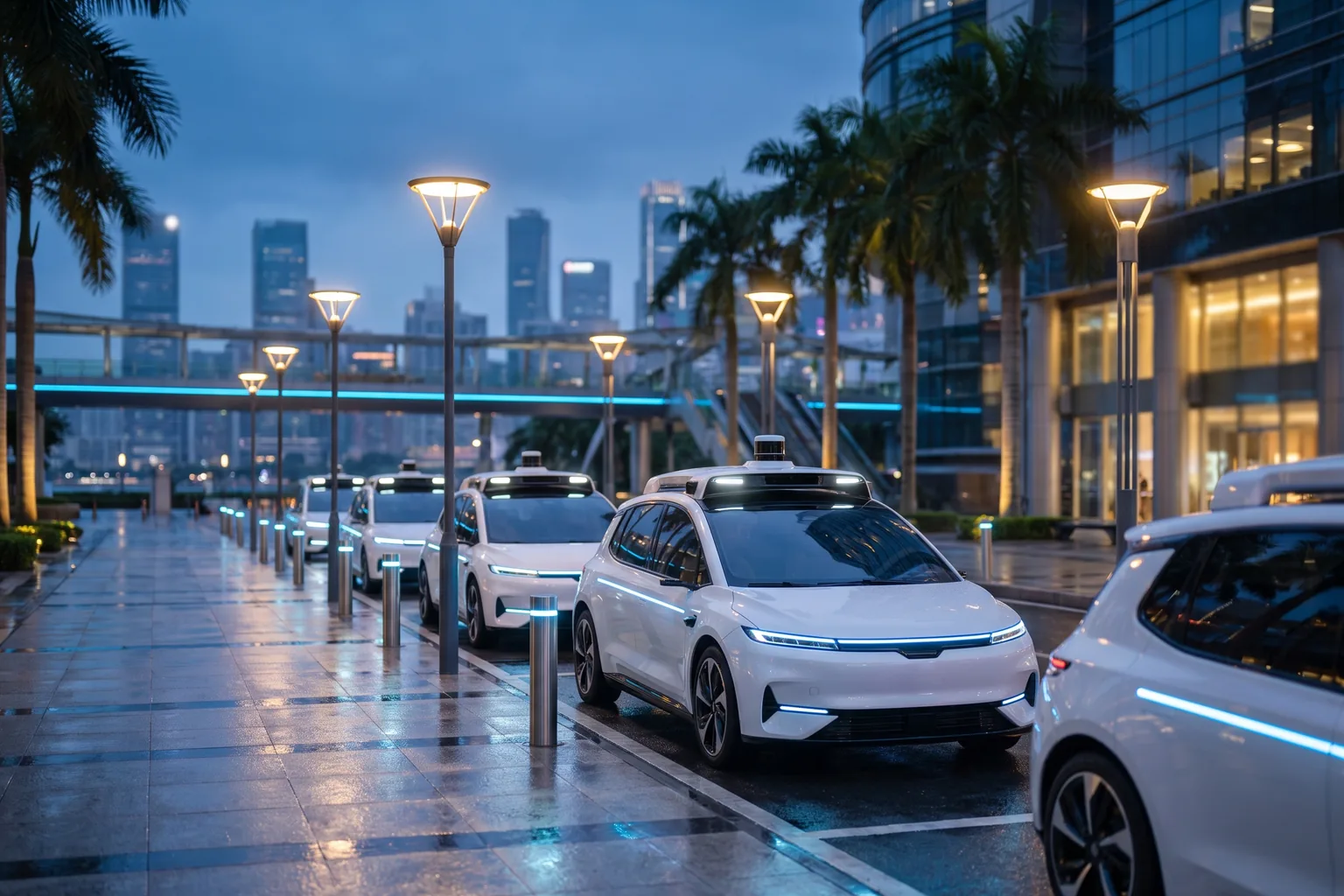
Waymo will reach Singapore in 2028, the company announced on 17 September 2026 in partnership with the Ministry of Transport and the Land Transport Authority. It is its first move into Southeast Asia, and the timetable is explicitly staged: an initial fleet of fully electric Jaguar I-PACE vehicles in the coming months, a preparation phase in 2027, then a public commercial launch in 2028 through the Waymo app. France appears nowhere in the list of markets cited.
A timetable in three stages
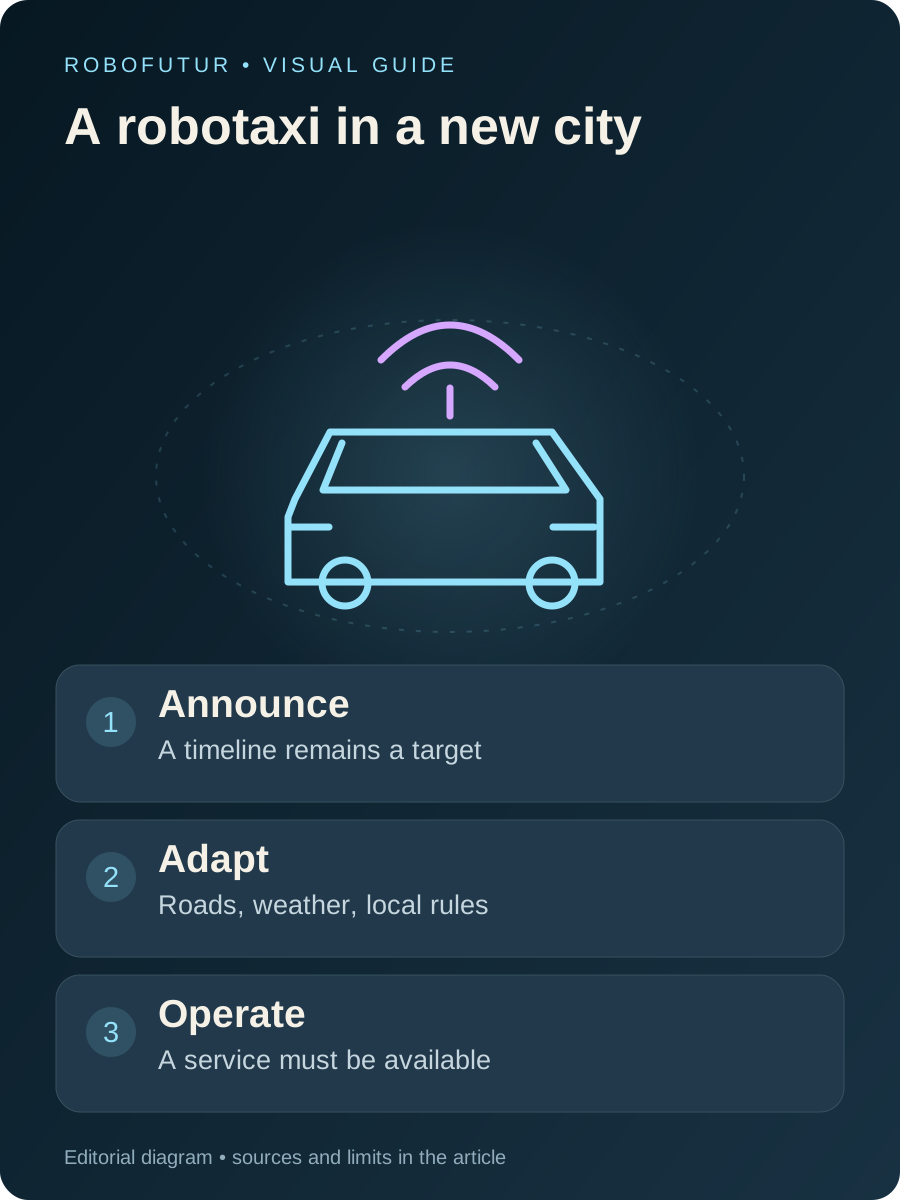
The most interesting detail is not the final date but the intermediate stage. In 2027, trained autonomous specialists will take the wheel manually. The stated goal is explicit: adapting the Waymo Driver to local road geometry and to monsoon conditions.
| Stage | Content |
|---|---|
| Coming months | arrival of an initial fleet of fully electric Jaguar I-PACE vehicles |
| 2027 | preparation phase, manual driving by trained specialists |
| 2028 | public commercial launch through the Waymo app |
The Singapore government separately plans a deployment in one or two more distant Housing Board towns, such as Tampines North and Tengah, on top of tests already scheduled in the west of the island, in the Labrador and Harbourfront areas.
That staging is a reminder that scaling a robotaxi is as much a methodology problem as a technology problem. Local adaptation takes real driving time, not just laboratory trials.
The 2027 phase is also the least spectacular and the most informative. It produces no paid ride, and therefore no announcement, yet feasibility is settled there: the Waymo Driver has to learn a road geometry, lane markings, driving habits and a rainy season it has never encountered. A fleet arriving "in the coming months" is not yet a service.
What Waymo claims, and on what basis
Three figures accompany the announcement, all reported as company figures:
- more than 20 million fully autonomous rides and more than 300 million fully autonomous kilometres to date;
- a claimed 94 % reduction in injury accidents compared with human drivers in US cities;
- roughly 480 tonnes of CO2 avoided per week at current scale.
Waymo adds that a little over a third of its San Francisco users are picked up or dropped off near public transit stations. That is a comfort indicator rather than a safety one, but it suggests the service is aiming at a feeder role rather than at replacing the metro.
The company was valued at $126 billion in February 2026, after raising $16 billion. Waymo also said it is targeting Tokyo in 2027 for Japan's first fully autonomous commercial taxi.
Those figures need reading for what they are: an operating record on cities already served, not a performance that transfers to Singapore as it stands. A densely built city-state with regulated traffic does not share the geography of a multi-million-resident US metro spread across several jurisdictions. The 94 % figure is a company claim, presented without detail on comparison protocols.
The institutional angle
Singapore's transport minister Jeffrey Siow welcomed Waymo as "our newest autonomous vehicle operator." The LTA positions the company alongside ComfortDelGro and Grab, two local players.
The government set one explicit condition: it "will not let autonomous vehicle deployment outpace our ability to reskill and support affected drivers." A workforce transition scheme had been announced in July 2026.
This is the most transferable point for France. In Singapore the issue is not only whether the vehicle is permitted. It is whether the country can absorb the job displacement. Comparing this with the arrival of European robotaxis through Bolt and Lucid shows the European debate remains heavily centred on regulation and much less on retraining.
The country did not pick Waymo out of fashion. It picked it to establish a reference point. Admitting an established operator with a known regulatory record, and sending it into bounded zones, gives local operators something they can be measured against. That is also what the minister's phrase "newest" makes possible: Singapore is keeping a list of operators, not handing over a monopoly.
What France can read from this
Three lessons, in order of immediate usefulness.
The first is duration. Between announcement and public service, Waymo allows two years, a full year of assisted manual driving. A comparable European timetable would require the same sequence: tests, a year of human-aided driving, and only then a commercial opening.
The second is geography. Waymo enters Southeast Asia through bounded zones, in the west of the island, then towards more distant ones. A rollout is never uniform.
The third is the absence of France. Waymo names Tokyo, London and Munich. The European market is being played by other operators on other timetables, which we track in the Waymo robotaxi file and in the state of autonomous trucking, where regulation remains the blocking factor.
In other words, there is no reference date for waiting on a French Waymo announcement. The useful signal is not the absence. It is the pace of deployment elsewhere, and the fact that London and Munich are already named while France is not. For an operator building a multi-year timetable, a city left out of a release stays left out.
Two events to date correctly
In late September, several French outlets picked up two announcements very close to this one. Both are dated 10 September 2026 and therefore fall outside this article's window: the first national level 4 permit issued in Spain by the DGT, to WeRide, Uber and AVOMO, with 20 GXR vehicles in Madrid; and the launch of fully driverless rides in Zagreb by Pony.ai and Verne.
They are not new to the news, but the date changes how they read. Together they show that Europe is advancing on several files at once, rather than on a single timetable driven from California.
✔ How we checked this
Written from Waymo's announcement of 17 September 2026, the Land Transport Authority and Ministry of Transport statements of 18 September 2026, and same-day Reuters coverage. The safety figures (94 % reduction in injury accidents, 480 tonnes of CO2 avoided weekly) are company claims. Two events widely picked up in France in late September — Spain's first national level 4 permit and the Zagreb launch — are dated 10 September 2026 and therefore fall outside this article's window.
Information verified as of the publication or update date shown. Technology moves fast — check the sources below.
Sources
- Waymo in Singapore — Waymo
- Land Transport Authority statements on autonomous vehicles, 18 September 2026 — Land Transport Authority
- Singapore welcomes Waymo as its newest autonomous vehicle operator — Reuters
- Waymo official blog — Waymo