Autonomous Trucks in 2026: US and China Driverless Freight, Verified
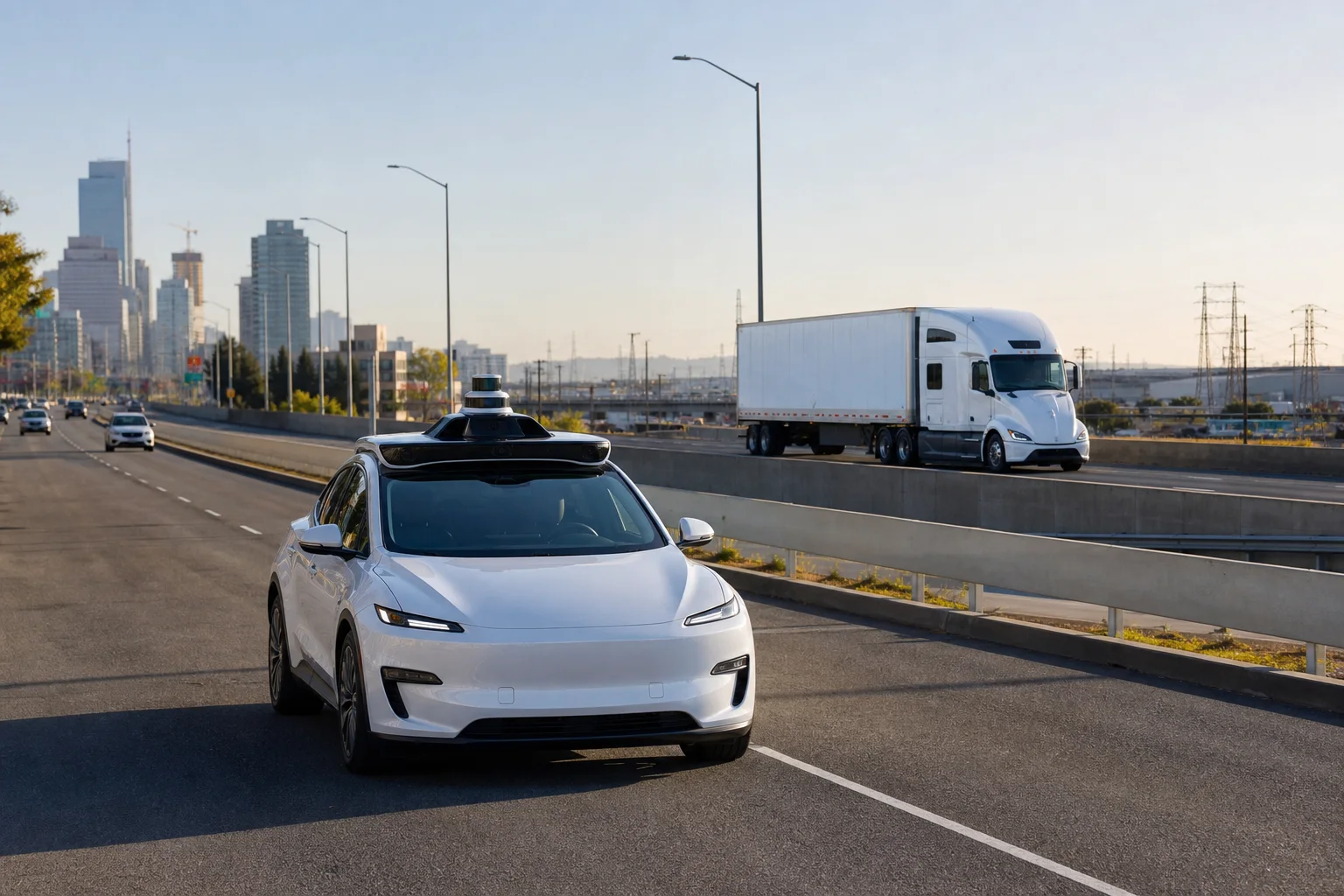
Commercial autonomous trucking exists, but in a form very different from “a truck that goes anywhere.” Aurora launched a driverless freight service between Dallas and Houston in May 2025. The system initially targets highways and defined terminals, not every loading dock in the country.
Why freight begins with a corridor
Highways have legible lanes, predictable directions and fewer pedestrians than city centres. An operator can map a route, qualify weather, adapt depots and maintain the fleet at both ends. It is a limited operational domain and therefore compatible with Level 4.
The beginning and end remain difficult. A trailer must be inspected, coupled, loaded and brought to the terminal. The common model therefore combines an automated long-haul segment with human or conventional operations at the ends.
What has actually been demonstrated
Aurora announced its commercial Dallas–Houston launch and later reported more than 250,000 cumulative driverless miles by early 2026 in a filing with the SEC. The figures demonstrate real operations. They do not establish that every road, season or configuration is solved.
Economics depend on how many hours the truck can move, platform cost, remote assistance, maintenance and utilisation. Removing the onboard driver does not remove the operations centre or depot staff.
China's parallel push — and a key caveat
China's autonomous-trucking effort is larger by fleet size than Aurora's Texas corridor. Pony.ai reported in a November 2025 SEC filing that its trucks have covered more than 1 billion ton-kilometres of freight since entering the market in 2018, with a fleet of roughly 200 vehicles and public-road testing permits in Beijing and Guangzhou. The company's Gen-4 truck kit, announced the same month, is aimed at mass production and deployment through 2026.
The caveat matters as much as the scale: Pony.ai's near-term rollout is described as a "1+4" platoon — one human-driven lead truck followed by four driverless trucks it directs — not unsupervised driverless operation on open roads. That is a meaningfully different claim from Aurora's fully driverless Dallas–Houston runs, and it is the company's own framing, not independently verified. Treat "China has driverless freight trucks" headlines the same way this guide treats any other unverified claim: check whether "driverless" means no human in the loop at all, or a human still leading the convoy.
Sensors and redundancy
An autonomous heavy truck combines cameras, radar, lidar, localisation and maps. Critical systems—braking, steering, power and compute—must tolerate failure. Stopping distance and mass demand early detection and large margins.
Weather affects both perception and grip. A sound system must also decline a mission, slow down or reach a safe state. Cancellation rate is part of performance, even if it is less impressive than mileage.
Safety: what evidence is needed
Responsible crashes, injuries, relevant disengagements and failure incidents should be compared with human fleets exposed to the same roads and times. Regulatory reports have definitions and coverage limitations; a raw count misleads.
Voluntary safety assessments explain company architecture and procedure but do not replace independent oversight. Incident investigations and standardised data should support better comparisons as mileage grows.
What happens to transport jobs?
Road freight is more than holding a steering wheel. Inspection, load securing, customer interaction, manoeuvring and exception handling remain necessary. Automation may shift employment toward terminals, maintenance and supervision while reducing some long-haul roles.
The transition will depend on corridors, labour rules and expansion speed. Predicting the general disappearance of drivers from one Texas route confuses a successful use case with an entire occupation.
The 2026 verdict: Level 4 autonomous freight has crossed the commercial line on selected corridors. The next indicator is not another video but safe expansion across more weather, traffic and customers. For urban services, see our robotaxi status report.
✔ How we checked this
Commercial milestones are checked in company and regulatory filings; safety figures are not extrapolated to the entire industry.
Information verified as of the publication or update date shown. Technology moves fast — check the sources below.
Sources
- Aurora launches commercial driverless trucking service — Aurora Innovation
- Aurora 2025 Q4 shareholder letter — U.S. Securities and Exchange Commission
- Automated Vehicles for Safety — NHTSA
- Automated driving systems safety assessment index — NHTSA
- Pony.ai Inc. announces Gen-4 autonomous trucks, set for mass production and deployment in 2026 — Pony.ai Investor Relations
- Pony AI Inc. Form 6-K — U.S. Securities and Exchange Commission