China's Dark Factories: What Is Really Automated—and What Viral Videos Get Wrong
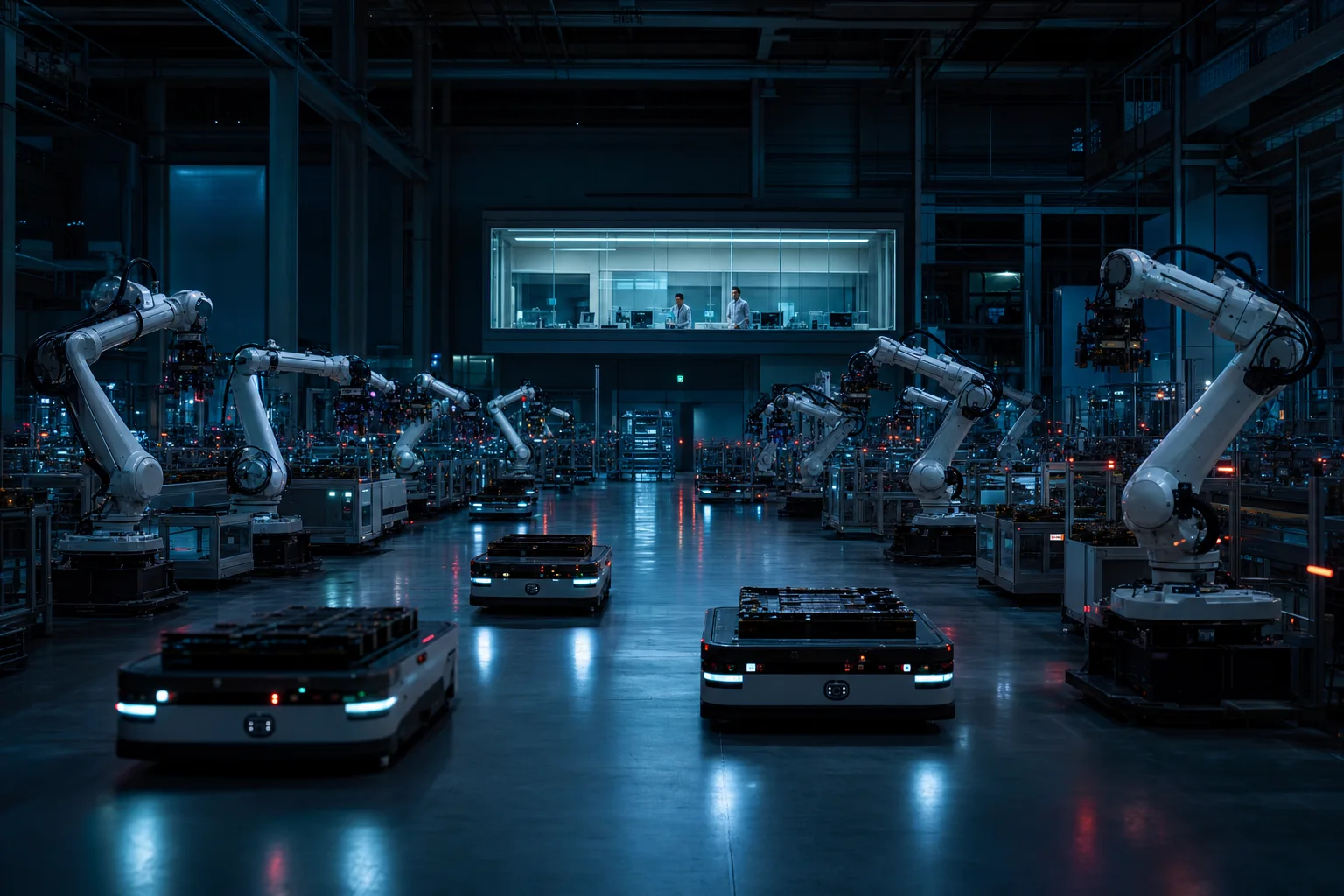
A factory that makes products in the dark, with robots working while people sleep, is irresistible social-media material. China does operate highly automated workshops that can run without normal lighting or an operator at every station. But “dark factory” is an industry shorthand, not proof that an entire building has no humans or that manufacturing has become autonomous magic.
The more useful story is how industrial robots, machine vision, quality-control algorithms and autonomous transport are being connected into one production system—and which jobs remain outside that loop.
What “lights-off” actually means
A lights-off line is designed to perform a defined sequence without continuous direct human presence. Robot arms position components, cameras inspect them, software adjusts process parameters and autonomous mobile robots move material. Because machines do not need comfortable lighting, the workshop can operate with most lights off during selected periods.
That definition can apply to one workshop, line or shift. It does not automatically describe receiving docks, maintenance areas, laboratories, tool rooms or the whole factory. Engineers still design the process, train vision models, validate quality, replace worn parts, investigate failures and decide when production should stop.
A documented example in Shenzhen
The World Economic Forum's Global Lighthouse Network describes Valeo's front-camera factory in Shenzhen as having deployed 42 Fourth Industrial Revolution use cases, including 14 advanced algorithms and fully automated lights-off workshops. The case study reports a 45.9% reduction in finished-goods defects, a 34.5% cut in lead time, a 60.2% productivity increase and 27.1% lower unit energy consumption.
Those figures are meaningful, but their scope matters. They describe one selected factory transformation and are reported through the Lighthouse programme. They are not evidence that every Chinese factory achieves the same result, nor that each improvement came from robots alone.
The system combines AI-assisted troubleshooting, closed-loop optical and X-ray inspection, changeover optimisation and cooling controls. The advantage is orchestration: inspection data can change the process before thousands of defective units are produced.
Why China is a strong test bed
China combines enormous manufacturing volume, dense supplier networks and aggressive capital investment. A plant that produces millions of similar devices can spread the cost of robots, sensors and software over many units. Local suppliers can also modify grippers, cameras and production equipment quickly.
Automation is not limited to repetitive assembly. Flexible lines increasingly use digital product definitions and software-controlled changeovers to handle more variants and smaller batches. That is harder than making one identical object continuously, because the system must know which component and inspection rule belongs to each order.
The hidden human layer
The cleaner and darker a line looks, the easier it is to miss the work around it. Automation creates demand for controls engineers, maintenance technicians, machine-vision specialists, quality engineers, cybersecurity teams and production planners. It can reduce some manual handling and inspection roles while making downtime more dependent on a smaller group of highly skilled people.
Humans also handle the exceptions. A deformed component, unexpected contamination, supplier variation or software fault can fall outside the training data. A robust factory needs safe fallback modes, traceable decisions and people authorised to stop the line.
The risks behind the performance
Connected production expands the attack surface. Compromised scheduling software or altered inspection thresholds can interrupt output or let defects pass. Proprietary systems can also lock a manufacturer into a vendor, while sensors and models need calibration as products evolve.
There is an employment question, but “all factory jobs disappear” is too simple. Tasks change at different speeds. Highly structured handling is easier to automate than repair, judgement and adaptation. The policy challenge is whether workers can move into the new roles and whether productivity gains improve conditions as well as margins.
The verdict
China's dark factories are real as a production architecture: selected workshops can operate with very little direct labour and little light. The strongest examples are not empty monuments to robots. They are supervised systems linking automation, data and rapid human intervention.
When a viral clip claims an entire factory is human-free or quotes an astonishing output rate, ask which site, line, period and audited metric it describes. The future of manufacturing is darker on the shop floor—but still full of human decisions behind the glass.
✔ How we checked this
Performance figures are attributed to the World Economic Forum's factory case studies and report; company-level results are not presented as a census of Chinese manufacturing.
Information verified as of the publication or update date shown. Technology moves fast — check the sources below.
Sources
- Valeo Interior Controls — Shenzhen — World Economic Forum
- Global Lighthouse Network 2025 — World Economic Forum
- Global Lighthouse Network 2025 announcement — World Economic Forum