World Labs Atlas: impressive 3D worlds, early-access evidence
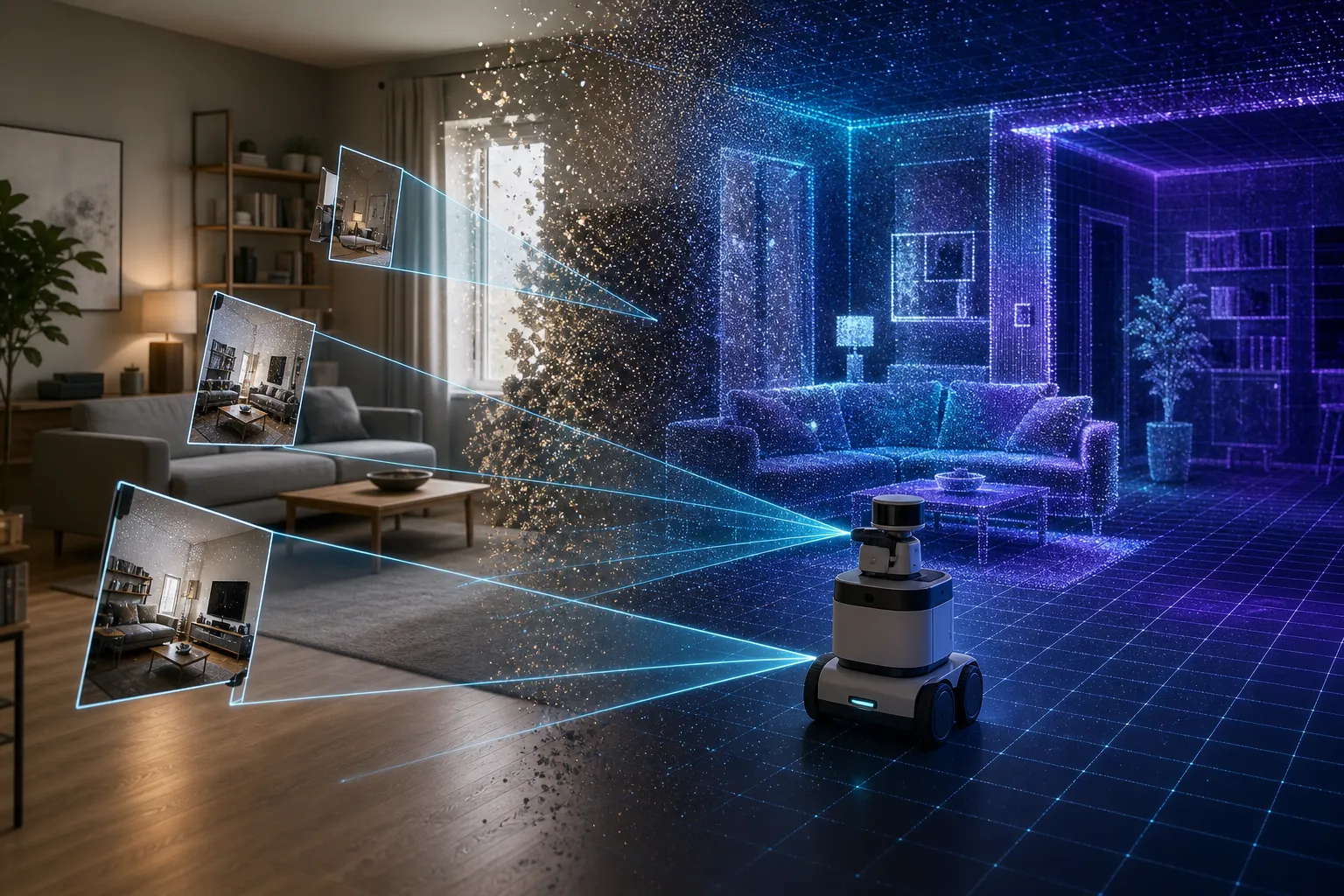
World Labs has introduced one model that can generate a scene, reconstruct it in 3D and simulate how it changes—but the public evidence is still controlled by the company. Atlas accepts combinations of text, images, camera poses, depth and video frames. It then produces images, video, point clouds or 3D Gaussian splats within a shared spatial context.
The announcement on September 1, 2026 is technically ambitious. World Labs shows camera-controlled video up to one minute at 1440p, reconstruction from a handful of photographs, “bullet time” reframing from several phones and Real-to-Sim environments for robot navigation and manipulation. Atlas is entering selective early access. There is no public price, open model release or independent production benchmark yet.
What a world model is supposed to do
A conventional image generator creates a frame that looks plausible. A useful world model must preserve relationships when the viewpoint or time changes. A chair should remain beside the same table; a doorway should connect the same rooms; an object should move according to constraints that remain coherent across frames.
Atlas builds what World Labs calls a spatial context. Each image or depth map is tied to a camera position. The model generates the next element in a multimodal sequence while conditioning on what came before. The architecture combines an autoregressive transformer with a rectified-flow diffusion process.
That design makes very different tasks look like variations of one sequence. Given a picture and camera path, Atlas predicts new views. Given several photographs, it estimates geometry. Given video, it models depth and time. The same context can then feed a simulation or a rendered output.
Generation and reconstruction are not the same claim
The most important caveat is visible in World Labs’ own explanation. When a photograph does not show the back of a house, Atlas imagines a plausible back. That can produce a coherent cinematic scene, but it is not evidence that the hidden structure exists in reality.
Adding more photographs constrains the model. World Labs says two or three views can often produce faithful reconstructions and that Atlas can use more than one hundred inputs. Yet “faithful” remains task-dependent. A visual-effects artist may accept a plausible wall; a robot planner needs the real doorway width and obstacle position.
Explicit 3D output helps because a point cloud or Gaussian splat can be inspected and rendered by other tools. It does not automatically turn invented areas into measurements. Any industrial workflow should retain uncertainty and trace which geometry came from sensors versus generation.
Why camera control is a meaningful advance
Text commands such as “pan left” are imprecise. Atlas can instead receive explicit camera poses, letting a creator define the position and angle of each view. World Labs demonstrates smooth paths from one to six input images and a one-minute 1440p sequence.
The company reports human-rater comparisons against recent video models, with a larger advantage as camera trajectories become more complex. It also reports lower reconstruction error than selected specialist open-source systems. These evaluations are useful because they state tasks and baselines, but they were designed and run by World Labs. Model size, dataset composition, inference cost and full per-scene failure distributions are not disclosed in the announcement.
Independent tests need to examine repeated textures, mirrors, thin structures, moving people, occlusion and long paths that return to their starting point. Those cases expose whether a world is truly consistent or simply convincing frame by frame.
The robotics opportunity—and the risk
Robot teams need many environments in which to train and test policies. Scanning every warehouse, home or laboratory with specialised equipment is expensive. World Labs shows Atlas rebuilding large spaces from 24 video frames, then generating RGB and depth views from a simulated robot’s camera.
For manipulation, the model can vary objects, positions, lighting and background. This could create more diverse training data and stress-test policies against conditions that were not present during the original recording. The benefit is scale: one real capture becomes many virtual scenarios.
The risk is a simulation that looks realistic but encodes the wrong physics. A robot may learn from an imagined friction coefficient, an incorrect collision boundary or a deformable object that behaves too neatly. Real-to-Sim therefore cannot end at visual quality. Policies must return to real hardware for measured validation, and safety-critical decisions need conservative geometry and physics.
What Atlas is available for today
World Labs says Atlas will power future versions of its Marble products and invites selected partners to request access. That is an announced early-access programme, not general availability. Developers cannot yet compare a public API price, latency, data-retention policy or export limits.
The model is also not an autonomous agent that acts in the world by itself. It produces and simulates spatial representations. A robot still needs perception pipelines, planning, controllers, safety limits and hardware integration. A game or VFX pipeline still needs asset review, editing and rights management.
What would prove the breakthrough
Three independent tests would be persuasive. First, give multiple teams the same sparse images and compare geometry against a laser-scanned ground truth. Second, train a robot policy in an Atlas-derived simulation and measure transfer on a physical robot against established simulators. Third, test temporal consistency over long, looping camera paths with hidden areas revealed later.
Cost matters too. A model can outperform a baseline while requiring enough compute to make routine use uneconomic. Public latency, GPU demand and output-editability will determine whether Atlas becomes infrastructure or remains a premium demonstration.
RoboFutur verdict
Atlas presents a coherent idea: generation, reconstruction and simulation share a spatial context instead of living in separate tools. Its explicit camera control and 3D outputs make the release more substantial than a video-effects demo.
But the current evidence level is announced, internally evaluated and selectively accessible. Atlas can plausibly fill unseen space; that imagination must not be confused with measurement. The model becomes a real robotics breakthrough only when independent teams show that policies trained in its worlds work better, more safely or more cheaply on physical machines.
✔ How we checked this
Verified on September 2, 2026 from World Labs’ model announcement, benchmark description and Real-to-Sim material, then cross-checked with The Decoder. Capabilities and benchmark leadership are company-reported; Atlas remains in selective early access and no independent production evaluation was available.
Information verified as of the publication or update date shown. Technology moves fast — check the sources below.
Sources
- Atlas: A World Model for Spatial Intelligence — World Labs
- Building Worlds That Train Robots — World Labs
- World Labs unveils Atlas — The Decoder