China Recovered Its First Orbital Booster: Six Contenders to Watch
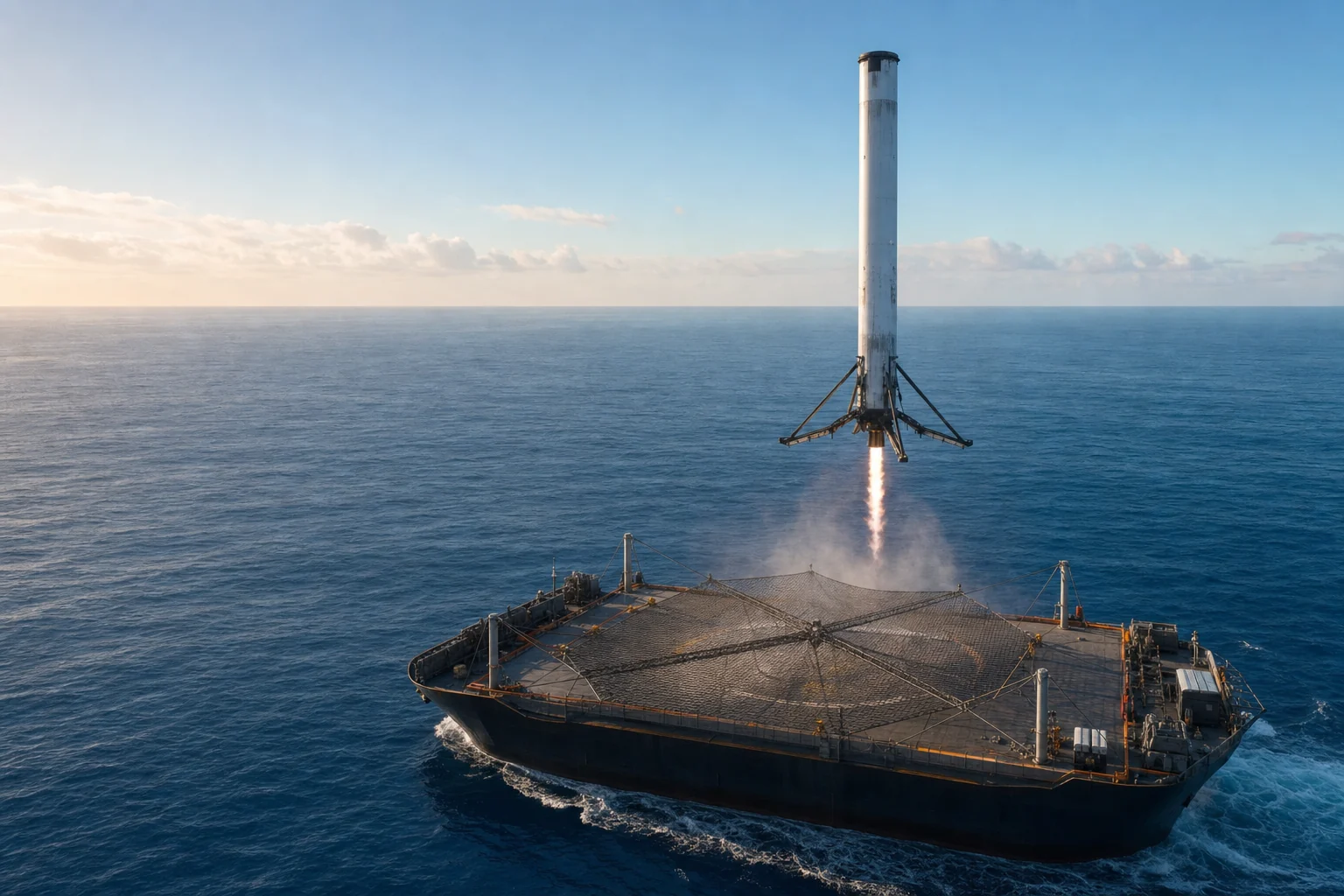
At 12:15 Beijing time on 10 July 2026, Long March 10B lifted off from the Hainan commercial spaceport, placed a satellite in orbit and sent its first stage back toward a ship. Instead of landing on legs like Falcon 9, the stage was captured vertically in a cross-shaped net.
CNSA calls the mission China's first controlled recovery of an orbital launch-vehicle first stage and the world's first sea-based net capture. This is not yet reuse at SpaceX's operational cadence. It is, however, the point at which China's competition stopped being only a collection of prototypes.
What Long March 10B actually proved
The two-stage vehicle is about 63 metres tall and five metres in diameter. In reusable configuration, its advertised capacity is approximately 16 tonnes to a 200-kilometre low orbit. The core stage uses liquid oxygen and kerosene; the second stage uses liquid oxygen and methane.
The demonstrated sequence matters: separation, engine relight, entry guidance, approach to a moving ship and capture by the onboard mechanism. The net absorbs the arrival and engages the stage through cables and hooks. It avoids carrying heavy landing legs, but demands high accuracy and a specialised ship.
Three pieces of evidence are still missing before this becomes reusable economics:
- the real condition of engines, tanks and structures after recovery;
- the time and cost of refurbishment;
- reflight of the same stage with another payload.
CASC says it intends to refly the stage before the end of 2026. That is an industrial goal, not yet a result. The number of replaced parts and the inspection time will matter as much as the next lift-off.
1. Long March 10B: the leader after capture
Long March 10B now has the simplest advantage: recovery after an orbital mission. Its five-metre diameter, payload class and place in the Long March industrial system give it access to a formidable public supply chain.
It can support Chinese low-orbit constellations and large commercial payloads. Net capture may save the mass of landing legs and avoid stability problems on a deck. Conversely, it makes recovery dependent on unique maritime infrastructure. Operations in rougher seas and at high cadence remain unproven.
2. Long March 12A: the public sector's other route
Long March 12A burns liquid oxygen and methane and targets a conventional vertical landing on legs at a ground site. Its first flight on 23 December 2025 placed the second stage in the intended orbit, but the first stage was not recovered. CNSA described the data gathered as a foundation for later attempts.
The programme matters because it explores a different solution from sea capture. If both survive, China's state sector can compare a landing zone against a net-equipped ship rather than locking in one concept too early.
3. Zhuque-3: the private methane rival
LandSpace became the first Chinese private company to send a large reusable launcher toward orbit with Zhuque-3 in December 2025. The upper stage reached its objective, but the booster landing attempt failed.
The Y2 vehicle completed a static-fire test on 29 June 2026 ahead of another mission. Its stainless-steel structure, methane-oxygen engines, grid fins and landing legs follow a now-familiar propulsive-return logic. The challenge is no longer proving that China can build this kind of vehicle. It is stabilising the landing and organising reflight.
4. Long March 12B and Kinetica-2: orbit first, recovery later
Long March 12B completed its maiden flight on 1 June 2026 carrying Qianfan constellation satellites. The announced vehicle is about 72 metres tall and targets roughly 20 tonnes to low Earth orbit. Its first mission validated orbital transport; recovery is meant to arrive through later iterations.
CAS Space's Kinetica-2 completed its maiden mission on 30 March. The Chinese Academy of Sciences says future versions are to receive reusable engines. That distinction matters: today's success demonstrates a transport platform, not a completed reuse loop.
5. Pallas-1: ambitious specifications awaiting flight
Galactic Energy describes Pallas-1 as a medium liquid launcher with a recoverable first stage. It advertises seven tonnes to low Earth orbit, seven kerosene-oxygen engines and a design goal of 25 uses for the first stage.
Those numbers describe a design. Before an orbital flight, landing and reflight, they cannot be compared directly with Falcon 9's real cadence. Pallas-1 is nevertheless worth watching because it targets the medium-constellation segment where frequency may matter more than maximum size.
6. Tianlong-3, Nebula-1 and the other outsiders
Space Pioneer, Deep Blue Aerospace and several other companies are developing their own approaches, including Tianlong-3 and Nebula-1. Their schedules have moved after tests and anomalies. The useful measure is therefore not an advertised launch date but a chain of evidence: full engine test, orbital flight, controlled descent, landing, inspection and reflight.
Multiple teams do not imply that six systems will become profitable. They do create a pool of engines, guidance software, launch sites and engineers that can accelerate the eventual winners.
Why China needs reuse
Domestic demand comes first. National connectivity constellations require many launches. Higher cadence shortens the time between satellite manufacture and service. It can also reserve traditional launchers for lunar, scientific or military missions.
The economic case is not mainly about propellant, which is a small portion of launch cost. Value comes from returning an expensive stage in good enough condition to avoid rebuilding it. If inspection, sea transport and engine replacement cost nearly as much as a new stage, a beautiful recovery does not win the market.
The RoboFutur evidence ranking
| Evidence rank | Programme | What is established | Next proof required |
|---|---|---|---|
| 1 | Long March 10B | Orbit and sea capture of first stage | Reflight of the same hardware |
| 2 | Zhuque-3 | Orbit reached; return attempted | Intact landing |
| 3 | Long March 12A | Orbit reached; return attempted | Intact landing |
| 4 | Long March 12B | Successful orbital debut | Recovery demonstration |
| 5 | Kinetica-2 | Successful orbital debut | Reusable-engine and stage version |
| 6 | Pallas-1 and outsiders | Development and ground tests | First orbital flight |
Verdict
China has not matched Falcon 9's operational experience. It has crossed the most visible threshold: bringing back an intact stage that helped perform an orbital mission. Long March 10B now leads the national race; Zhuque-3 and Long March 12A remain the most advanced pursuers, while another wave is preparing the next market.
The 2026 question is no longer, “Can China recover a rocket?” It is, “How many weeks until it flies again, and in what condition?” See the wider context in our 2026 global launcher comparison.
✔ How we checked this
The 10 July result, vehicle configuration and capture method come from CNSA. Other programme status was checked against Chinese public bodies or manufacturers; future dates are not treated as guaranteed.
Information verified as of the publication or update date shown. Technology moves fast — check the sources below.
Sources
- China's first controlled launch-vehicle recovery — CNSA
- Long March 10B details and reflight goal — SASAC / CASC
- Long March 12A reaches orbit — CNSA
- Reusable vehicles in development — NCSTI / China Daily
- Zhuque-3 Y2 completes static fire — SCIO / Xinhua
- Kinetica-2 completes maiden mission — Chinese Academy of Sciences
- Pallas-1 — Galactic Energy