China is cooling the humanoid IPO boom: the return of arithmetic

On 21 September 2026, Reuters reported that Chinese authorities were slowing down the IPOs of humanoid robot companies. This is not a ban: it is a selection process. And it is a novelty, because it comes from the country that made embodied AI a national priority.
The timing is the point. For three years the message out of China was that this sector deserved capital. Money went into manufacturing capacity, into research centres, into municipal data-collection facilities, and into a wave of listings. What has changed is not the direction of policy but the question being asked of the companies applying: who is actually paying, and will they still be paying in three years?
The trigger: Unitree
The signal that set it off was the IPO of Unitree in August 2026.
| Item | Value |
|---|---|
| Listing date | 19 August 2026, Shanghai Stock Exchange (STAR Market) |
| Offer price | 150.80 yuan |
| Initial market cap | ~60.99 billion yuan |
| Raised | ~6.1 billion yuan (~$905 million) |
| First day | +460%, close at 845 yuan |
| As of 24 September | −42% versus the first day |
| Valuation | ~$29 billion |
| 2025 price/earnings | ~219x |
| Price/sales | ~36x |
A share that quintuples in a single session, then loses almost half its value within a month, is not an accident. Regulators read it as evidence that valuations are running ahead of real demand.
The three criteria
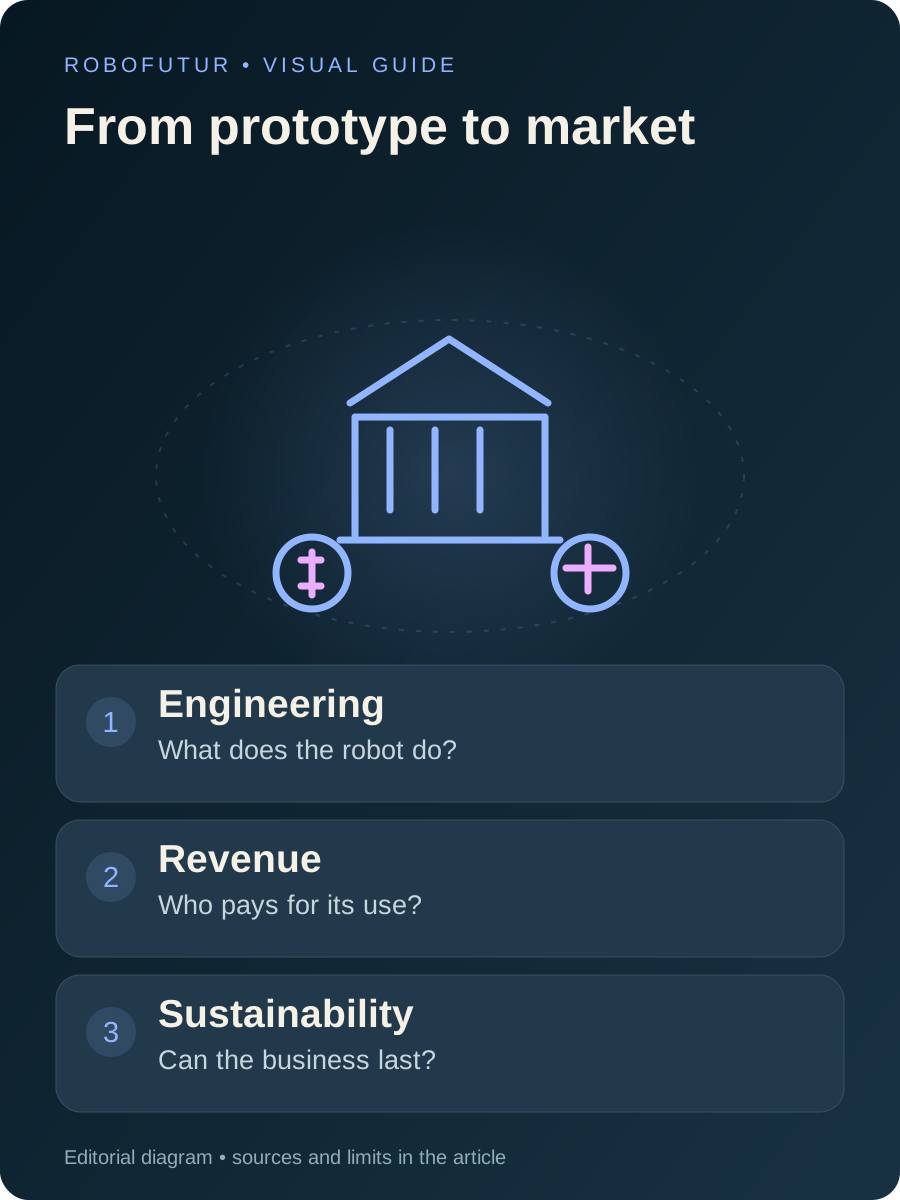
According to CNBC, which interviewed three people familiar with the regulator's position (the CSRC), candidates are expected to meet three conditions:
- Sustainable revenue and genuine commercial orders — not merely intentions or demonstration projects.
- A path to narrowing losses — one source mentions a three-year forecast.
- A core technology — what the sources call a robotic "brain" or advanced robotic hands.
One source indicates that meeting two out of three might be enough. The problem, as CNBC points out, is that nobody knows which two — and therefore how many candidates could realistically get through.
The deeper point: where the revenue comes from
This is what makes the story matter beyond finance. Regulators do not suspect the companies of cheating; they suspect that the market itself is not yet real.
A large share of reported revenue is said to come from two institutional sources:
- data collection centres built to train the robots;
- joint ventures funded 80 or 90% by local authorities.
Both sources are real and neither is fraudulent. But they create a fundamental problem: is this solvable demand, or public spending dressed up as demand? According to the sources cited by Reuters, excluding revenue from data collection centres could cut the valuation of some companies by 60 to 70%.
That last figure is the most consequential number in the story, because it inverts the usual logic of a market correction. The risk is not that these companies are hiding losses — it is that a substantial part of their reported revenue would not survive the withdrawal of public funding. A data collection centre is a customer only for as long as the municipality that built it has money to keep building.
This is also why the criteria are framed the way they are. Asking for real commercial orders, a credible path to narrower losses, and a defensible core technology is not hostility to the sector. It is a demand that these companies distinguish themselves from companies that bought their way into a headline.
The market turns
This correction sits within a broader turn that several analyses describe as a shift "from a general frenzy to selective rationing":
- UBTECH, listed in Hong Kong, has fallen more than 40% since the start of the year; it reported an operating loss of 279 million yuan in the first half of 2026.
- UBTECH's humanoid revenue has nonetheless surged, from 38 million yuan in the first half of 2025 to 590 million in the first half of 2026 — close to half its total revenue, lifting its gross margin from 35% to 44.7%.
- At least six companies — including AgiBot, DEEP Robotics and X Square Robot — were preparing IPOs.
- At least two dozen embodied AI companies have filed in Hong Kong, and 40 to 50 robotics companies are said to be waiting among more than 500 applicants under the specialist technology regime (Chapter 18C).
What is known and what is not
It is important to be precise about the nature of this information: it rests on anonymous sources, not on a published rule. The Chinese regulator has not publicly confirmed these criteria. The sources themselves disagree on scope: one speaks of a de facto freeze, the other of a simple sector-wide slowdown.
A reader should therefore treat the three criteria as a description of what applicants are being asked, not as a checklist with published thresholds. "Two out of three" is a formula reported by one source, not a rule that exists in writing anywhere. Until the CSRC publishes something, the practical test is what happens to the next group of filings.
What is solid, however, is the convergence: three independent newsrooms, on three continents, describe the same movement and the same trigger. And the context is a regulator that has warned against a bubble in embodied AI.
None of this is a verdict on the technology. The same scrutiny would be applied to any sector where a large share of revenue comes from a single subsidised customer, and the correction that follows is usually healthy: capital moves to the companies that can survive without the subsidy.
Why this is structural
Three reasons to treat this as a major signal rather than a stock-market anecdote.
1. Robotics is being put through the solvable-demand test. As long as humanoids were funded by state subsidies and data centres, the question "is anyone paying for a real need?" did not need an answer. Now it is being asked.
2. It is the first large wave of lucidity about a sector. The equivalent in classical AI would be an accounting regulator starting to examine the revenue quality of AI chip fabs. It is a sign of maturity for a sector.
3. The European calendar is affected. If the Chinese market cools after years of heavy funding, timelines for Chinese equipment announcements in Europe will become more cautious. For the sector's dynamics, see our analysis of humanoid shipments and the file on Unitree's listing.
✔ How we checked this
Checked on 1 October 2026 against the Reuters report of 21 September 2026, CNBC's investigation of 29 September 2026 ("China has three new criteria for humanoid robot IPOs") and market analyses published on 25 and 29 September. The admission criteria come from "sources familiar with the regulator's thinking": they are unofficial information relayed by anonymous sources, not a published rule.
Information verified as of the publication or update date shown. Technology moves fast — check the sources below.
Sources
- China curbs humanoid robot IPO boom, scrutinising revenue sustainability — Reuters
- China has three new criteria for humanoid robot IPOs. Few, if any, meet them — CNBC
- China Tightens IPO Rules for Humanoid Robot Startups as Valuations Face Reality Check — Tekedia
- The State of Chinese Physical AI 2026 — AI Supremacy