Genisom L1 Maker: building a quadruped at IROS 2026
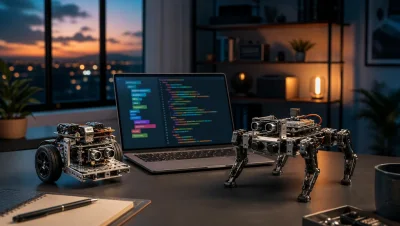
Genisom introduced L1 Maker at IROS, according to its 1 October 2026 release. It is an educational quadruped platform for assembly and development rather than a verified household appliance.
Manufacturer specifications
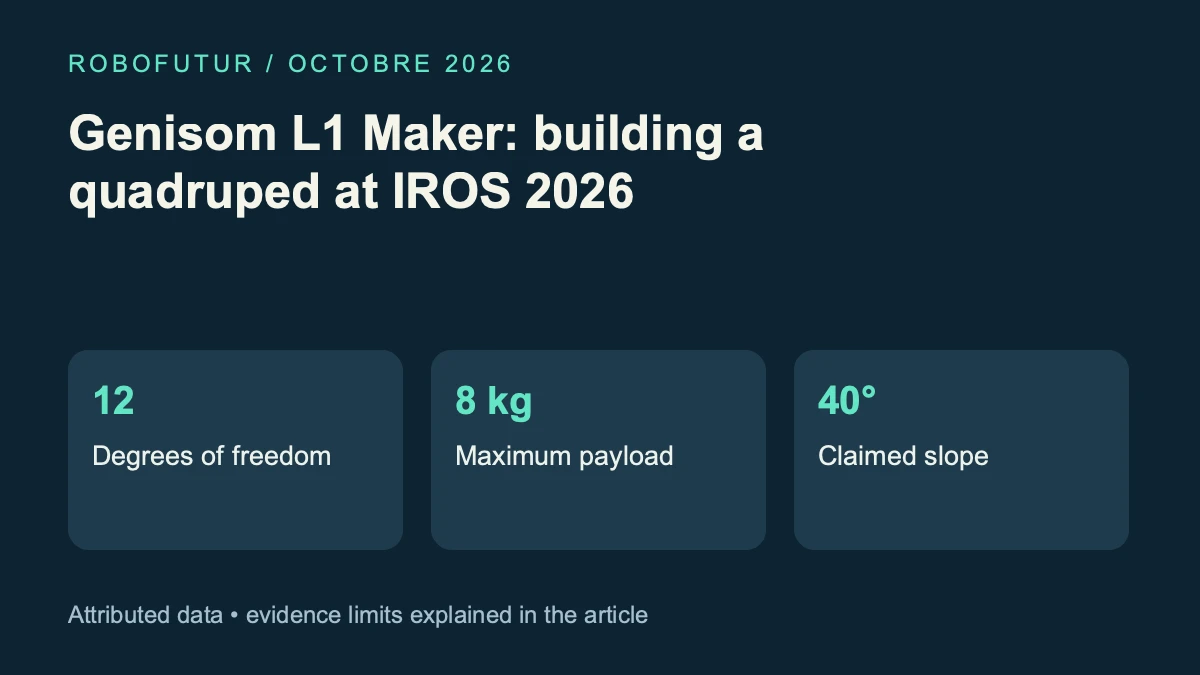
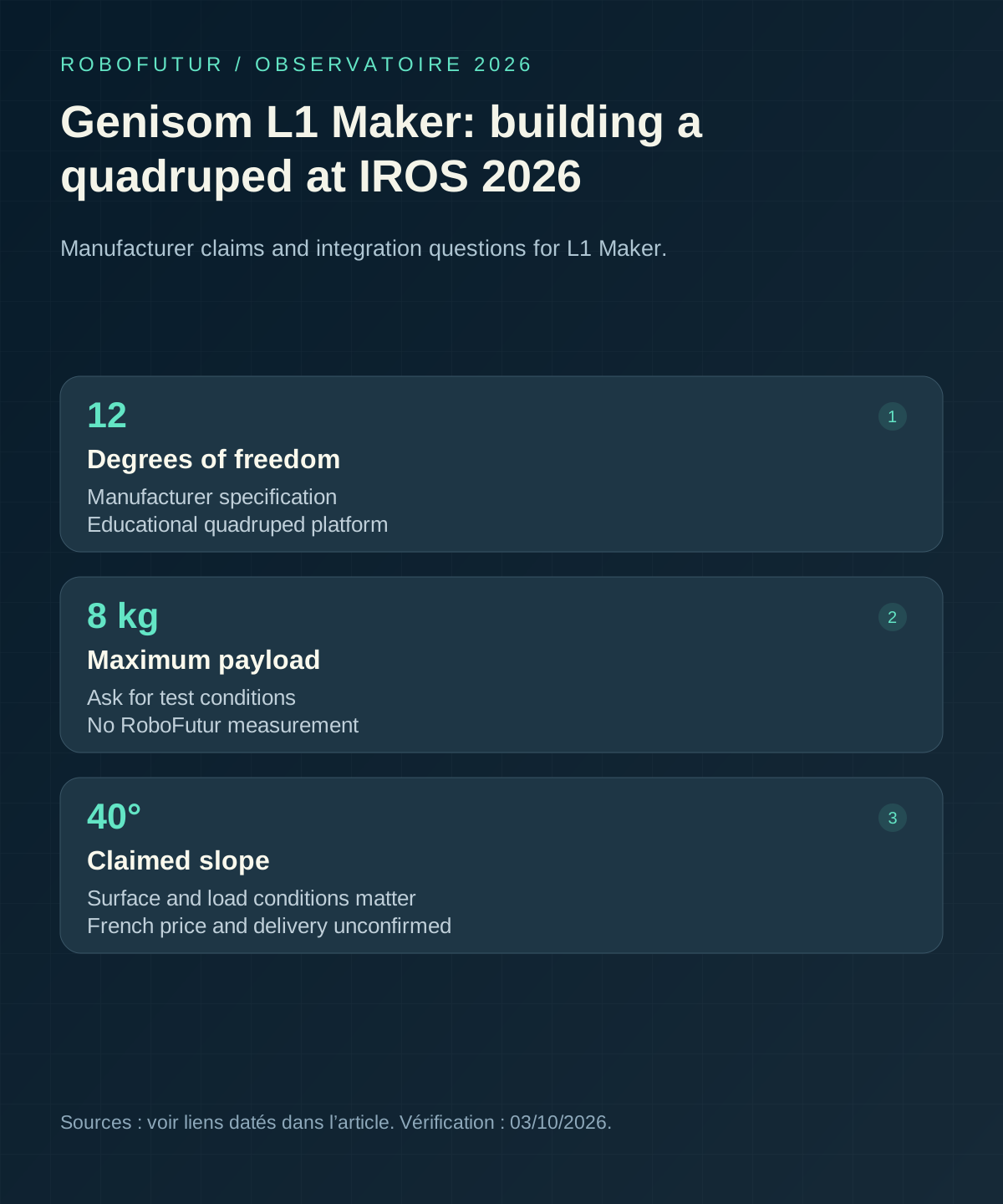
Genisom states 12 degrees of freedom, an 8 kg maximum payload and slopes up to 40 degrees, with open interfaces for additional sensors and computing. These remain manufacturer claims, not RoboFutur measurements. The announcement also describes MATRiX 2.0 simulation. A verified French price and delivery schedule are not established by the release.
Make the learning objective explicit
Our assessment is that assembly can reveal connections between mechanics, sensing and software. A class should nevertheless begin with a defined learning goal: calibrating a joint, measuring the effect of a setting or comparing a simulated trajectory with real motion. Making a machine walk once is not the same as understanding why it works.
The required level of support matters. Teachers should ask which tasks learners can perform independently and which require an experienced operator. A development platform can be rewarding while still demanding significant preparation and recovery time between sessions.
Specifications need test conditions
Payload and slope describe different tests. A meaningful comparison would include surface, load placement, trial duration, battery state, repetitions and any assistance. Combining attractive headline numbers does not create a reliability score.
Before adding hardware, a team should establish mounting points and available power. Changes to a robot’s mass distribution can alter the experiment. These are integration questions, not extra capabilities we assign to this model.
Simulation is a starting point
A first hardware transfer should use a simple, measurable scenario with a clear stop procedure. Keep failed trials alongside successful ones. The discrepancy between the simulator and the machine can itself become a useful teaching result.
A prospective buyer should request the exact kit contents, necessary tools, software support, spare parts, training and warranty terms. None should be presumed included without a documented offer. For consumer tasks, see RobotDeMaison; this announcement belongs in a development and education watchlist.
✔ How we checked this
Primary sources opened and checked on 3 October 2026. Company claims remain attributed. No RoboFutur hands-on test.
Information verified as of the publication or update date shown. Technology moves fast — check the sources below.
Sources
- L1 Maker at IROS — 1 October 2026 — GENISOM AI / PR Newswire