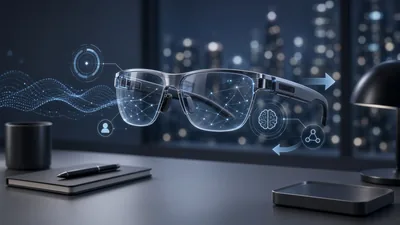
Meta Ray-Ban Display: screen glasses reach France on October 13 for 899 €

On 13 October 2026, the Meta Ray-Ban Display go on sale in France, Germany and Italy, from 899 € in Europe. It is the first time mainstream glasses with a screen, and wrist-based controls, reach the French market. Pre-orders opened with the announcement made overnight from 23 to 24 September 2026, during Meta Connect.
Three facts carry most of the story: the price, the date and the place. The rest — a monocular display in the right lens, a band that reads forearm muscles, battery figures that come from Meta rather than from independent testing — deserves a closer read before anyone hands over a bank card.
Price, date, retail
| Detail | Figure |
|---|---|
| Price in Europe | from 899 € |
| Price in the United States | 799 $ |
| Price in the United Kingdom | 749 £ |
| Price in Canada | 1,149 CA$ |
| Sale date | 13 October 2026, online and in store |
| Pre-orders | open from the announcement, 23 September 2026 |
| Cities named | Paris, Milan, Rome, Frankfurt, Hamburg, Munich |
| Prescription versions | 13 October 2026 at EssilorLuxottica in France and Italy |
The European price is higher than the US dollar price. At 899 €, these glasses sit above a high-end smartphone. For a product whose promise comes down to a small display that lights up for a few seconds at a time, that is the central question to answer.
What the display actually shows
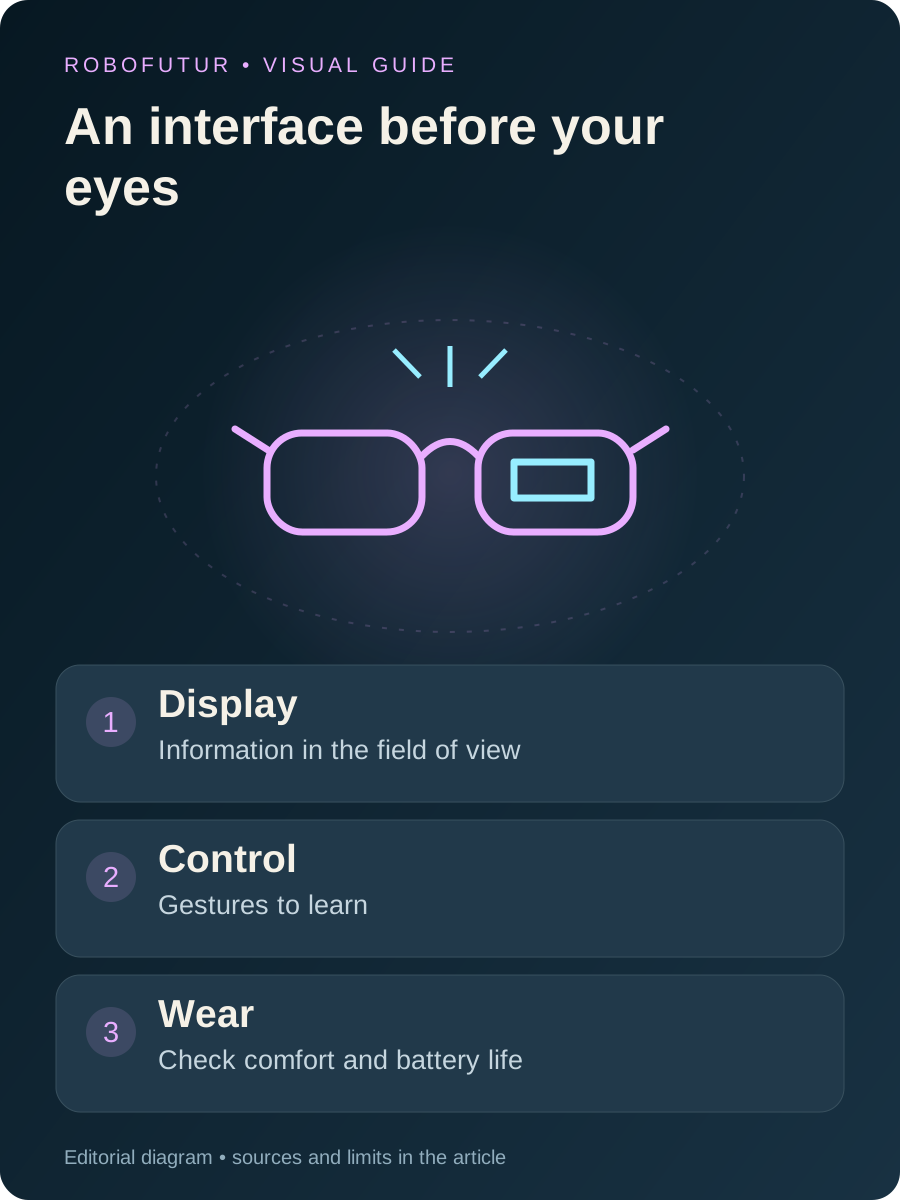
The display is in colour, but only in the right lens. Output is therefore monocular: the left eye sees nothing. Stated resolution is 600 x 600 pixels, for a density of 42 pixels per degree.
The content stays deliberately narrow: a message, a route, a photo preview, or an answer from the Meta AI assistant. Nothing is permanently overlaid in the field of view. This is an enriched notification screen, not an augmented reality platform.
That distinction matters for anyone comparing it with the rest of the market. Our smart glasses overview sorts hardware into four families: audio-camera frames, small heads-up displays, true AR, and screen-only glasses. The Ray-Ban Display sit in the second, at a price closer to the fourth.
The band: control without touching
The Meta Neural Band is the most original part of the set. It reads the electrical activity of forearm muscles through electromyography: pinching two fingers confirms, sliding the thumb scrolls. Stated battery life reaches 18 hours, and it carries IPX7 water resistance.
It answers a recurring problem with connected glasses: with no touch control on the frame, you reach for your phone. Here the gesture happens at the wrist, and your eyes stay on the street or on the route.
Battery life, as stated
Meta's relayed spec sheet gives up to 6 hours of mixed use for the glasses, and roughly 30 hours in total with the charging case. Those figures come from Meta product sheets, not from independent measurement. They describe mixed use, not continuous video playback or a full day of navigation.
Six hours makes sense for glasses you take off and put back on. It does not make sense for someone who wears them continuously. The case, which lifts the total to 30 hours, is the practical answer.
What changes for Europe
Three adjustments matter directly to a European buyer. Online purchase is possible without an in-store demonstration, which is convenient but consistent with a display that only stays on for a few seconds. GPS now covers cycling and public transport, where it previously handled mostly walking and driving. Photo retouching is part of the package.
One point is routinely misread: the version sold in France is the model already on sale in the United States since 2025. This is not a new generation. It is the opening of three European markets to the same product at the same price.
Who it is for
Three profiles look coherent. People who navigate a lot by bike or on public transport and want to check the route without taking out a phone. People who want a display for messages and voice assistance while keeping a frame that looks like a frame. And people who wear prescription lenses, since those versions exist from 13 October.
The product suits less well anyone wanting continuous augmented reality, anyone working with dense on-screen information, or anyone who simply forgets to charge. The 899 € price is justified first and foremost by the display: that is the feature the Ray-Ban Meta Gen 3 announced the same day does not offer. Our connected devices guide covers what a sensor worn all day changes, and what it does not.
The rest of the line-up
Meta Connect also introduced other hardware. The Ray-Ban Meta Gen 3 and the Ray-Ban Meta Audio, the latter without a camera, were announced the same day. The Meta VR Glasses, a 100 g headset, are targeted for spring 2027 at $1,299.99.
None of those announcements changes the price of the Display. They clarify where the screen sits in the Ray-Ban range: at the top, at a price point with nothing of an entry-level accessory about it. If what you are after is what on-device AI does without wearing a display, our NPU PC guide covers the neighbouring ground.
What remains to be checked on 13 October
Three points can only be settled by buying the product or using it: all-day comfort, display legibility outdoors, and real battery life against the advertised 6 hours. The prescription route adds a second question, since fitting happens through optical stores rather than through the online channel. Until independent tests exist, all of these remain manufacturer figures, and the 899 € price buys a specification sheet rather than a proven daily experience.
✔ How we checked this
Written from the Meta Connect 2026 announcement (overnight from 23 to 24 September 2026) and coverage from VR Expert, UploadVR and ECRTech. The stated battery figures (6 hours, 30 hours with the case, 18 hours for the band) come from Meta spec sheets relayed by those outlets; RoboFutur did not measure them.
Information verified as of the publication or update date shown. Technology moves fast — check the sources below.
Sources
- Meta Connect 2026 : le déluge de lunettes qui doit verrouiller le marché avant Samsung et Apple — ECRTech
- UploadVR — XR and VR news — UploadVR
- VR Expert — immersive news — VR Expert
- Meta — Reality Labs news — Meta