Codex in a quantum lab: automating measurements

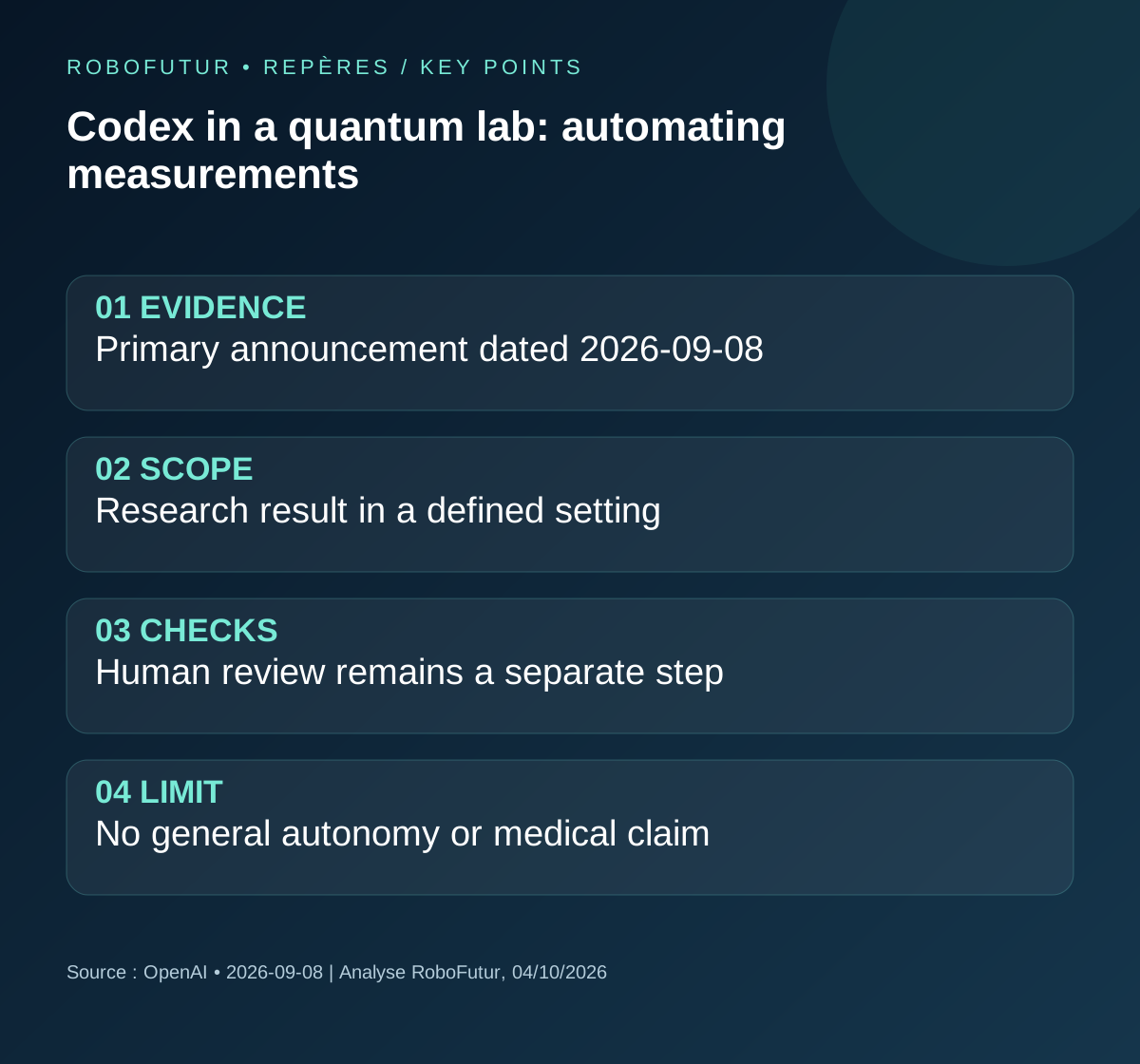
On 8 September 2026, OpenAI described MIT researcher Beatriz Yankelevich connecting GPT-5.6 Sol, through Codex, to superconducting-qubit measurement software. The case includes a six-qubit chip; weak or ambiguous signals required more expert help. This feature fills a coverage gap without claiming a new announcement this week.
A workflow of measurements
Laboratory work includes preparation, interpretation and deciding whether results are usable. Our reading focuses on controlled sequencing. A sound early measurement can support the next; an overlooked error can propagate.
Ambiguous signals matter
Evaluation should include difficult-to-interpret results. Time saved on clear cases cannot predict behaviour under unexpected conditions. Useful reports include interventions, recovery and stopping criteria alongside successful runs.
Workflow progress and hardware progress
Better equipment control does not automatically change chip properties. Software assistance, measurement quality and hardware advances should remain distinct. A calibration study is not a promise of an immediately available universal quantum computer.
What to watch next
Reproducible evaluation across varied conditions, including supervision and failures, would be useful next evidence. Result quality matters more than action counts. This feature provides a concrete experimental context for our AI-agent coverage.
Continue reading: protein-design provenance and Claude-assisted enzyme research.
✔ How we checked this
Primary source checked on 4 October 2026; announcement dated 2026-09-08. No RoboFutur experiment; editorial interpretation kept distinct.
Information verified as of the publication or update date shown. Technology moves fast — check the sources below.