SynthID Bio: tracing AI-designed proteins

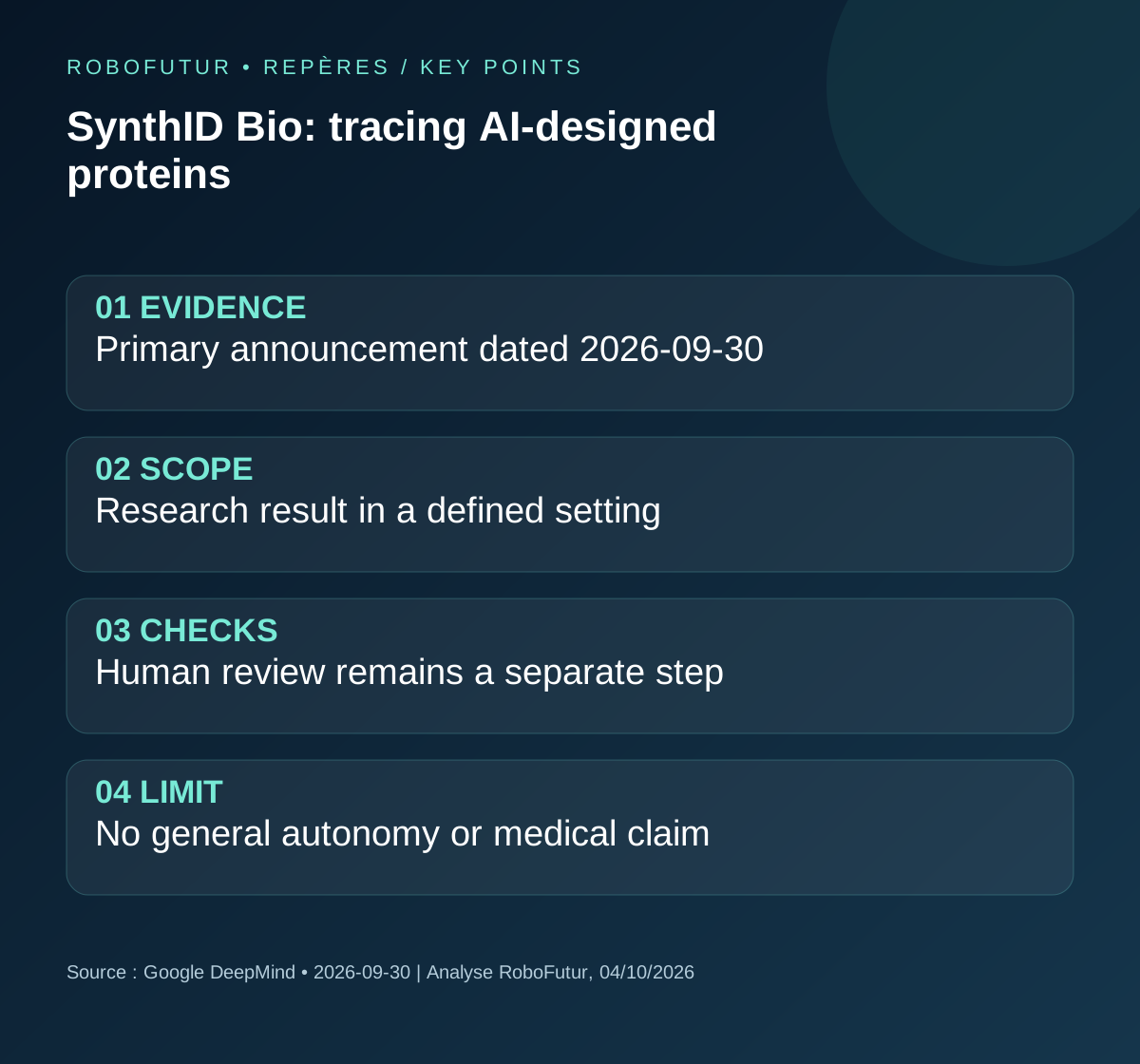
On 30 September 2026, Google DeepMind presented SynthID Bio, a proof of concept for identifying AI-designed proteins. The authors describe sequence and digital-structure watermarks, with binding tests on three targets under their experimental conditions. Deliberate tampering remains a research challenge. These results establish neither general safety nor therapeutic efficacy.
Why provenance matters
A database may contain a natural observation, a computational prediction or a manufactured molecule. Mixing those origins without a label can turn a hypothesis into an apparent observation. Our interpretation is that provenance can help identify the origin of data, while validation remains a separate task.
A signature is not a safety certificate
Recognising a design process and demonstrating safety answer different questions. Readers should ask about the validation domain, transformations tolerated and controls applied. Detectability alone confers no medical status.
What to watch next
Independent evaluation and documented provenance uses will matter next. Detection errors should be separated from changes to biological function. Comparable detection scores can conceal different test objects and conditions.
A different question from drug discovery
This feature concerns the origin of biological designs. Mechanistic understanding and clinical validation require their own evidence. The distinction helps readers avoid turning a useful research tool into an unsupported treatment promise.
Continue reading: AlphaGenome variant predictions and Claude-assisted enzyme research.
✔ How we checked this
Primary source checked on 4 October 2026; announcement dated 2026-09-30. No RoboFutur experiment; editorial interpretation kept distinct.
Information verified as of the publication or update date shown. Technology moves fast — check the sources below.
Sources
- SynthID Bio: tracing AI-designed proteins — 2026-09-30 — Google DeepMind