One cancer in eight may be preventable: what the global Lancet Oncology study found
About 12% of new cancer cases worldwide, or 2.3 million cases in 2024, are attributable to infections, according to a study published in The Lancet Oncology. Five infections are involved, and three pathogens are named: Helicobacter pylori, human papillomavirus (HPV) and the Epstein-Barr virus.
Before going further, one clarification that belongs inside the article.
Reliability warning
The primary The Lancet Oncology article could not be opened. What follows rests on reporting by Newsweek, Medscape, People, MedPage Today, Discover, Deccan Herald, Health&Me, Medical Xpress and News18, dated September 28 to 30, 2026.
Three consequences, stated plainly. The exact denominator of the estimate was not verified, so "one in eight" is a rounded value rather than a controlled quotient. The total number of cancer cases worldwide was not verified, and no total is given here for that reason. The study's author list could not be consulted.
The three key figures — 12%, 2.3 million and five infections — are instead reported consistently by at least eight independent outlets, which is a strong coherence signal. That is a point of trust, not a weakness: you know exactly what is verified and what is not.
What the study says
The reasoning is one of attribution: across all new cancer cases worldwide, what share would be due to an avoidable infection rather than other causes?
| Element | What is reported |
|---|---|
| Share of new cases | About 12%, roughly 1 in 8 |
| Associated volume | 2.3 million new cases in 2024 |
| Infections implicated | 5 |
| Named pathogens | H. pylori, HPV, Epstein-Barr virus |
| Reference year | 2024 |
| Media framing | "Preventable" |
The important word is "would". The accounts describe a model, not an individual count. Nobody, in this estimate, follows a patient to determine after the fact what caused their disease. The 2024 reference year points the same way: it corresponds to a modelling exercise, of the kind large world databases produce to estimate avoidable fractions.
The reversal
The value of this study is not the number. It is the shift in perspective it performs.
A substantial share of cancers has long been presented as a lottery: mutations that accumulate, a threshold crossed, a chance no behaviour controls. The infection hypothesis removes a fraction of that lottery. It does not say cancer is contagious in the ordinary sense, or that a patient caught their tumour. It says an identifiable number of cancers develop from an infection that was present, often for years, and that could have been prevented.
That shift has an immediate practical consequence. Where the cause is biological chance, the answer is screening and treatment. Where the cause is an avoidable infection, the answer may be vaccination, targeted screening, or curative treatment of the infection itself.
This is where the two classic interventions come in. A vaccine exists against HPV. An infection with Helicobacter pylori is treated with antibiotic therapy aimed at eradicating the bacterium. These tools exist, are deployed in many countries, and are not experimental. What the study offers is a measure of their weight at global scale.
What "preventable" does not mean
Three limits deserve setting out, because "preventable" framing is easy to turn into a sales pitch.
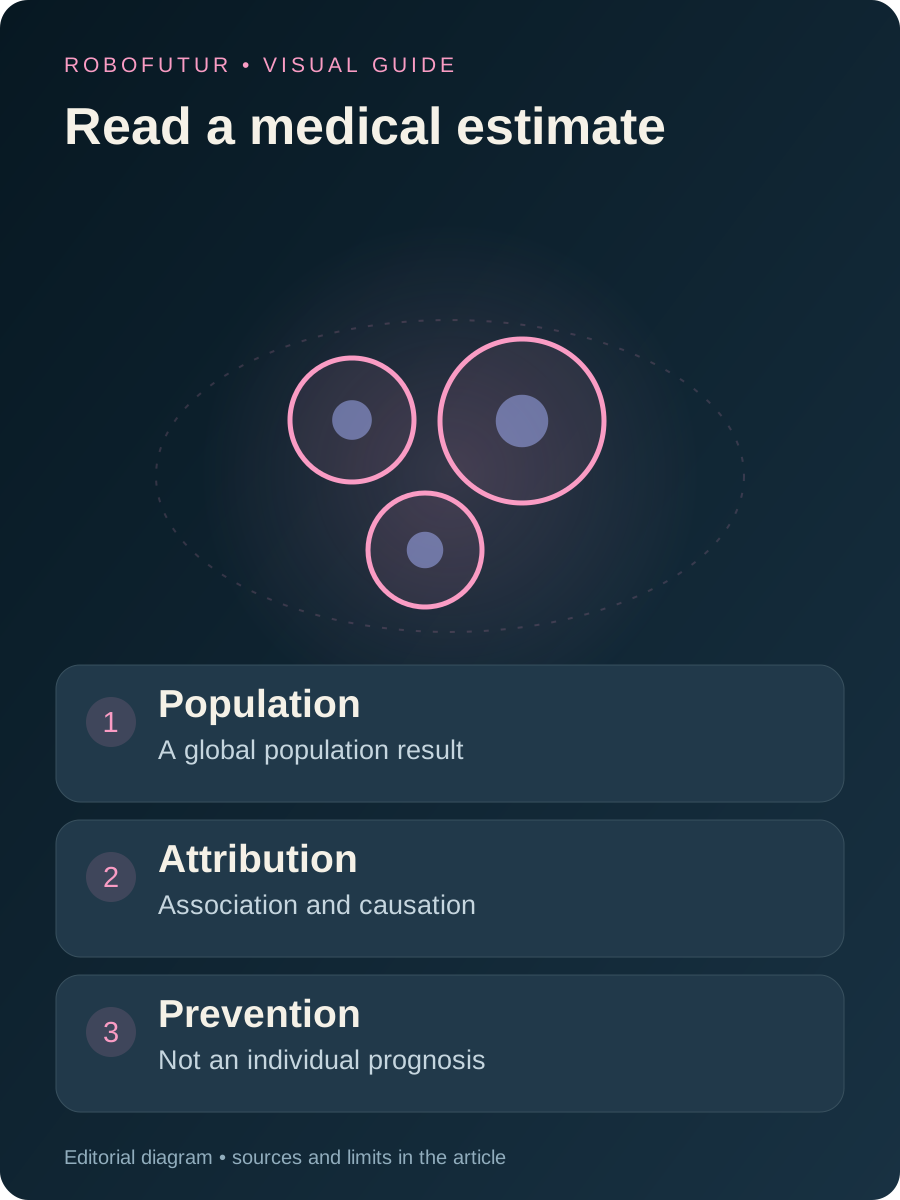
Preventable at the population level does not mean an individual case is entirely preventable. It indicates an attributable fraction: a share of risk that could have been removed upstream, not a destiny. Cancers linked to infection remain multifactorial diseases.
The term does not mean a given infection guarantees cancer either. The overwhelming majority of infected people do not develop cancer. The estimate covers a fraction, and that fraction is not the same across countries, ages, sexes, socioeconomic levels or access to care.
Finally, preventable does not mean already prevented. The gap between what an estimate designates as avoidable and what public health programmes actually achieve does not close on its own. A dietary supplement and a clinical trial do not have the same capacity to move that number. What cancer medicines have actually changed concerns treatment; this study concerns upstream, which is often the cheaper lever. Our file on CRISPR therapies recalls the difference between a lead and an authorised tool.
The context of the warning
The study arrives in a context that sharpens it. The WHO warned in July 2026 that annual cancer cases could almost double by 2050 without stronger action.
If a measurable fraction of those cancers is linked to avoidable infections, then part of that trajectory is not an arithmetic inevitability. It depends on vaccination, screening and curative treatment. That is the real reach of the number: not a prediction, but a shift of part of the problem towards levers that already exist.
What the modelling alone cannot settle remains: how many of these infections are actually prevented today, in which regions, and with what resources. Public surveillance data on HPV vaccination and on H. pylori eradication are not consistent across countries. A fraction that is avoidable in theory can remain largely avoidable in practice. That is the point on which our assessment of what longevity claims from big tech are really worth offers a useful counterweight: the announced potential of an innovation never measures what will actually be available.
Verdict
About one cancer in eight may be linked to an infection, and some of those infections are preventable or treatable. That is the most actionable information in this study, and it is solid both in its figure and in its limit.
Three caveats stay attached to the file. The primary article was not opened, so the denominator, the worldwide case total and the author list remain unverified. "One in eight" is a modelled estimate, not a count. And attribution to an infection removes nothing from the other factors involved in cancer.
What has not changed: HPV vaccination, targeted screening and treatment of H. pylori infections are real interventions, already available, whose effectiveness is no longer in question. The debate has moved to coverage, not to principle.
✔ How we checked this
Facts checked October 1, 2026 from Newsweek (September 28), Medscape (September 30), People (September 30), MedPage Today (October 1), Discover (September 29), Deccan Herald, Health&Me, Medical Xpress and News18 (September 28-30). The primary The Lancet Oncology article could NOT be opened, so the exact denominator, the total number of cancer cases and the author list were not directly verified. The figures cited are those reported consistently by at least eight independent outlets. No worldwide cancer case total is given here, because none was verified. No medical advice.
Information verified as of the publication or update date shown. Technology moves fast — check the sources below.
Sources
- The Lancet Oncology — The Lancet
- MedPage Today — MedPage Today
- Medical Xpress — Medical Xpress
- Medscape — Medscape
- World Health Organization — World Health Organization