AlphaGenome Atlas: predictions are not diagnoses
Announced on 8 September 2026, AlphaGenome Atlas contains precomputed molecular-effect predictions for roughly nine billion single-letter substitutions in the human genome, according to Google DeepMind. This 4 October feature fills an earlier coverage gap rather than claiming a new announcement within the past fortnight.
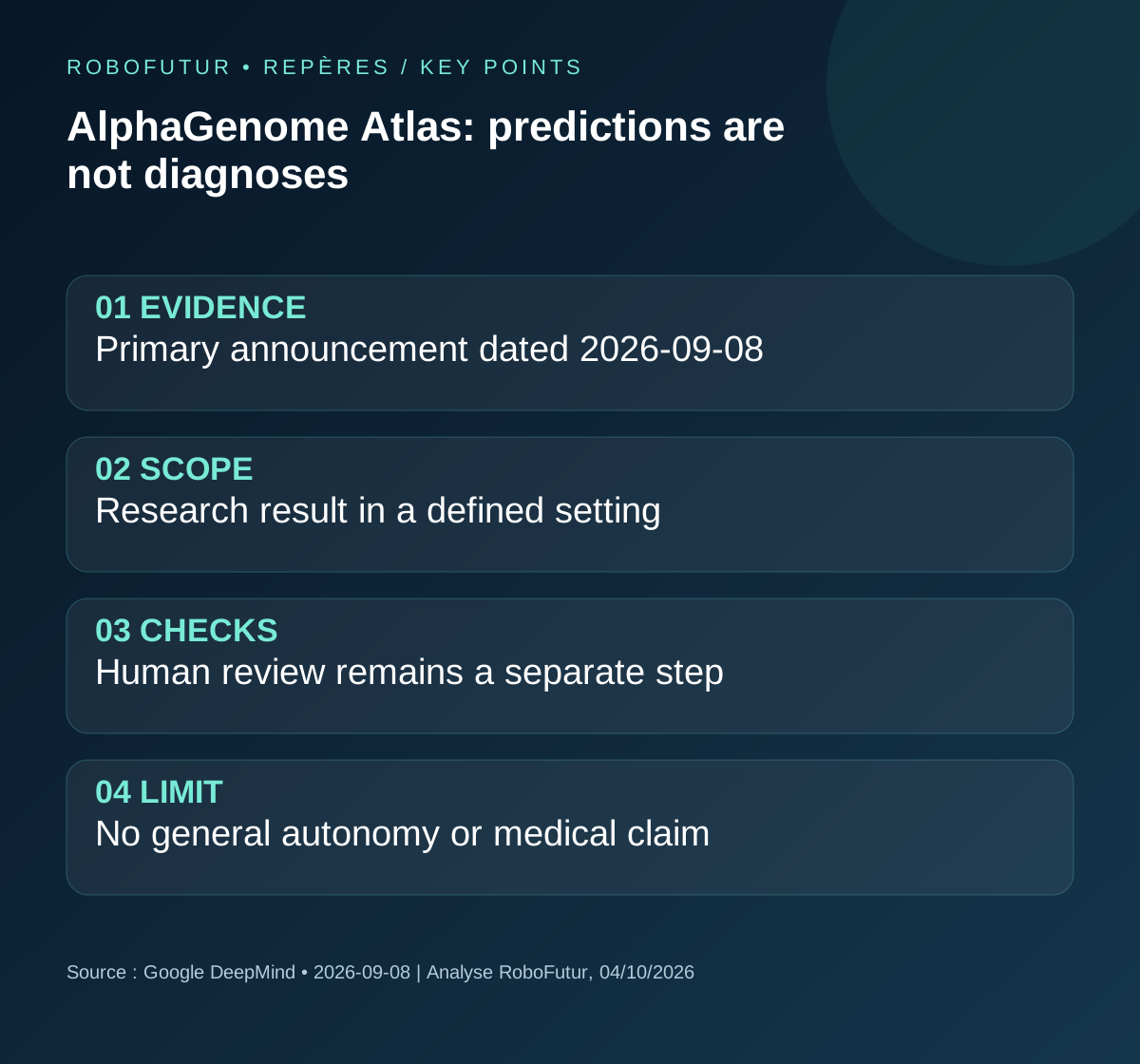
Scale and interpretation
A catalogue of possible changes is not a count of variants observed in people. Understanding a prediction requires its context and target. Computational scale and confidence in one conclusion are separate dimensions.
From signal to diagnosis
A prediction can help prioritise an experiment or hypothesis. It cannot establish causation in a patient by itself. Keeping observations, model outputs and researcher interpretation separate makes conclusions easier to audit.
Why precomputed results help
Precomputed outputs can help a team compare hypotheses before starting individual runs. Experimental selection remains scientific work. A high score does not automatically identify a mechanism, risk or intervention.
What future studies should document
Useful evaluations should explain their datasets, training and evaluation separation, failures and experimental confirmation. This research coverage does not interpret individual medical records.
Continue reading: Claude-assisted theoretical physics and Claude-assisted enzyme research.
✔ How we checked this
Primary source checked on 4 October 2026; announcement dated 2026-09-08. No RoboFutur experiment; editorial interpretation kept distinct.
Information verified as of the publication or update date shown. Technology moves fast — check the sources below.
Sources
- AlphaGenome Atlas: predictions are not diagnoses — 2026-09-08 — Google DeepMind