AI Wearables in 2026: Uses and Limits of Glasses, Pins and Rings
Between 2024 and 2026, the AI wearable market tested several formats. Humane’s pin stopped working when its services shut down, while smart rings and glasses continue to evolve. A useful comparison now focuses on everyday value, cloud dependence, support life and the data each device records.
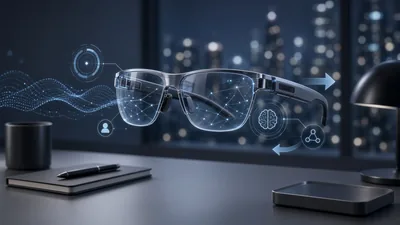
Smart glasses: the most established format
Meta now sells a full price ladder, and these prices are confirmed on its own store: an entry line simply called Meta Glasses from $299, announced in June 2026; Ray-Ban Meta Gen 2 camera glasses from $379; Oakley sport models between roughly $399 and $499; and Ray-Ban Display at $799, which pairs a small monocular screen with the wrist-worn Neural Band controller. The Display model launched with in-store demos and limited stock in the US, and its international rollout — Canada, France, Italy, the UK — was announced for early 2026.
One caveat applies to every camera-equipped wearable: it creates the same bystander problem we detailed in our breakdown of the four kinds of AI glasses. A small recording light is not the same thing as consent. Unannounced product rumours are deliberately excluded until a manufacturer publishes specifications and availability.
The camera-free alternative
A second school of glasses removes the camera entirely. The Even Realities G2 ($599) is a 35-gram frame with a monochrome heads-up display for translation, navigation and meeting notes — no camera, no speakers, and a battery the company claims lasts about two days. Reviewers consistently praise the hardware and criticise the software's dependence on a paired phone. Halliday follows a similar route at $499 with a tiny module that beams a display toward one eye; early independent reviews found the concept ambitious and the execution frustrating.
What camera-free designs genuinely solve is privacy at the hardware level: a device with no lens cannot record the people around you. What they do not solve is usefulness — a glanceable display is a convenience, not a revolution, and most of its features already exist on your phone.
What Humane's collapse teaches
The AI pin category effectively died on 28 February 2025. That day Humane, which had sold its Ai Pin for $699 plus a $24 monthly subscription, switched off its servers after HP bought most of its assets for $116 million — without the pin business itself. Humane's own notice confirmed the devices would "no longer include calling, messaging, Ai queries/responses, or cloud access". Refunds covered only recent shipments; earlier buyers were left with a paperweight unless they flashed community-built firmware.
The lesson generalises to every product on this page. Before buying any AI wearable, ask three questions: what still works if the maker's servers disappear, what the refund policy actually covers, and whether the device can be used offline at all. A cloud-only wearable is a subscription with hardware attached, not a product you own.
Smart rings: a discreet format, with or without a subscription
Smart rings avoided both the camera controversy and the pin collapse, and mid-2026 pricing is stable. The Oura Ring 4 starts at $349 (up to $499 in gold) but needs a membership at $5.99 per month or $69.99 per year to unlock most features. Samsung's Galaxy Ring costs $399 with no subscription. The RingConn Gen 3 costs $349 to $369, also subscription-free, and claims up to 14 days of battery plus an automated sleep-apnoea risk assessment — a manufacturer claim and a screening aid, not a medical diagnosis.
Do the total-cost maths before choosing on sticker price: over three years, an Oura Ring 4 with membership comes to roughly $559, more than either subscription-free rival. Rings track sleep, heart rate and temperature well. None replaces a doctor, and all of them send intimate health data to a cloud whose retention policy you should actually read.
How to choose for your use case
Camera glasses from $299–$379 may suit people who accept their recording constraints. A smart ring is useful only if its measurements genuinely inform your habits. Display glasses at $799 remain a first generation with few apps. In every case, check which functions remain if the maker shuts down its servers.
Also remember that translation, voice assistance and reminders — the core of most wearable pitches — already run free on the phone in your pocket, as our roundup of free AI tools shows. And if what you really want is ambient AI at home rather than on your face, a smart speaker does the job for a tenth of the price.
More hardware reality checks in Gadgets & Tech.
✔ How we checked this
Prices and availability were checked against manufacturer stores and at least two independent reviews in July 2026. Manufacturer battery and health claims are labelled as claims, not verified facts.
Information verified as of the publication or update date shown. Technology moves fast — check the sources below.
Sources
- Meta AI Glasses: Ray-Ban Meta & Oakley Meta — Meta
- Meta announces new smart glasses starting at $299 — CNBC
- HP acquiring parts of AI Pin startup Humane for $116 million — Fortune
- Samsung Galaxy Ring vs. Oura Ring 4 — Tom's Guide
- Even Realities G2 smart glasses review — Tom's Guide
- RingConn Gen 3 smart ring — RingConn