Microduck: the $399 robot pet is really an open RL lab
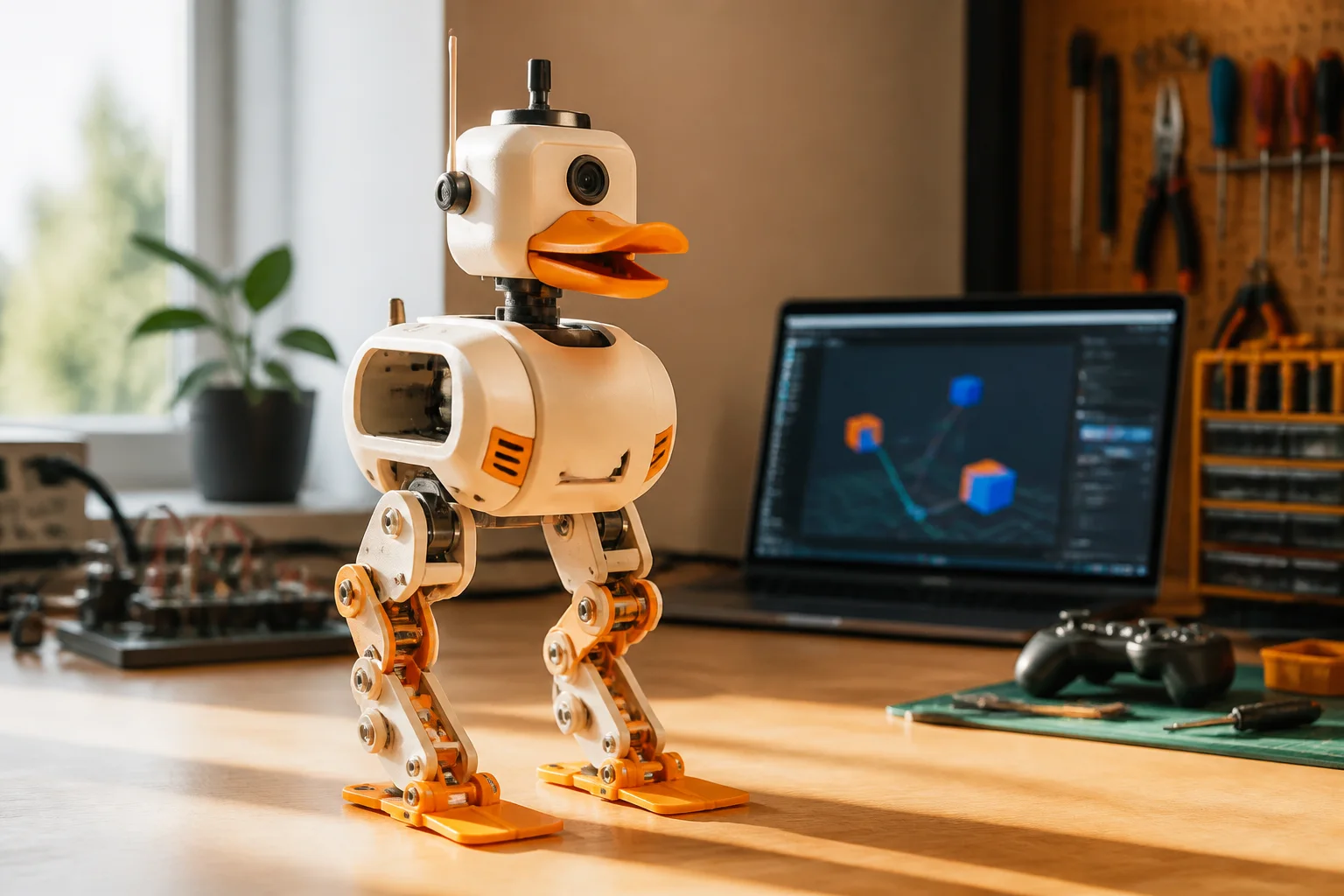
Microduck looks like a robot pet, but its most interesting feature is not the beak or the quack. The 25-centimetre biped from Pollen Robotics, now part of Hugging Face, is a compact reinforcement-learning platform whose control software, simulator and training environments are published for developers to inspect and modify.
Preorders opened on August 27, 2026 at an introductory price of $399 before tax and shipping. Pollen says the robot should arrive with seven learned behaviours and that early orders are intended to ship before Christmas. Those are sales commitments, not completed deliveries. No independent review has yet measured battery life, fall resistance, motor wear or how easily a buyer can reproduce the advertised training workflow.
What the $399 base robot includes
Pollen lists a height of 25 cm and a mass of roughly 800 g. Fifteen motors move the legs, head and beak mechanism. Perception includes a camera, a small LiDAR and two inertial measurement units. The computer is based on a Rockchip RK3566, with radios for Wi-Fi and Bluetooth and a 50 Hz onboard policy loop.
The box is advertised with the robot, one battery, a USB-C cable and a game controller. Optional packs add spare batteries, motors, cables, NFC tags, a laser pointer, a ball and passive roller attachments. The $399 figure therefore describes the base preorder, not every configuration.
Out of the box, Microduck is shown walking, sitting, standing, kicking a light ball, grabbing a small object with its beak, moving on rollers and recovering after a fall. Several actions can be triggered directly by a controller. Calling all of this “AI autonomy” would be misleading: some movements are trained policies, while the person still selects commands and sets the context.
Why this is more than a connected toy
Most consumer robot pets hide their control stack. Microduck’s repositories expose a different proposition. The runtime is written as several services that manage the motors, sensors, Bluetooth, configuration, media and software updates. The control process runs neural policies exported in ONNX format.
The companion reinforcement-learning repository provides MuJoCo environments, PPO training, actuator modelling, domain randomisation and export tools. A developer can train a behaviour in simulation, test it against varied virtual conditions, export the resulting policy and deploy it to the real robot.
That pipeline matters because collecting thousands of failed movements on physical hardware is slow and destructive. Simulation lets an agent practise at scale without wearing out motors or repeatedly throwing a robot onto the floor. Domain randomisation changes friction, delays and other parameters so the policy is less dependent on one perfect virtual model.
“Train it yourself” still requires engineering
Open code lowers the barrier, but it does not remove it. Pollen’s quickstart expects a CUDA-capable GPU for local training, or access to paid or limited cloud compute. A useful gait can require many parallel simulated environments and careful reward design. Transferring the result to hardware can still expose differences in backlash, battery voltage, surface grip and motor temperature.
The robot’s small size makes experiments safer than on a full humanoid, not risk-free. A badly trained policy can fall from a desk, pinch an object in the beak or overwork a joint. Buyers should treat community policies like software from any external source: inspect permissions and origin, keep the robot in a clear space and preserve a simple stop path.
The published stack also creates a privacy question. Open source makes code auditable, but a camera and microphone can still send data if an installed application is configured to do so. Transparency is a tool; it is not an automatic privacy guarantee.
Robot animal, home robot or developer gadget?
Microduck belongs most clearly in the developer-gadget category. Its duck form makes balance failures readable and emotionally forgiving. A fall looks like part of the character, while recovery is also a serious locomotion benchmark. That design may help students understand that physical AI is probabilistic and imperfect.
It is not a substitute for a pet. It has no biological needs or reciprocal animal behaviour. It is also not a domestic servant: 800 g of hardware and a beak gripper cannot carry laundry, load a dishwasher or clean a room. The sensible comparison is with programmable robots and electronics kits, not with a dog or a general-purpose home humanoid.
The charm is strategically useful. Robotics education often starts with wheels because balancing legs is difficult. Microduck packages a biped, simulation and modern policy training at a price much lower than research humanoids. If the tooling works as advertised, a classroom can move from commanding joints to testing learned locomotion without buying laboratory-scale hardware.
What must be tested after delivery
The first question is whether the preorder ships on schedule and whether replacement parts remain available. The second is reproducibility: can an independent developer clone the repositories, train a policy, deploy it and recover cleanly from a bad update?
Durability will be equally important. Repeated falls are a marketing feature only if shells, gears and cables survive them. Battery runtime should be measured under walking and training loads rather than idle use. Wireless setup, update signing and rollback behaviour also need real-world scrutiny.
Finally, “open source” should be checked as a complete experience. Published code is valuable, but documentation, hardware schematics, firmware access and the ability to repair the robot determine how open the product feels after purchase.
RoboFutur verdict
Microduck is one of the more honest robot launches of 2026 because its ambition is bounded. It does not promise to run a household. It offers a small moving body, seven initial behaviours and an inspectable sim-to-real workflow for $399 before tax and shipping.
The product is still a preorder, so delivery and reliability remain announced rather than proven. If independent users reproduce the training pipeline and share behaviours without breaking hardware, Microduck could become a useful bridge between an educational toy and a robotics lab. The duck shape gets attention; the open control loop is the real story.
✔ How we checked this
Checked on September 2, 2026 against Pollen Robotics’ product page, Apache-2.0 runtime and reinforcement-learning repositories, then cross-checked with TechCrunch and Axios. Price and specifications are preorder information; delivery, durability and learning claims have not yet been independently tested on retail units.
Information verified as of the publication or update date shown. Technology moves fast — check the sources below.
Sources
- Microduck product page and specifications — Pollen Robotics
- Microduck open-source runtime — Pollen Robotics / GitHub
- Microduck reinforcement-learning environments — Pollen Robotics / GitHub
- Hugging Face is selling a cute $399 open source duck robot — TechCrunch
- Hugging Face debuts Microduck robot — Axios