Why Elon Musk is betting Tesla's future on Optimus
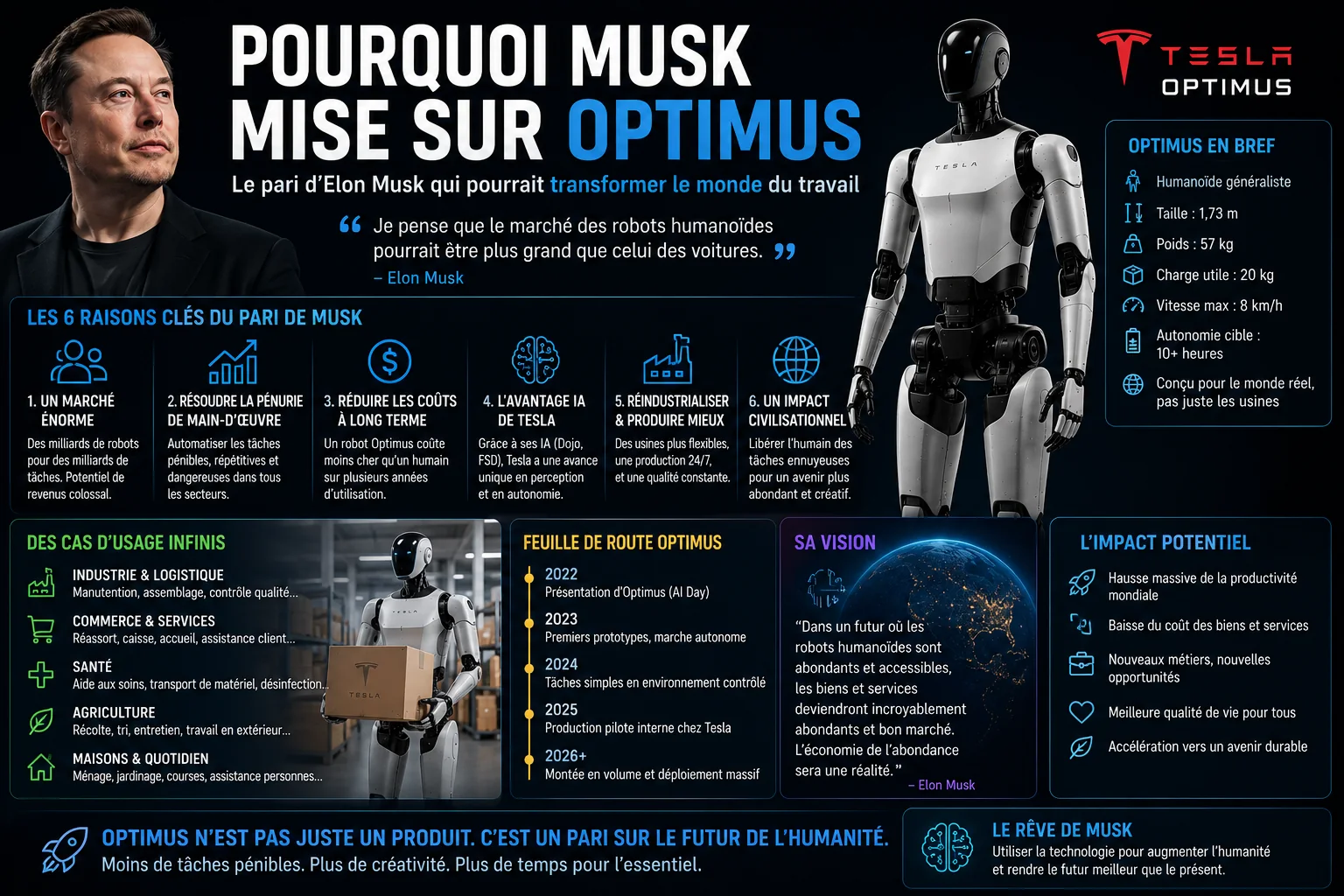
Tesla is treating Optimus as more than a side project. The logic is easy to see: if a company can build an affordable robot that performs useful physical work, the market could extend far beyond cars. Tesla's public mission frames Optimus around unsafe, repetitive and boring tasks, while its latest master plan places robots alongside vehicles and energy products.
The bet is strategically coherent. It is also far from proven. A humanoid factory prototype, a mass-produced machine and a dependable worker are three separate achievements.
Tesla already owns several pieces
An electric humanoid needs batteries, motors, power electronics, thermal management, sensors, compute and software. Tesla develops many of those areas for vehicles and operates large manufacturing plants. Its factories also offer a controlled place to test robots on real internal tasks before selling them elsewhere.
The AI connection is equally important. A car interprets cameras and acts in a changing physical environment; a humanoid must also understand scenes and control movement. The problems are not identical—hands and contact make manipulation much harder—but Tesla can reuse data infrastructure, training expertise and custom computing.
Finally, Tesla knows how to design for manufacturing cost. Many robotics companies can build a remarkable prototype. Fewer have taken complex electromechanical products to high volume. Optimus is a wager that Tesla's industrial system can compress the price of actuators and robot hardware as it did for some vehicle components.
What Tesla has actually committed to
In its Q4 2025 investor update, Tesla described the third-generation Optimus as a design intended for mass production. It targeted a reveal in the first quarter of 2026, production before the end of the year and eventual capacity of one million units annually. Its Q1 2026 update described investment and preparation for large-scale production.
Those documents are stronger evidence than an unsourced social post, but they still express management plans. “Eventual capacity” does not mean one million working robots have been ordered or built. Production starts can slip, initial yields can be low and hardware can change after real-world failures.
Tesla also discloses fewer current product specifications than Boston Dynamics does for Atlas or Unitree does for G1. There is no public, independent benchmark showing an Optimus completing a representative work shift with measured uptime, intervention rate and cost per useful task.
Why a human shape?
Factories, warehouses and homes were designed around human reach, doors, stairs and tools. A humanoid can theoretically enter those spaces without rebuilding everything. Two arms and mobile legs could let one platform perform different tasks as software improves.
But the human shape is not automatically optimal. Wheels are more efficient on flat floors, fixed robot arms are more precise, and dedicated machines are easier to certify. Optimus must justify its extra mechanical complexity by switching between enough valuable tasks.
The economics Tesla needs to prove
The useful metric is not the purchase price alone. It is cost per successful task, including maintenance, charging, supervision, insurance, downtime and integration. A robot that costs less but needs frequent human rescue may be more expensive than conventional automation.
Safety is another gating factor. A mobile machine working near people needs predictable behaviour, emergency controls, cybersecurity and clear responsibility when something goes wrong. Workplace deployment will also involve regulators, employees and unions—not only engineering.
A bet worth watching, not pricing in as fact
Optimus could become important even if the most ambitious timelines fail. Tesla may lower component costs, establish a supply chain and force competitors to make their capabilities measurable. Its factory provides a credible test environment, and scale is a genuine advantage.
The correct conclusion is narrower than the hype: Tesla has a plausible industrial strategy for humanoid robots and has publicly committed resources to it. It has not yet demonstrated a general-purpose worker at mass-market scale. Compare the available evidence in our top five humanoids of 2026 and our analysis of jobs exposed to AI before turning a manufacturing plan into a labour-market forecast.
✔ How we checked this
We distinguish Tesla's filed investor statements from executive forecasts. Production timing and eventual capacity are plans, not independently verified results.
Information verified as of the publication or update date shown. Technology moves fast — check the sources below.
Sources
- Tesla AI and Robotics — Tesla
- Master Plan Part IV — Tesla
- Q4 2025 Update — Tesla Investor Relations
- Q1 2026 Update — Tesla Investor Relations