AI stethoscope in pets: strong in dogs, poor in cats
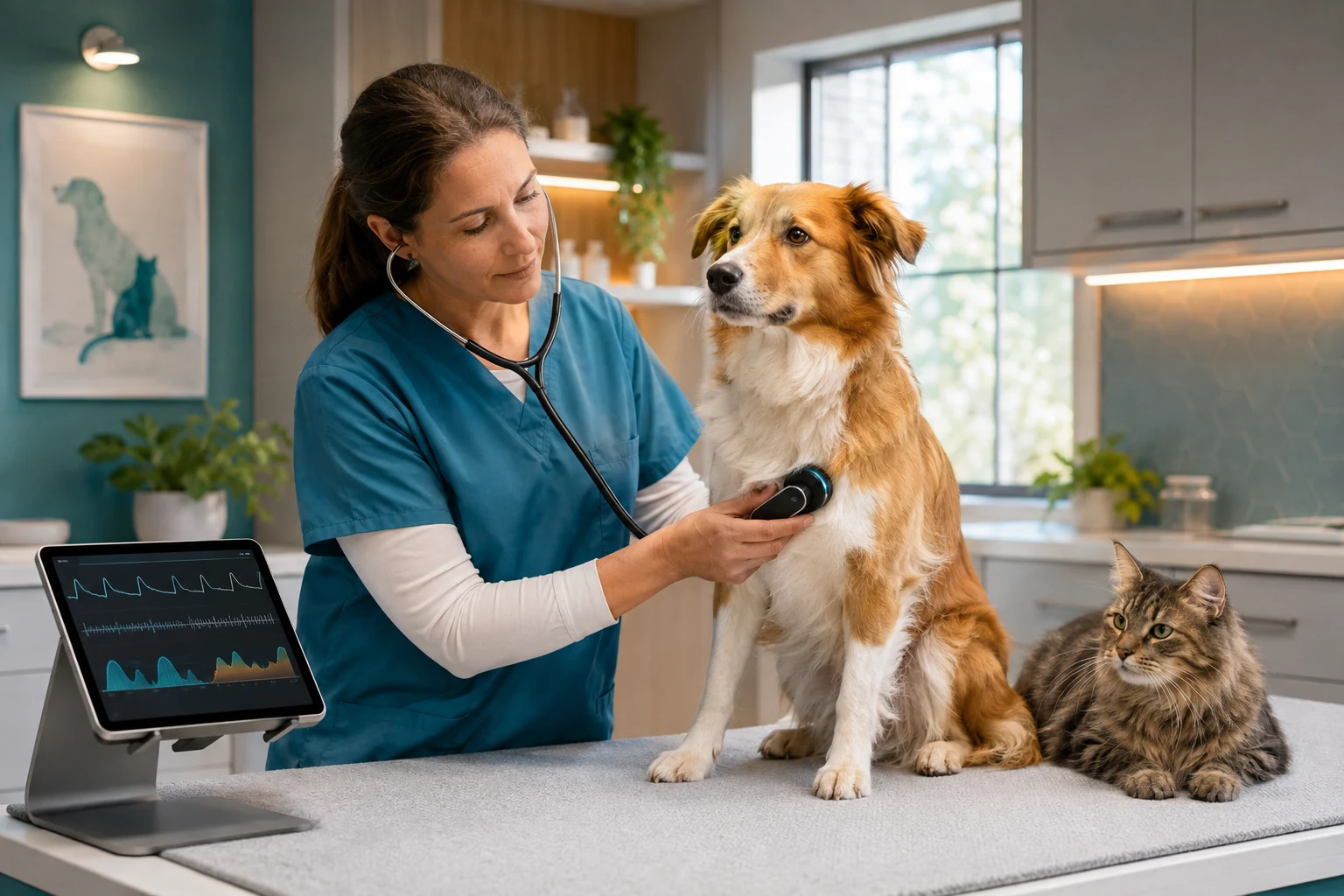
A digital stethoscope trained for people detected most heart murmurs in dogs, but it missed 20 of 22 murmurs in cats and generated unreliable rhythm alerts in both species. That is the central result of a prospective study published in the Journal of the American Veterinary Medical Association on August 5, 2026.
The result is neither a blanket rejection of veterinary AI nor evidence that a consumer gadget can diagnose a pet. It is a useful boundary test: an algorithm that performs a defined task in human medicine may not transfer cleanly across species, body size, heart rate and acoustic anatomy.
Evidence level
- prospective diagnostic-accuracy study;
- 105 client-owned animals: 54 dogs and 51 cats;
- examinations conducted from August 1 to December 31, 2025;
- one human-trained Eko Core 500 digital stethoscope;
- comparison with a board-certified veterinary cardiologist, a cardiology resident and a fourth-year veterinary student;
- six-lead ECG and echocardiography when clinically indicated;
- peer-reviewed publication, not a regulatory authorisation trial;
- no conclusion about every digital stethoscope or every veterinary AI model.
The sample is large enough to reveal a striking species gap, but too small to establish performance across breeds, ages, disease types and clinical settings.
What the researchers actually tested
The team at North Carolina State University recruited pets presented for cardiology evaluation. Each animal was auscultated by three human examiners with different experience levels. The digital device also recorded sounds and returned automated classifications.
The reference process did not rely on a single listener. The animals received a six-lead electrocardiogram, and echocardiography was used when indicated to investigate structure and blood flow. That matters because a murmur is a sound, an arrhythmia is an electrical rhythm problem, and neither label alone is a complete diagnosis.
The tested system was designed and trained for human patients. Dogs and cats were an out-of-domain population. Cats typically have faster heart rates and smaller hearts; respiratory sounds, purring, movement and handling can further complicate recordings. The study therefore asks whether a human model transfers—not whether a purpose-built veterinary model has reached its ceiling.
Dogs: useful sensitivity, weak specificity
Veterinary assessment identified murmurs in 38 of the 54 dogs. The device flagged 33 of those 38 cases. That corresponds to sensitivity of 86.8%: it missed five dog murmurs.
Sensitivity is only half of a screening result. Specificity was 56.3%, meaning the system also labelled a substantial share of dogs without a reference murmur as positive. Its positive predictive value was 82.5% in this particular referral cohort.
Those numbers cannot be reduced to “87% accurate.” Accuracy depends on the mix of affected and unaffected animals, while a referral hospital can have a much higher prevalence of cardiac findings than an ordinary clinic. A tool that catches many true murmurs but produces frequent false alerts may help direct attention; it cannot replace clinical interpretation.
Cats: the transfer failed
The feline result was far more severe. Human examiners identified 22 cats with murmurs. The device detected only two, for sensitivity of 9.1%. Twenty cat murmurs were missed.
This is not a marginal performance difference. In the tested population, a reassuring automated output would have been unsafe to treat as a rule-out. The authors’ conclusion is appropriately narrow: this device demonstrated moderate murmur detection in dogs but not cats.
The study does not determine exactly why. Species acoustics, high heart rate, signal quality and a human training set are plausible contributors, but identifying their relative effects requires new experiments.
Arrhythmia alerts were unreliable
Rhythm classification was problematic in both species. The system identified all six dogs with confirmed atrial fibrillation, but it also generated 22 false-positive atrial-fibrillation alerts. In the study’s dog group, it did not classify any dog as free of arrhythmia.
That combination shows why a high-profile success metric can mislead. Detecting all six true cases sounds excellent until the false alerts and the absence of normal classifications are included. An automated label may prompt an ECG; it is not an ECG result.
The publication describes arrhythmia classification as unreliable in both dogs and cats. That distinction should remain visible in product design: signal capture, murmur screening and rhythm diagnosis are separate tasks with separate evidence.
Why species-specific AI may do better
Another 2026 peer-reviewed study developed deep-learning models specifically for canine heart sounds. That work supports the scientific plausibility of veterinary-focused classification, but it does not rescue the device tested here. Different datasets, labels, microphones, clinics and validation designs produce different performance.
A credible veterinary system needs representative recordings across species, breed, body size, heart rate, disease severity and background noise. It also needs external validation at clinics that did not create the training data. Performance should be reported as sensitivity, specificity and calibration—not as a single marketing percentage.
Regulatory and practical status
This was a diagnostic-accuracy study of an existing human-oriented device used experimentally in animals. It was not a veterinary approval study and does not establish a new authorised indication. The publication reports measurements; it does not authorise autonomous diagnosis, treatment or home screening.
For clinics, the realistic near-term role is assistance: cleaner recording, documentation, teleconsultation and a second signal that may justify closer examination. Any workflow must make failure visible, especially a false-negative result in cats and a false rhythm alarm.
Pet owners should not use these findings to start, stop or delay care. A veterinarian combines history, examination and appropriate tests. This article offers no medical or veterinary recommendation.
What the next study needs
The next evidence step is a multicentre, species-specific validation with a larger and more diverse population. It should predefine clinically important thresholds, include ordinary primary-care animals as well as referral cases, and publish performance by species and relevant subgroups.
It should also test whether the system improves an actual outcome: earlier appropriate referral, fewer missed cases, better documentation or reduced examination time without increasing unnecessary tests. A classifier can look impressive in isolation and still make a workflow worse.
RoboFutur verdict
The study delivers a precise warning against AI transfer by assumption. The tested stethoscope showed promise as a dog-murmur aid, failed as a cat-murmur screen and produced too many rhythm errors for diagnostic trust.
That does not end veterinary AI. It defines the work required: species-specific training, external validation, transparent error rates and human responsibility at every decision point.
✔ How we checked this
Evidence checked September 2, 2026: prospective diagnostic-accuracy study of 105 client-owned animals (54 dogs and 51 cats), examined from August through December 2025 and published in JAVMA on August 5, 2026. Results concern one human-trained Eko Core 500 algorithm and do not validate AI diagnosis in pets generally. This article provides no veterinary advice.
Information verified as of the publication or update date shown. Technology moves fast — check the sources below.
Sources
- AI-enabled stethoscope can miss the beat in pets — North Carolina State University
- An AI-enabled digital stethoscope demonstrates moderate murmur detection in dogs but not cats — Journal of the American Veterinary Medical Association
- Deep learning for automated canine heart sound classification — Veterinary Research Communications / PMC
- Independent report on the pet stethoscope study — StudyFinds