140,000 home batteries, 580 MW: the peak power California drew from its own homes

580 megawatts were delivered to the California grid by 140,000 home batteries during a September heat wave. The Manila Times called it the largest residential distributed power plant event in history. It is a spectacular figure, and it is also a company figure.
Two caveats before going further. The first concerns the data: these are operator numbers, not a regulator measurement. The second concerns a circulating numbers trap that is best settled immediately.
The figures, and the trap
| Element | Reported value | Source |
|---|---|---|
| Total power to grid | 580 MW | Electrek, Renewables Now, ESS News, pv magazine, Nature World News |
| Home batteries mobilised | 140,000 | Electrek, The Manila Times, TaiyangNews |
| Of which Tesla Powerwall | 517 MW | BASENOR, September 21 |
| Context | September 2026 heat wave | Multiple sources |
| Legislative context | Virtual power plant bill "on the governor's desk" | pv magazine USA, September 25 |
Two numbers circulate, and they do not say the same thing. 580 MW is the total, supplied by all participants combined, and it is the only figure that belongs in a headline. 517 MW is the contribution of Tesla Powerwalls alone, reported by BASENOR on September 21.
Presenting 517 MW as the total would be a 63 MW error that changes how the event reads: it would credit one company with the achievement of a collective movement. The correct formulation is this: 580 MW in total, of which 517 MW from Tesla batteries alone, the rest coming from the other participants.
TaiyangNews breaks the gap down: Tesla and Sunrun combined 517 MW of Powerwall with 63 MW of additional batteries. The explanation is therefore documented rather than deduced. What the sources do not document is how the 63 MW splits between operators beyond those two.
What 140,000 batteries change
The number deserves more attention than the power.
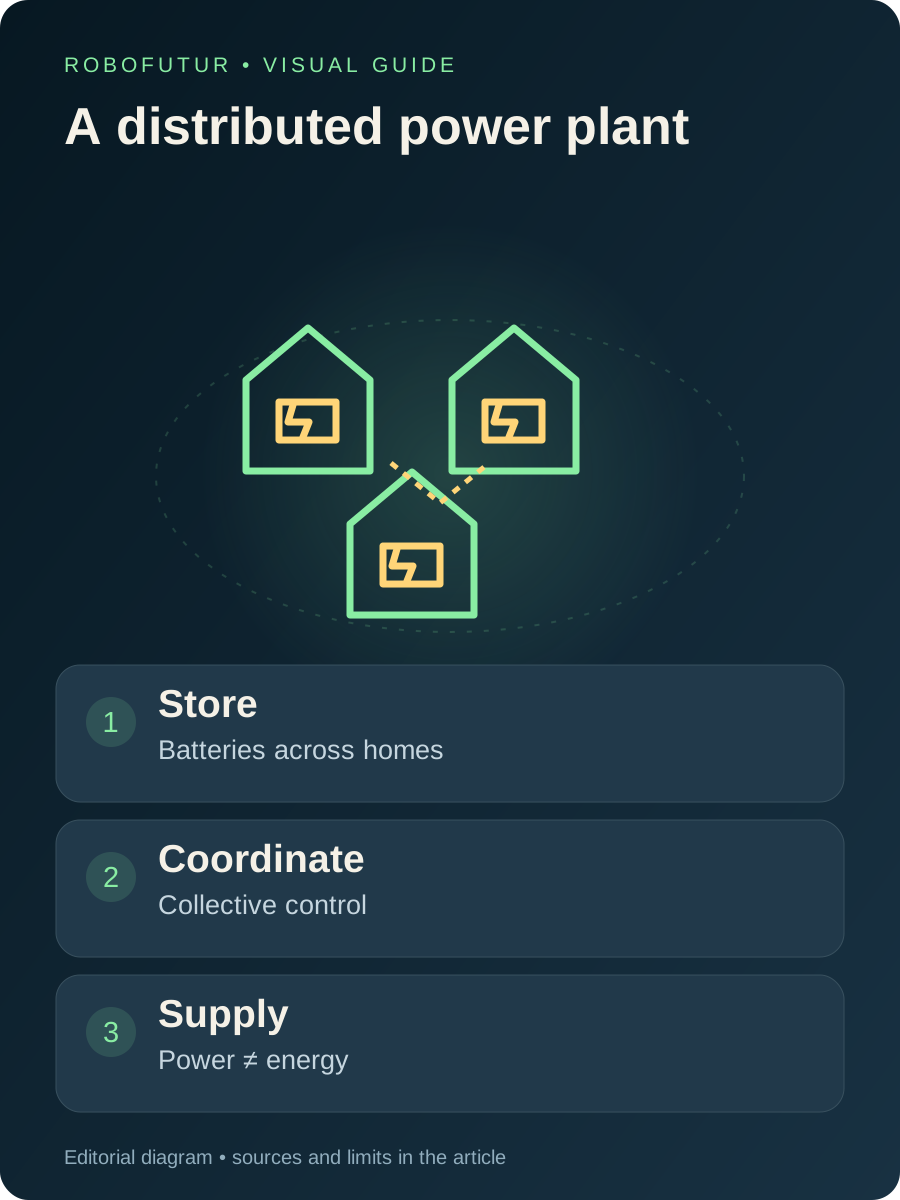
A one-megawatt plant, even at the best capacity factor, answers one command. A peaking thermal plant cannot raise output beyond what its installation allows, and often not at all on short notice. A fleet of 140,000 home batteries is made of units already installed, already connected, and whose only job is to store and then return. Calling on them does not require building anything. It requires coordination.
That is the reversal the September event illustrates. A grid's useful peak capacity depends as much on how fast it can aggregate storage already in place as on the size of new plants. On a California heat peak, where demand climbs within hours, that difference becomes decisive.
The Manila Times therefore wrote that this was the largest residential distributed power plant event in history. The phrase is a value judgement, but it describes an order of magnitude: peak capacity is no longer carried by a single installation, but by thousands of devices already sitting there.
Company data, and that is the whole problem
The limit needs naming, because it sits at the core of the subject.
The 580 MW were released at the request of the California Energy Commission and the utilities, not as part of an independent measurement campaign. They therefore remain operator data, even though the regulator triggered the event. That is the normal situation for virtual power plants today, and it is also what holds back their official recognition: an aggregator announcing its own performance does not carry the weight of a network operator measuring it.
That is why the next step is legislative rather than technical. According to pv magazine USA on September 25, the California virtual power plant bill sits "on the governor's desk." In other words the technical infrastructure already exists at scale, and what is missing is the framework that allows a third party to decide, on behalf of 140,000 owners, when and how their battery discharges.
Markets reacted to the announcement: Tesla and Sunrun shares advanced. That is an indicator of investor interest in the model, not technical validation.
What the precedent says about France
The analogy with France is structural, and that is what makes the example relevant rather than merely curious.
A French winter peak carries the same logic as a Californian summer peak: demand rising fast, a generation fleet that cannot follow immediately, and a necessary reliance on fast-response means. The problem with electricity that responds to demand is not the same as the problem of a plant that responds to supply.
The useful lesson fits in one sentence: what matters is not how much storage is installed, but the ability to dispatch it at the right moment. A battery fleet that cannot be dispatched by a network operator at peak time is worth little, even if it amounts to gigawatt-hours. So the question of storage and tariffs turns as much on virtual power plant dispatch capacity as on the number of batteries installed.
Two limits to that transfer. The French grid is more centralised than the Californian one, and it operates under tighter regulatory constraints. And this article gives no figures for French storage or French rules: it points to an observed mechanism, not an applicable result.
Verdict
580 MW, 140,000 batteries and a heat wave: the September 2026 event shows that a fleet of residential storage can reach a useful scale at peak. The precedent is real, and it is documented by a dozen consistent sources.
Three caveats remain. These are operator data, not a regulator measurement, and the lack of a full breakdown by operator leaves part of the total to be deduced. The key figure is 580 MW, not 517 MW. And the French lesson depends less on the number of batteries than on the ability to call them at the right moment, which is precisely what the California bill is meant to settle.
✔ How we checked this
Facts checked October 1, 2026 from Electrek (September 21), Renewables Now (September 24), Nature World News (October 1), ESS News (September 28), pv magazine USA (September 25), TaiyangNews (September 22), The Manila Times (September 21) and BASENOR (September 21). These are COMPANY DATA: the release was triggered at the request of the California Energy Commission and the utilities, but no independent regulator measurement is published. 580 MW is the combined total across both partners and is the only figure used as a headline; 517 MW is the contribution of Tesla Powerwalls alone and must never be presented as the total. The verified TaiyangNews article breaks the gap down as 517 MW of Tesla Powerwall and 63 MW of additional batteries; how those 63 MW split between operators is not documented. No internal links are used in this article: no article in this publication covers the power grid or storage, and an off-topic link was deliberately rejected. No French grid figures are given, as none were verified.
Information verified as of the publication or update date shown. Technology moves fast — check the sources below.
Sources
- pv magazine USA — pv magazine
- Electrek — Electrek
- ESS News — ESS News
- Renewables Now — Renewables Now
- Sunrun, Tesla Dispatch A Record 580 MW To California Grid — TaiyangNews