After the ISS: Which Commercial Space Stations Can Really Take Over?
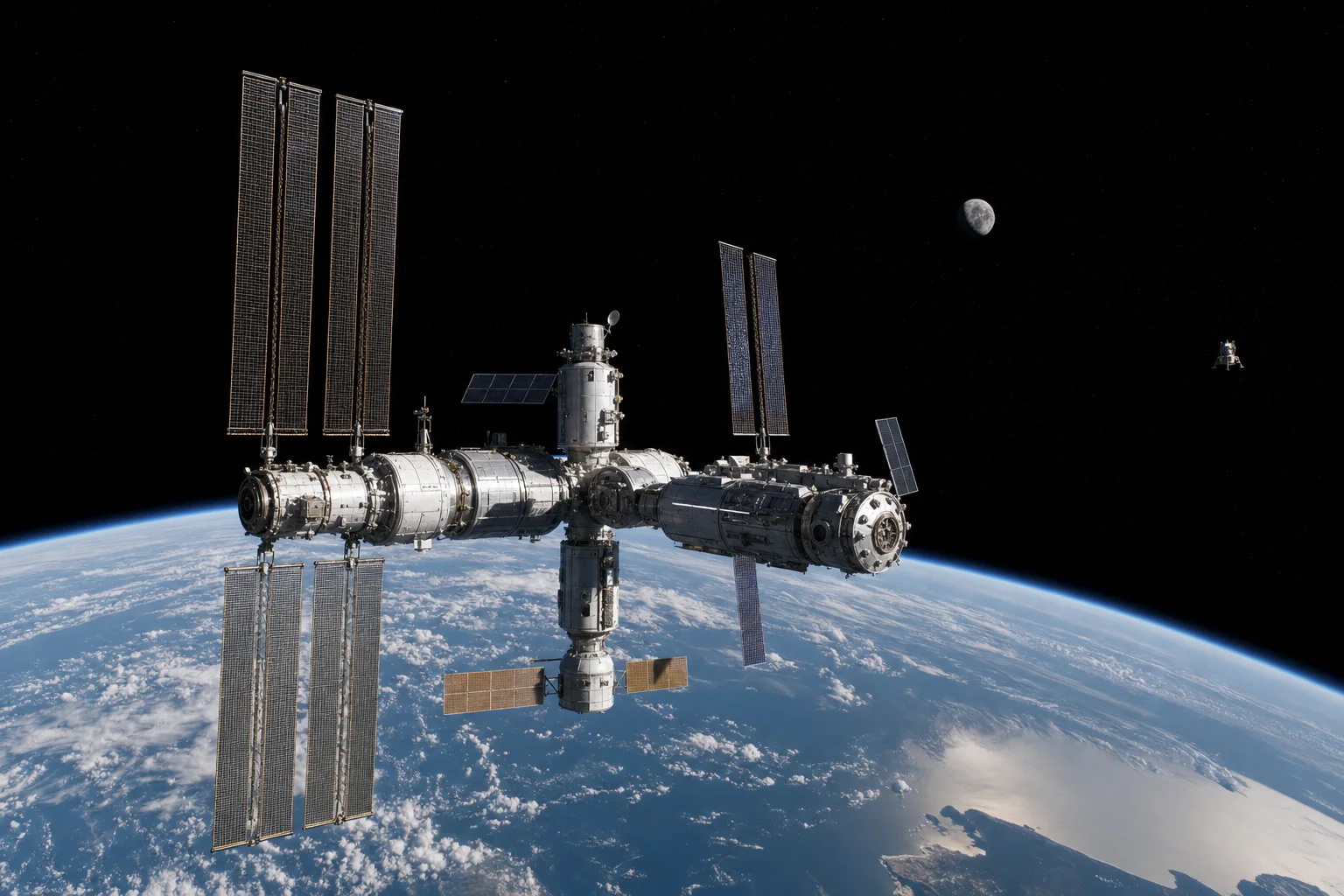
The ISS is expected to end operations around 2030 and then undergo a controlled deorbit. NASA does not plan to replace it with an identical public station: it wants to buy services from one or more commercial platforms. The approach may reduce costs, but creates a gap risk if no station is ready.
Why retire the ISS?
Its first elements have been in orbit since 1998. The station remains productive, but age increases maintenance and some components are not simply replaceable. Extending it indefinitely would shift money away from lunar programmes while retaining an old architecture.
NASA plans a US deorbit vehicle to guide the complex toward a remote ocean area. A controlled re-entry is needed because the ISS is too massive to burn up completely.
Four project families
Axiom Station is intended to begin with modules attached to the ISS and later separate. That gives access to existing infrastructure but also links the schedule to ISS interfaces and lifetime.
Orbital Reef, led by Blue Origin, Sierra Space and partners, targets a modular station for agencies, research and industry. Starlab, backed by Voyager Space and Airbus with other partners, pursues a more compact architecture with a large single launch. Vast is developing Haven-1 as a smaller station and step toward larger systems.
A project name or mock-up does not establish availability. Watch funding, contracts, design reviews, launch vehicle, life-support systems, flight tests and insurance.
In July 2026, NASA released a draft request for proposals for Phase 2. Its planned approach uses multiple firm-fixed-price contracts, followed by competition for task orders covering final design, testing, certification and services. That is a procurement milestone, not proof that a station is ready to fly.
Who pays?
NASA is likely to remain an anchor customer, buying crew time, volume, power and services. Other agencies, laboratories, pharmaceutical companies, manufacturers and tourists may add demand.
The challenge is avoiding a station that depends almost entirely on one public customer while remaining too expensive for everyone else. Microgravity work must create enough value relative to launch, crew and sample-return cost.
The low-Earth-orbit gap
NASA's inspector general highlights the risk that no commercial platform will be certified early enough for an overlap period. Without overlap, the United States could lose continuous human presence, operational experience and research access while China's Tiangong remains active.
Delaying ISS retirement is not free: partners must agree, operations must be funded and technical risk rises. The decision will depend on station condition and commercial progress.
What a station must prove
Before carrying crew, a station must demonstrate structure, atmosphere, thermal control, power, communication, fire protection, safe haven, docking and emergency return. Human rating is an experimental and documentary chain, not one launch.
The strongest progress markers are therefore completed reviews, assembled flight hardware, a contracted launcher and integrated tests. Tourist reservations come later.
The verdict: several credible projects exist, but the market has not selected one obvious successor. A smaller station may arrive before a large orbital campus, and specialised platforms may coexist. For the vehicles that will serve them, see the global launcher race.
A station depends on more than its habitat: robots already used in space explain inspection and manipulation. The MRV satellite-servicing dossier then distinguishes repair, refuelling and rendezvous evidence.
✔ How we checked this
We use NASA's official programme, its July 2026 Phase 2 acquisition update and the transition audit; company dates remain targets.
Information verified as of the publication or update date shown. Technology moves fast — check the sources below.
Sources
- Commercial Space Stations — NASA
- NASA 2025 top management and performance challenges — NASA Office of Inspector General
- International Space Station deorbit analysis summary — NASA
- NASA Seeks Industry Input on Second Phase of Commercial Space Stations — NASA