Life in 2035 with robots: a grounded scenario, not science fiction
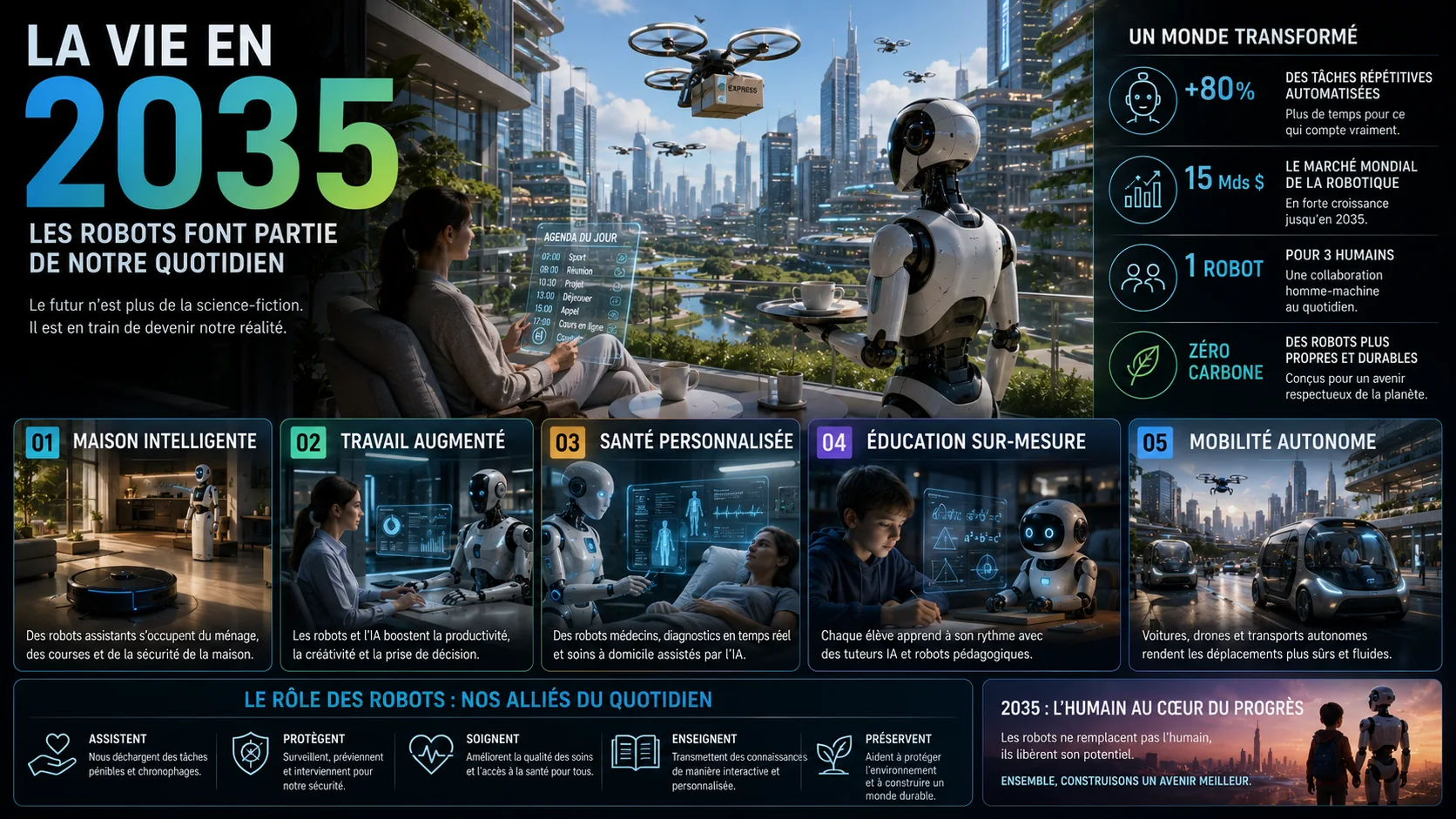
The most believable robot-filled life in 2035 does not look like a street of androids. It looks like specialised automation becoming ordinary: machines move goods behind shop walls, software schedules transport, household devices handle one chore, and some workers supervise fleets instead of operating one machine.
Ten years is long enough for adoption to spread, but short enough that infrastructure, regulation and economics still dominate. This is therefore a scenario built from current evidence—not a promise about the future.
Morning: quiet automation, not a robot butler
In the plausible home, a floor robot has cleaned overnight and an energy system has charged devices when electricity was cheaper. A general-purpose humanoid may exist as an expensive service for people with specific mobility or care needs, but most homes still use narrow products.
That follows the current market. The International Federation of Robotics reports that domestic-task machines—especially floor, lawn, pool and window cleaners—dominate consumer service robots. General-purpose home humanoids remain demonstrations or early-access services in 2026.
By 2035, better perception and cheaper components could let devices handle more varied layouts. Adoption will still depend on repair networks, privacy and whether the saved time justifies the cost. Read which home robots work today for the baseline.
Travel: electric becomes common, autonomy stays uneven
The International Energy Agency's 2026 stated-policy outlook places electric vehicles around half of global car sales in 2035, with a stock potentially above 500 million excluding electric two- and three-wheelers. That is a scenario based on policy and market assumptions, not certainty, and regional differences remain enormous.
Autonomous driving will likely be similarly uneven. Geofenced robotaxis can expand in mapped cities while rural roads, bad weather and complex regulation slow deployment elsewhere. Many people may encounter autonomy through a ride service or delivery vehicle rather than owning a self-driving car.
Electrification and autonomy should not be conflated. A vehicle can be electric and human-driven; an autonomous vehicle can still require remote support and operational limits.
Work: more robots behind the scenes
Logistics is already the largest professional service-robot application in the IFR's supplier sample. Warehouses, hospitals, factories and farms offer repeatable routes and measurable tasks, so adoption is easier to justify than an unpredictable home.
In 2035, a technician may monitor ten mobile robots, a nurse may delegate supply runs to a machine, and a small manufacturer may rent robot capacity instead of buying hardware. Humanoids could become useful where human-shaped access matters, but wheels and fixed arms will continue to win many jobs on cost and reliability.
Employment will change by task. WEF employer projections show both large job creation and displacement by 2030, while the ILO argues that transformation is more likely than complete replacement for most AI-exposed occupations. Training, worker participation and the distribution of productivity gains will determine whether automation improves jobs or merely intensifies them.
Care and public space: trust becomes infrastructure
Robots may deliver meals in hospitals, support rehabilitation and help people with limited mobility. These are high-value uses, but care involves dignity, consent and human connection. A machine should extend staff capacity, not become an excuse to remove contact from vulnerable people.
Public acceptance will depend on visible rules: where cameras point, when remote operators connect, how incidents are reported and who is liable. Cybersecurity updates and access logs will matter as much as motors. Cities may create robot speed limits, operating zones and accessibility requirements just as they regulate vehicles today.
Three variables that could change the picture
First is reliability. Humanoids need to move from curated demonstrations to thousands of safe hours. Second is cost per useful task, including supervision and maintenance. Third is governance: privacy, labour agreements and safety certification can either build trust or trigger backlash.
A 2035 home with one universal robot is possible for wealthy early adopters, but there is not enough current evidence to call it normal. A world containing millions of specialised robots is much easier to support from today's data.
The grounded forecast is therefore gradual and uneven: more automation, mostly invisible; more human-machine teams; and persistent demand for human judgement. Our top humanoid comparison shows what the most advanced machines can demonstrate now, while the jobs analysis explains why adoption should be discussed in tasks rather than replacement slogans.
✔ How we checked this
This article presents conditional scenarios based on current deployment data and stated-policy outlooks. It is not a prediction. Company roadmaps are treated as claims until independently demonstrated.
Information verified as of the publication or update date shown. Technology moves fast — check the sources below.
Sources
- World Robotics 2025 — Service Robots — International Federation of Robotics
- Global EV Outlook 2026 — Executive summary — International Energy Agency
- Future of Jobs Report 2025 — World Economic Forum
- Generative AI and Jobs index — International Labour Organization