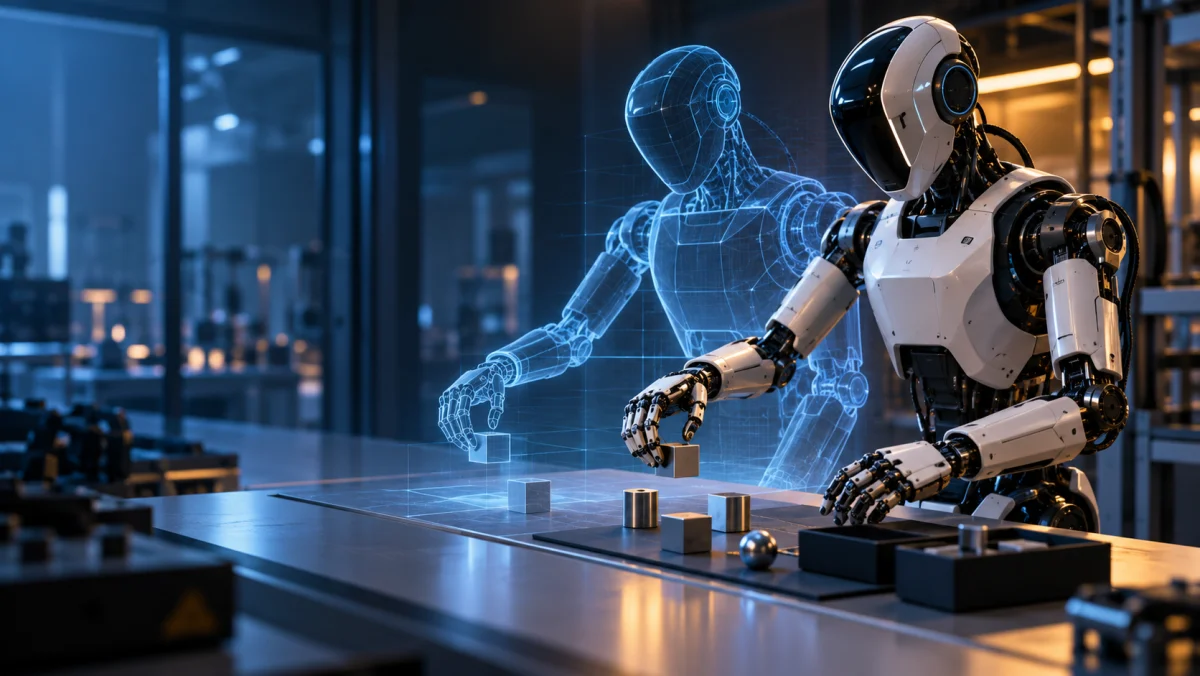
Humanoid Games 2026: running fast is no longer enough
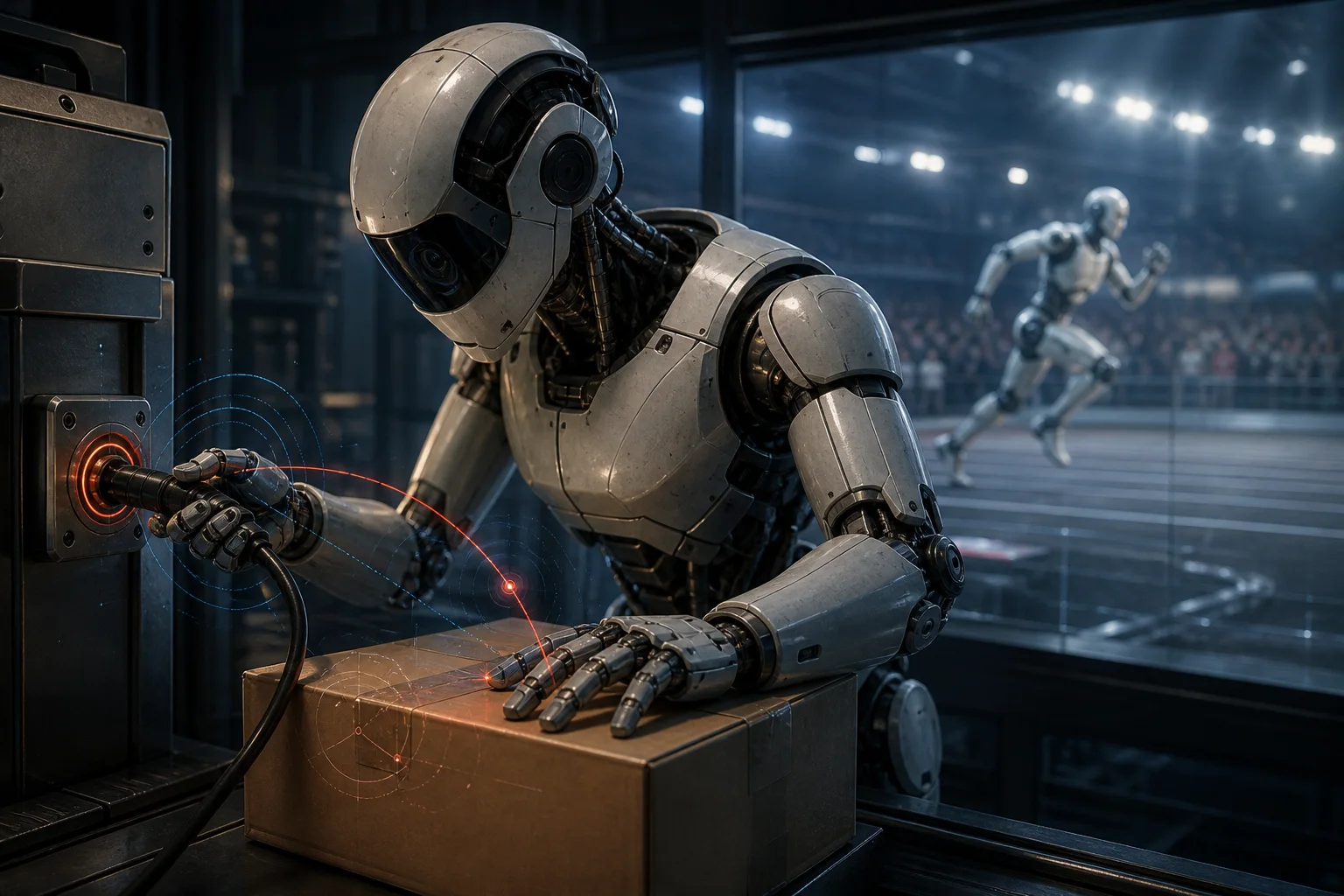
Humanoids can now produce extraordinary sporting images. The decisive test starts when an object is not exactly where the robot expects it. At Beijing’s second World Humanoid Robot Games, held from August 22 to 26, 2026, machines run, play football and table tennis. They also attempt EV charging, restaurant service, material loading and emergency scenarios.
The municipal organiser reports 666 teams, 2,056 robots, 51 events and 1,301 sessions at the National Speed Skating Oval. The scale is remarkable. Yet the most important conclusion is not a race time: these events expose the difference between a trained skill and robust autonomy.
What the programme actually tests
There are 30 competitive events and 21 scenario-based events. Sport attracts the cameras: sprints, 400 metres, football, table tennis and free combat. Professional scenarios assess electric-vehicle charging, service work, emergency response, dexterous grasping, assembly and material loading.
Beijing says most non-hurdle races and other competitive events are fully autonomous. Reuters, citing a Huawei partner involved in the event, reports that just over 40% of the entire programme requires full autonomy. Those statements address different scopes: selected sporting categories versus all events.
For a live French news account that does not duplicate this technical analysis, Actu Humanoïde is covering the event.
Sport measures a foundation that has become stronger
Reuters describes a 400-metre run completed in 39.7 seconds and two robots reaching speeds above the human record benchmark. The comparison needs care: this is not automatically a ratified athletics record under the same conditions as a human race. One robot also struggled to brake and ended its run in a safety mat.
The achievement still matters. Fast running requires dynamic control, joint coordination, pose estimation and mechanical durability. Multiple teams putting robots through a dense competition suggests that biped locomotion is moving beyond a single laboratory demonstration.
But a marked track removes much of the world’s complexity. The surface is known, the direction is clear and the motion repeats. A robot can optimise a running policy without understanding a rotated cable or a box that has moved.
Why plugging in a cable is the real exam
In scenarios reported by Reuters, a small variation can break the sequence: connector angle, displaced object, imperfect grasp or no recovery strategy. The robot must detect the difference, decide whether to adjust its hand, wrist, torso or feet, and verify that the action succeeded.
That chain combines several capabilities:
- sufficiently accurate 3D perception;
- force control that does not damage the socket;
- coordination of hands and body;
- retention of the goal after an unexpected event;
- failure detection and recovery without human intervention.
These “small” errors determine industrial value. A task that succeeds nine times out of ten may look excellent in a video, but it stops a line ten times in every hundred cycles. Without autonomous recovery, every incident calls an operator.
Can a competition prove commercial maturity?
It can provide comparative evidence, not certification. The strongest evidence combines a public protocol, repeated trials, a success rate, human-intervention time and a clear distinction between teleoperation and autonomy. A highlight reel or best time does not answer all of those questions.
Our humanoid proof checklist ranks evidence from scripted demonstrations to sustained customer deployments. The Games sit between those levels: the environment remains organised, but the number of teams and task diversity create comparison and make failures visible.
It is also misleading to describe all participants as one “Chinese robot.” Platforms, software, autonomy levels and goals differ. The value of the Games is that they reveal a distribution of performance rather than one showcase prototype.
What businesses should measure
A factory or warehouse should not select the fastest robot. It should track five quantities: success per attempt, average cycle time, recovery after object displacement, time before human intervention and availability across several hours.
New industrial initiatives aim to turn repetition into transferable skill. The AEON and Schaeffler Humanoid Gym is designed to train and validate representative tasks before deployment. That is a direct response to the problem exposed by the Games: an impressive skill has value only when it survives real-world variation.
Our assessment on August 24
The Games are still running; it would be inaccurate to announce a final result or overall winner. The early events already show two advances. Humanoid locomotion is reliable enough for competition at scale. And useful scenarios are becoming specific enough to expose, rather than hide, manipulation and recovery limits.
The next frontier is therefore not simply running faster. It is completing an ordinary task when the cable rotates, the package slides or the first grasp fails. The most advanced robot will not be the one that never falls on camera, but the one that knows it failed—and tries again correctly.
✔ How we checked this
Analysis current to August 24, 2026, while the event scheduled for August 22–26 is still running. Participation and format figures come from the Beijing government; event observations come from Reuters and AP. No final result is anticipated.
Information verified as of the publication or update date shown. Technology moves fast — check the sources below.
Sources
- World Humanoid Robot Games to Bring Together 2,056 Robots — Beijing Municipal Government
- Robots can outrun humans, but can they plug in a cable? — Reuters / Investing.com
- Humanoid robots sprint, play soccer and set records — Associated Press