Future Military Robots: How Armed Forces Will Work With Machines
For civilian platforms, start with our top 5 humanoid robots verified review.
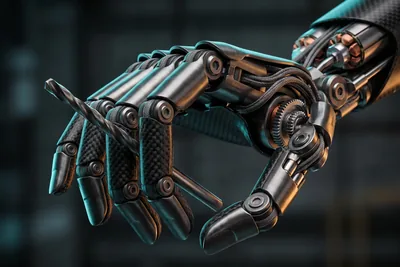
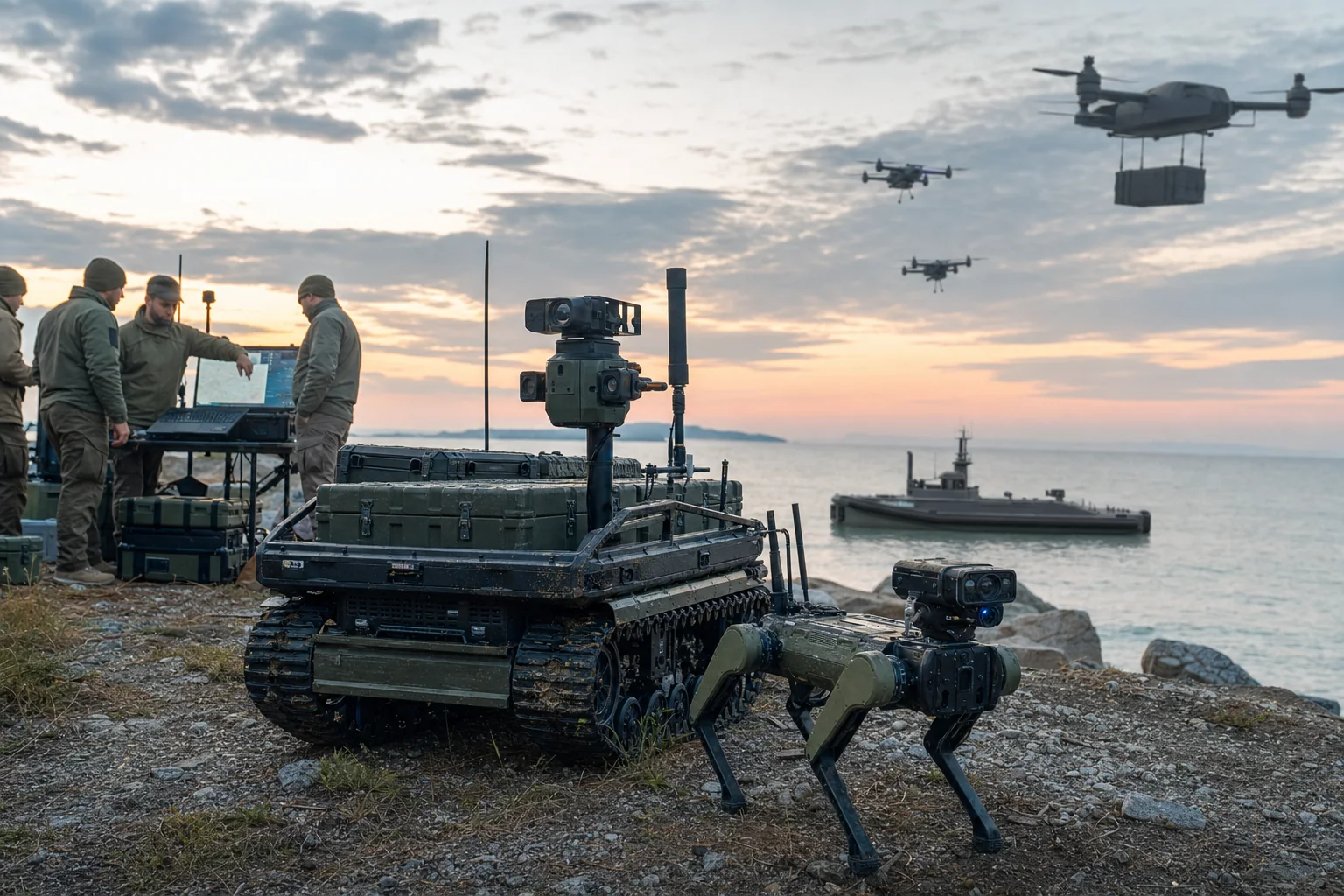
The humanoid robot soldier dominates the imagination. In practice, change is coming from less theatrical and more specialised machines: reconnaissance drones, uncrewed ground vehicles, bomb-disposal robots, sensor-carrying quadrupeds, autonomous vessels and software that coordinates them.
China is testing a chain from transport to medical evacuation. The United States is developing Robotic Combat Vehicles and funding autonomy across air, land and sea. NATO is working on interoperability. The challenge is no longer just getting a robot to move. It is giving it a bounded task, connecting it to people and preserving a clear line of responsibility.
Key points
- The most useful military robot is not necessarily armed: logistics, reconnaissance, explosive-ordnance disposal and evacuation can directly reduce human exposure.
- “Uncrewed” does not mean “autonomous,” and “autonomous” does not mean authorised to use force alone.
- Each environment favours a form: quadruped, wheels, tracks, aircraft, surface vessel or underwater system.
- Performance depends as much on communications, power, maintenance and software as on the chassis.
- Swarms and systems of systems increase scale, but also the spread of error, jamming and loss-of-control risk.
- International humanitarian law still applies; the UN, ICRC, NATO and individual states have not converged on one treaty.
The main families of military robot
| Domain | Platforms | Typical missions | Dominant technical risk |
|---|---|---|---|
| Ground | Wheeled/tracked UGVs, quadrupeds, EOD robots | Reconnaissance, transport, engineering, evacuation, support | Terrain, link failure and recovery of a disabled machine |
| Air | Microdrones, reconnaissance, cargo and combat aircraft | Observation, relay, delivery, search and military effects | Energy, weather, jamming and airspace density |
| Maritime surface | Uncrewed surface vessels | Surveillance, patrol, mine warfare and relay | Navigation, collision and beyond-line-of-sight communications |
| Underwater | Uncrewed underwater vehicles | Mapping, inspection, search and naval missions | Positioning, low-bandwidth communication and recovery |
| Soldier-worn | Exoskeletons and wearable systems | Load assistance, sensing and command interface | Weight, battery, ergonomics and fatigue |
An exoskeleton is not always an autonomous robot, but it belongs to the same operational system: sensors, actuators, energy and software change what a person can do. Conversely, a vehicle with no one aboard can remain remotely controlled from start to finish.
China: a chain of robots, not one universal model
In February 2026, a brigade of China’s 77th Group Army tested exoskeletons, uncrewed all-terrain vehicles, heavy-lift drones and robot dogs in the Gobi Desert. The Ministry of National Defense listed material transport, long-range delivery, reconnaissance, medical assistance and casualty evacuation.
That list is revealing. Armed forces first robotise the dirty, dangerous and repetitive work: carry, observe, open a route, approach a threat or bring someone back. The benefit can be measured without asking an algorithm to determine the lawfulness of a target by itself.
In January 2026, the Chinese ministry also presented a three-quadruped team called “robot wolves.” Official material assigned reconnaissance, transport and combat-support roles within a human-machine formation. It did not publish the decision chain, accuracy, resilience to jamming or failure rate.
The videos show that scenarios were tested. They do not establish fleet size, level of autonomy, production capacity or wartime performance. Our French-language dossier on China’s military robots reconstructs the public chronology and equipment shown from 2024 to 2026.
United States: from prototype to system programme
The U.S. Army’s Robotic Combat Vehicle programme targets lightweight, transportable platforms that can scout or escort crewed fighting vehicles. The Army says operators may remotely control RCVs or assign tasks that the vehicles perform semi-autonomously. Its software work covers autonomous mobility, interface, platform control and payload control.
That hardware-software split matters. The same chassis can evolve through updates, receive a new perception stack or change its module. It also creates a long-term burden: software versions, cybersecurity, compatibility, operator training and validation must be sustained for years.
In its FY 2026 budget-request briefing, the U.S. Department of Defense grouped $13.4 billion under autonomy and autonomous systems: $9.4 billion for air, $210 million for ground, $1.7 billion for water-surface systems, $7.34 million for underwater systems and $1.2 billion for autonomy-enabling software. These were requested amounts presented by the DoD, not proof of executed spending or delivered robots.
NATO: making machines from different suppliers work together
NATO’s Autonomy Implementation Plan calls for interoperable “systems of systems.” The aim is to combine platforms from different countries and vendors while ensuring operators understand their levels of autonomy. The Alliance ties adoption to six principles for defence AI: lawfulness, responsibility and accountability, explainability and traceability, reliability, governability and bias mitigation.
The NATO Communications and Information Agency has tested a Spot quadruped for situational awareness in hard-to-reach or dangerous environments. The work is as much about connecting the device securely as assigning it independent tasks. In 2026, NATO also highlighted European UGVs designed for logistics, reconnaissance and casualty evacuation.
Interoperability is not administrative trivia. If video, position, battery state and return commands do not share trusted formats, a multinational team cannot operate the machines safely.
Why quadrupeds attract so much attention
A quadruped places each foot independently, crouches, recovers and crosses some stairs or rubble. It can accompany people where a wheeled vehicle stops. Its back accepts a mission module: sensor, radio, small logistics load or specialised equipment.
The dog shape also creates an illusion of animal competence. A machine does not sense danger like a trained working dog. It depends on perception, computation, actuators and a battery. Slippery ground, mud, cables, uneven steps, impact, dust or a degraded link can stop the mission.
The carrier and payload must be separated. A photograph of a quadruped with a module does not prove that the module works in motion, that any weapon is accurate, that decisions are autonomous or that the configuration has been adopted at scale.
Wheels, tracks or legs: no form wins everywhere
Wheels are efficient and fast on roads or prepared tracks. Tracks carry more and spread weight over soft ground, at the cost of noise, consumption and wear. Legs cross obstacles but multiply joints, control systems and points of failure.
The right question is not “which robot looks most like a soldier?” It is “which mechanism finishes the mission with the smallest logistics burden?” A simple tracked carrier can beat a humanoid at moving crates. A manipulator or legs become valuable when the task requires a human handle, tool or stair.
Missions where robots already offer clear value
Reconnaissance and surveillance
Sending a sensor ahead lets a team inspect an intersection, basement, tunnel or contaminated area. The machine can map and transmit. Its limit is the frame: even a sharp camera cannot provide every piece of context available to a person on scene.
Logistics
Moving batteries, water, ammunition, tools or medical supplies exhausts people and exposes convoys. A UGV or cargo drone can carry part of that load. Real value is measured in kilograms delivered, energy consumed, successful sorties and human interventions.
Explosive ordnance disposal and engineering
Remotely operated robots have handled explosives for decades. New platforms add mapping, perception and semi-autonomous movement. Automation must fit a strict process: identify, confirm, isolate, act and record.
Search, rescue and evacuation
A vehicle can carry a stretcher or guide a team to a casualty. It must preserve stability, allow manual takeover and never delay care. Removing a crew from the vehicle does not remove medical responsibility.
Armed support
Ground, air and maritime platforms can carry weapons. This is where mobility, perception, recommendation and engagement must be separated most carefully. Our investigation of AI in warfare examines the targeting chain; the robotic chassis is only one component.
The Achilles heel: power, links and recovery
A specification often measures endurance under favourable conditions. Payload, temperature, slope, onboard computation and radio use shorten a real mission. A depleted battery in the wrong place becomes another object to recover, sometimes under threat.
The link is vulnerable too. Jamming, interference, terrain, cyberattack or navigation spoofing can cut video or command. Fallback behaviour must be defined beforehand: stop, return, continue a tightly bounded route or enter a safe state.
Maintenance forms an invisible second force: batteries, motors, legs, tracks, rotors, sensors, calibration, updates, spares and technicians. A sophisticated platform that is unavailable adds no capability.
From remote control to autonomy: four levels to keep separate
| Level | What the machine does | What the person does |
|---|---|---|
| Remote operation | Executes movement commands | Drives continuously |
| Assistance | Stabilises, avoids some obstacles, holds a route | Selects the route and monitors |
| Supervised autonomy | Plans and performs a bounded task | Defines the mission, observes and can intervene |
| Autonomous critical function | Selects a high-impact action within parameters | Sets the framework; intervention may not be immediate |
These levels can coexist on one vehicle. A drone may take off automatically, follow a plan, accept manual takeover and then use terminal guidance. Calling it an “autonomous drone” hides which decisions have actually moved to software.
Autonomous weapons and human control
U.S. DoD Directive 3000.09 requires autonomous and semi-autonomous weapon systems to be designed so commanders and operators can exercise appropriate levels of human judgement over the use of force. It also calls for understandable interfaces, activation and deactivation procedures, and realistic testing of performance and reliability. Some categories require senior approval before development or fielding.
The UN notes that no universally agreed definition of lethal autonomous weapon systems exists. The Secretary-General has called for prohibiting systems that operate without human control or oversight and cannot comply with international humanitarian law, while regulating other autonomous weapons.
The ICRC recommends prohibiting unpredictable autonomous weapons and those designed or used to apply force against people, then tightly restricting others. States have not yet agreed on the instrument, terminology or control threshold. They remain bound by distinction, proportionality and precautions in attack.
Eight pieces of evidence every military robotics programme should provide
- The exact mission and intended environment.
- The autonomy level for each function, not one label for the product.
- Reliability tests with payload, weather and jamming.
- Human takeover rate and mission failures.
- Safe behaviour after loss of link or navigation.
- Cybersecurity, logs and update management.
- Decision and accountability chain for any use of force.
- Maintenance, spares, recovery and full lifecycle cost.
The service member of 2035: orchestrator, technician and decision-maker
The near future does not look like an army of humanoid copies. A unit may carry microdrones, a quadruped, a logistics vehicle, a ground sensor and coordination software. An operator will not steer every motor; they will express intent and monitor several systems.
Human work shifts toward planning, validation, exception handling, cybersecurity and accountability. That can overload the operator or place too much trust in a polished synthesis. Interfaces need to expose uncertainty, not only recommendations.
Robots will therefore change armed forces before a humanoid becomes a credible universal soldier. The first revolution is already underway: removing people from some platforms and distributing their tasks across machines. The boundary is equally clear: removing a human from danger must not mean removing human judgement.
Frequently asked questions
What robots do armed forces already use?
Air drones, remotely operated ground vehicles, bomb-disposal robots, maritime systems and logistics or reconnaissance platforms. The level of autonomy varies widely by mission.
Is a military robot dog always armed?
No. Quadrupeds are also used for inspection, mapping, sensing, transport and search. The carrier and its payload must be described separately.
Does autonomous mean a robot can fire on its own?
No. Autonomous navigation, automated detection and target selection or engagement are different functions. Mobility autonomy says nothing by itself about autonomy in the use of force.
Does international law apply to autonomous weapons?
Yes. International humanitarian law applies to every weapon system. International negotiations are considering additional prohibitions and restrictions, human control, predictability and accountability.
✔ How we checked this
This article covers platforms and integration, complementing our investigation of AI in the targeting chain. Missions are drawn from official military sources and tested against NATO, US Department of Defense, UN and ICRC frameworks. An exercise is not treated as fleet-wide deployment.
Information verified as of the publication or update date shown. Technology moves fast — check the sources below.
Sources
- Chinese coordinated exercise with vehicles, drones, exoskeletons and robot dogs — Chinese Ministry of National Defense
- ‘Robot wolf’ team for reconnaissance, transport and support — Chinese Ministry of National Defense
- Summary of NATO’s Autonomy Implementation Plan — NATO
- NCI Agency explores autonomous robot technology — NATO Communications and Information Agency
- Army opens competition for Robotic Combat Vehicle prototypes — U.S. Army
- DoD Directive 3000.09 — Autonomy in Weapon Systems — U.S. Department of Defense
- Background Briefing on the FY 2026 Defense Budget — U.S. Department of Defense
- Lethal Autonomous Weapon Systems — UN Office for Disarmament Affairs
- Position on autonomous weapon systems — International Committee of the Red Cross