Psyche Used Mars as a Full-Scale Rehearsal for 2029
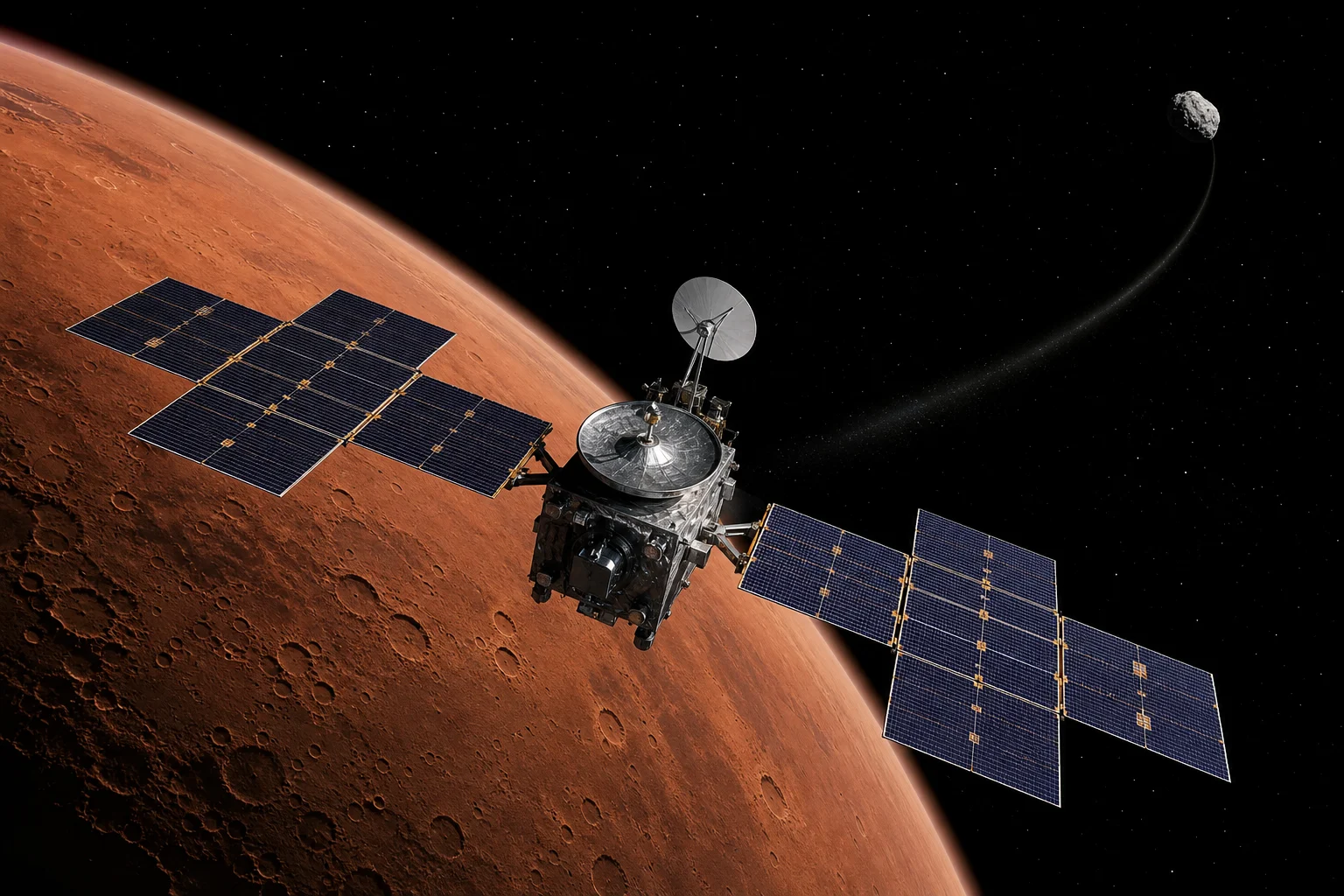
NASA's Psyche spacecraft did not visit Mars because its destination changed. It used the planet as both a gravitational steering wheel and the closest available rehearsal space. On 15 May 2026, the probe passed 4,609 kilometres above the Martian surface. Mars added about 1,000 miles per hour to its speed and shifted its orbital plane by roughly one degree, placing it on the route to asteroid 16 Psyche. Weeks of downlink and analysis later, JPL reported in July that every science instrument had returned useful calibration data.
The spectacular images are therefore only the visible part of the result. The operational value is that engineers tested cameras, magnetometers and a gamma-ray and neutron spectrometer against a planet whose properties are already measured by other missions. If Psyche disagreed sharply with that reference, the team would know to investigate the instrument or its processing before arriving at an unfamiliar asteroid in 2029.
A gravity assist is not free acceleration in every direction
A flyby trades momentum with a moving planet. From the Sun's frame of reference, the spacecraft leaves with a changed speed and direction; it does not burn propellant to make the full manoeuvre. Navigation still has to be extraordinarily precise. The useful corridor is defined years in advance, and Deep Space Network radio measurements reveal whether the probe emerged on the expected trajectory.
NASA says those Doppler measurements confirmed the intended boost and plane change. This is completed and confirmed, not a future launch target. Psyche is now headed toward the main asteroid belt and is scheduled to enter orbit around its namesake body in August 2029. Its solar-electric propulsion system should resume sustained thrusting later in 2026.
Solar-electric propulsion uses electricity from large solar arrays to accelerate xenon ions. The thrust is gentle compared with a chemical rocket, but it can operate for long periods with high efficiency. The Mars encounter supplied a large trajectory change that the spacecraft could not economically reproduce by simply running its thrusters harder.
Mars gave every instrument a known answer sheet
Psyche's twin multispectral cameras observed Mars through several filters. During approach, the planet appeared as a bright crescent because of the viewing angle and light scattered by dust in the atmosphere. Around closest approach, the cameras recorded the south polar cap, Huygens crater, long wind streaks and the small moons Phobos and Deimos. The moon observations rehearsed the search for possible moonlets around the asteroid.
The magnetometer recorded the first signature of a celestial body in its mission. It saw a strong rise in magnetic field near the Martian bow shock, where the solar wind encounters the planet's induced magnetic environment. That does not mean Psyche has discovered a new Martian magnetic field. Mars is the reference that let the team verify how the instrument reacts under changing conditions.
The gamma-ray and neutron spectrometer also collected calibration data. At the target asteroid, it will look for signatures of chemical elements near the surface. Mars has been measured by multiple orbiters, so comparison helps reveal background effects, detector response and the processing adjustments needed before the science campaign.
This cross-check was unusually rich. NASA's Mars Reconnaissance Orbiter, Odyssey, Curiosity and Perseverance contributed observations, alongside ESA's Mars Express and Trace Gas Orbiter and the United Arab Emirates' Hope orbiter. Independent instruments viewing related terrain and atmosphere provide the closest thing to a field calibration laboratory millions of kilometres from Earth.
What Psyche is actually going to test
Asteroid 16 Psyche is often called a “metal world” or the exposed core of a failed planet. The first description is a useful shorthand; the second remains a hypothesis. Remote observations indicate an unusual, metal-rich object roughly 280 kilometres wide, but scientists do not yet know whether it is a stripped planetary core, a mixture of metal and silicate, or material assembled through another early Solar System process.
The spacecraft will not mine it, land on it or return a sample. It is designed to orbit and map the body, measure gravity, analyse surface composition and investigate whether it carries a remanent magnetic field. Those datasets can test models of how rocky planets separated into core, mantle and crust. They cannot put a price on the asteroid's resources, and a theoretical metal value would say nothing about the cost or feasibility of extraction.
Arrival is not the same as immediate science. The spacecraft must be captured into orbit, establish communications, characterise the gravity field and progress through observation orbits at different altitudes. Each step depends on the previous one. The Mars rehearsal reduces risk; it does not guarantee that every instrument or manoeuvre will work three years later.
Why the July data release matters
Mission updates often focus on a single image because it is easy to share. The more consequential achievement here is systems engineering. A planetary flyby forced navigation, communications, instrument commanding, data storage, downlink and science processing to work together on a fixed timetable. It also exposed scattered-light behaviour in the cameras and dynamic magnetic conditions that quiet cruise could not provide.
Calibration before arrival preserves scarce time at the target. Once in orbit, unexplained detector behaviour would compete with navigation and the main science programme. Finding a bias now gives teams years to revise software, observation plans or interpretation methods.
Verdict
The Mars flyby and its trajectory change are confirmed accomplishments. All science instruments returned calibration results that NASA describes as successful. Psyche's arrival in August 2029 is planned, not guaranteed, and its origin as a planetary core remains scientific speculation to be tested.
The best way to read the new Mars images is not as a detour or a bonus postcard. They are evidence that the mission has completed a full-scale rehearsal using a known world before asking its instruments to explain an unknown one.
✔ How we checked this
Verified on 21 July 2026 using NASA and JPL mission updates, the JPL mission brief and independent AP reporting. Measurements released in July are described as calibration results; interpretations of asteroid Psyche remain hypotheses until arrival.
Information verified as of the publication or update date shown. Technology moves fast — check the sources below.
Sources
- NASA's Psyche Mission Delivers Mars Flyby Data, Time-lapse Video — NASA Jet Propulsion Laboratory
- NASA's Psyche Mission Aces Mars Flyby, Targets Metal-Rich Asteroid — NASA
- Psyche Mission Overview — NASA Jet Propulsion Laboratory
- NASA spacecraft uses Mars to propel toward rare metal asteroid — Associated Press