Future Police Robots: What Robot Policing Will Actually Look Like
For the defence side of the same question, see our guide to future military robots.
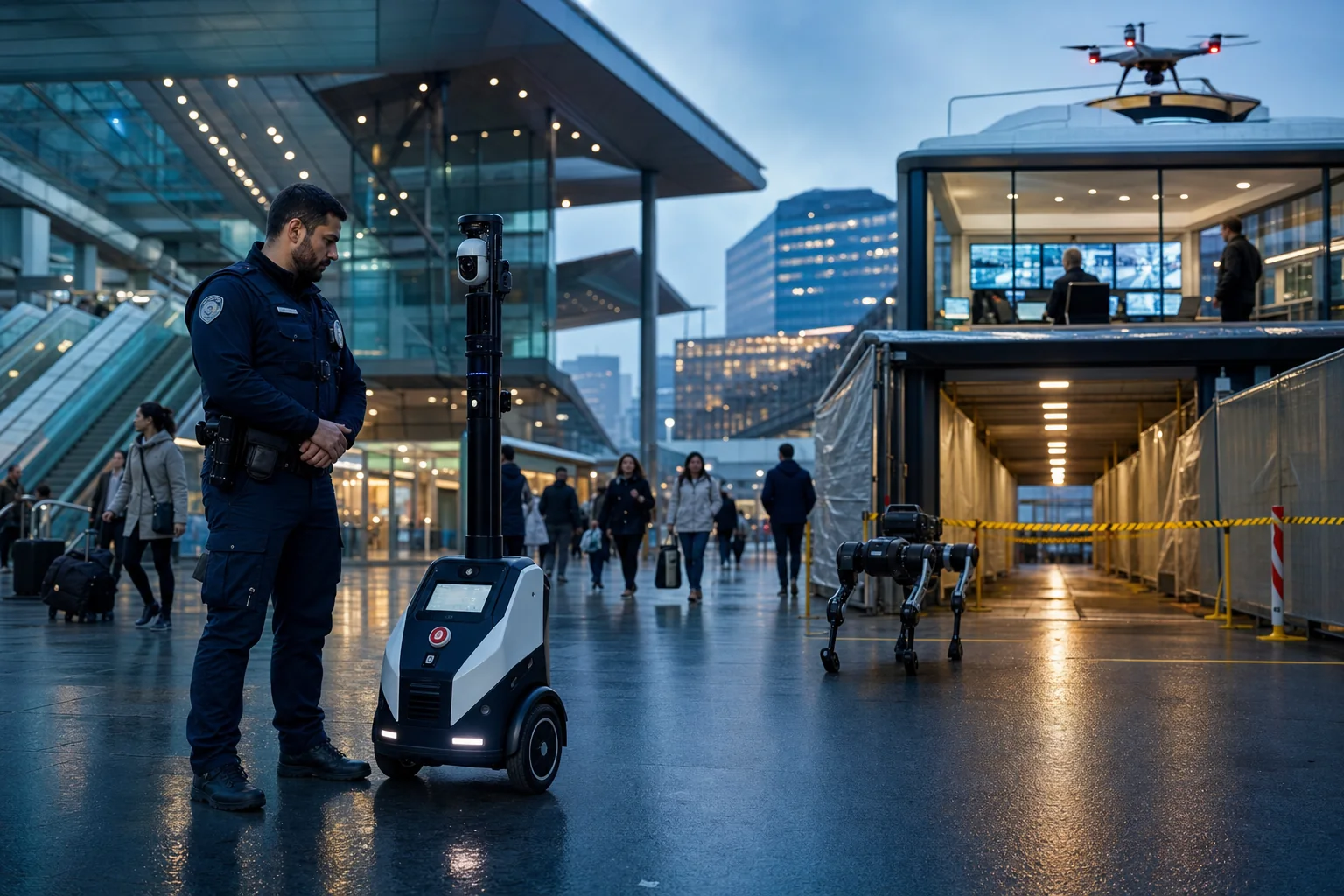
The “robot cop” is unlikely to arrive as one android that patrols, investigates and makes arrests. It is already arriving as a distributed system: a drone supplies the first view, a quadruped enters a hazardous location, a wheeled machine broadcasts instructions and software helps an operator sort the resulting feeds.
China is accelerating that model with traffic humanoids and air-ground patrol units. Singapore is expanding patrol robots across transport hubs. New York reserves Digidog for high-risk scenes. Together, these cases show both the real hardware and the question that matters most: which decisions must remain human?
Key points
- Today’s police robots extend perception and stand-off distance; they do not inherit an officer’s legal authority.
- Their equipment includes visible and thermal cameras, lights, loudspeakers, displays, communication links, navigation and charging systems.
- Form follows mission: wheels for terminals, four legs for stairs, drones for an aerial view and humanoids for gestures or traffic direction.
- Mobile sensors can widen surveillance. Purpose, legal basis, retention, access and remedy need to be settled before deployment.
- A nominal human “in the loop” is not enough if the interface and tempo turn review into an automatic approval.
- The credible future is an audited human-machine team, not autonomous policing.
Five families of police robot
| Platform | Main advantage | Documented tasks | Structural limit |
|---|---|---|---|
| Wheeled patrol robot | Endurance and payload on smooth floors | Patrol, video, messaging, cordon, public assistance | Stairs, crowds, thresholds and floor clutter |
| Quadruped | Mobility through difficult access | Inspection, hazardous-scene reconnaissance, search | Energy, noise, stability and public perception |
| Drone | Speed and wide-area view | First look, tracking, search, lighting and loudspeaker | Weather, airspace, noise and radio continuity |
| Humanoid | Gestures and interaction in human spaces | Traffic, directions, prevention and reception | Mechanical complexity and often weak advantage over simpler forms |
| Autonomous vehicle | Range, transport and electrical capacity | Area patrol, logistics and data relay | Restricted operational domain and human fallback |
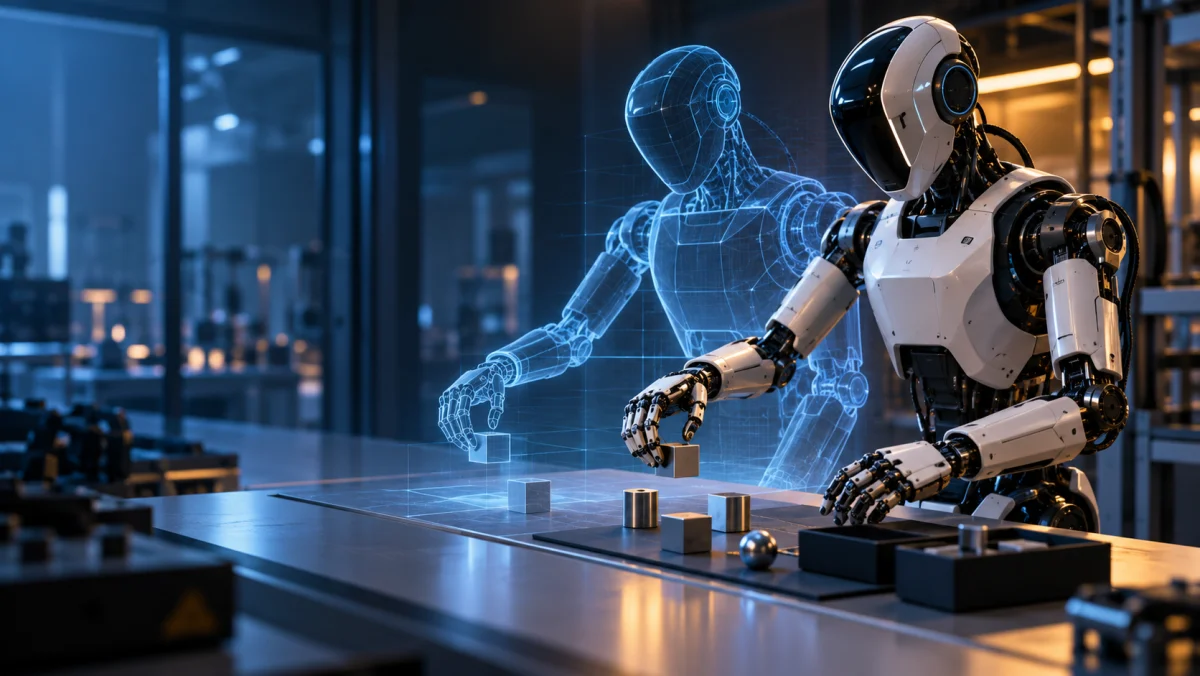
This classification prevents a common mistake: judging each machine by how closely it resembles an officer. A low, stable platform can patrol a terminal more effectively. A quadruped fits a stairwell. A humanoid becomes defensible only when gesture, eye-level interaction or human-built infrastructure truly requires it.
China: from a traffic humanoid to an air-ground network
Shanghai announced a two-humanoid pilot near its Expo centre in July 2026. The city lists four duties: traffic direction, guidance, public service and patrol. The robots answer questions in Chinese and English, recognise traffic lights and issue voice reminders for defined road behaviours, such as riding an e-bike without a helmet or crossing a line.
The language matters. Detecting a scene and speaking a warning is not legally identifying a person, issuing a fine or deciding a sanction. Shanghai describes the pilot as a way to collect data and optimise the system. A dedicated booth lets each robot return to charge when its battery runs low.
Hangzhou’s West Lake AI patrol unit has combined robot dogs, drones and autonomous vehicles since March 2026. Drones provide an overhead view, quadrupeds reach narrow or complex terrain and vehicles operate in busy areas. The city describes real-time information sharing, coordinated command and water-search and rescue equipment.
Beijing demonstrated another configuration in March 2025: 18 Level 4 autonomous vehicles, 15 crewed patrol cars and two industrial quadrupeds. The roughly 65 kg robot dogs carried multispectral cameras and a searchlight, according to the city. A 5G link connected ground inspection, transport and data reporting.
The common thread is not the humanoid. It is the orchestration of specialist machines around human command. Our French-language investigation of China’s police robotics documents each pilot, from the spherical RT-G to Shanghai’s humanoids.
Singapore: the patrol robot becomes a mobile help point
Since April 2023, the Singapore Police Force has operated two patrol robots at Changi Airport Terminal 4. They provide multidirectional live video, map the environment, avoid obstacles and broadcast messages. Warning lights and a siren can help establish a cordon.
An extendable mast raises the camera to about 2.3 metres. A 360-degree system returns video to the operations centre, while a public button opens two-way communication with police. From 2027, the SPF plans to expand patrol robots to more terminals and selected transit nodes, adding public-information touchscreens and automated external defibrillators.
Singapore is also building SkyGuardian. From May 2026, drones began operating from eight pods outside aerodrome areas with remote oversight from the Police Operations Command Centre. Listed payloads include high-definition thermal imaging, warning beacons, a searchlight and loudspeaker; a robotic arm in the pod can swap modules.
The humanoid CERA serves a different niche: community engagement. It uses gestures, photo poses, storytelling and a two-way chatbot to deliver safety messages. It is not an intervention robot. Keeping that distinction visible stops public outreach from being mistaken for general police capability.
New York: send Digidog where a human could be hurt
New York City presented Digidog in 2023 as a police adaptation of a Spot-type quadruped. The NYPD listed high-risk locations and incidents, including hostage negotiation and counterterrorism support. The official announcement says trained Technical Assistance and Response Unit officers remotely control it in support of the Emergency Service Unit.
This is one of the strongest cases for police robotics. The machine can look behind a door, enter an unstable building or approach a suspect object without immediately exposing an officer. The mission is not risk-free: the operator sees through sensors, depends on a link and can miss context outside the camera’s field.
The right outcome measure is therefore not “the robot got inside.” It is whether the system reduced human exposure, returned useful information, avoided escalation and preserved a complete record of its actions.
The equipment, in plain language
Visible, thermal and multispectral cameras
A colour camera supports navigation and observation. Thermal imaging detects temperature differences in darkness or smoke; it does not automatically reveal identity or intent. Multispectral imaging combines several bands. More sensors do not remove error: angle, range, rain, reflections and occlusion still matter.
Masts, lights and loudspeakers
A mast gives a view over a crowd or obstacle. A searchlight illuminates a scene. A loudspeaker warns, reassures or directs. The public should know whether the voice is a recording, a live operator or a generated response.
Navigation and obstacle avoidance
Cameras, inertial sensors, odometry and ranging help a machine localise itself and plan a route. “Autonomous” may mean no more than driving around a suitcase. It does not establish an ability to understand a running child, a crowd surge or conflicting instructions.
Network, command centre and logs
Video, alerts and commands move between machines and operators. Service quality depends on coverage, encryption, authentication, latency and a safe response to disconnection. Every access, detection, human takeover and configuration change should be logged for audit.
Power and charging
Automatic charging improves availability but creates fixed infrastructure to secure and maintain. The meaningful number is mission time with sensors, communications, thermal management and movement active, followed by time to return to service. A laboratory endurance claim does not describe a full shift.
A sensor is not police authority
A machine can flag an anomaly without establishing an offence. It can track an object without knowing whether the action is lawful. It can estimate a biometric match without proving identity. Three layers should remain visible:
- Perception records an image or detects an event.
- Interpretation classifies that event and produces an alert.
- Decision checks identity, restricts movement, imposes a sanction or uses force.
The more serious the consequence, the stronger the evidence, legal basis, oversight and remedy must be. An interface that presents a score as a verdict can produce automation bias: a human is technically present while judgement disappears.
Europe: what the AI Act changes
The EU AI Act generally prohibits real-time remote biometric identification by law enforcement in publicly accessible spaces. Narrow exceptions cover defined circumstances such as targeted searches for victims or missing people, prevention of specified serious threats and certain serious crimes. Use must be necessary, proportionate and authorised by a judicial or independent administrative authority, with a controlled urgent procedure.
Other law-enforcement applications — including post-event remote biometrics and systems that affect evidence or fundamental rights — fall into high-risk categories. That brings risk management, data quality, documentation, traceability, oversight and assessment requirements. Mounting a camera on a robot does not avoid the rule: function and impact matter.
The Council of Europe highlights privacy, expression, assembly, non-discrimination and effective remedy in policing. INTERPOL and UNICRI provide a responsible-innovation toolkit. At UN level, any use of force remains bound by legality, necessity and proportionality.
Ten conditions for responsible deployment
Before a robot patrols, an authority should be able to publish:
- its exact mission and exclusions;
- the legal basis for each data collection;
- the active sensors and notice given to the public;
- error rates measured in the real environment;
- retention periods and authorised access;
- the operator and decision owner;
- the safe mode for failure, impact or network loss;
- incident and human-takeover history;
- independent audit and discrimination testing;
- a simple route to challenge an outcome or report harm.
The police officer of 2035 will probably be a team
The most plausible system is an operations centre receiving several feeds. A drone observes after a call. A ground robot checks a package or building. A vehicle brings equipment. A service robot explains directions. Software prioritises signals while officers question context, choose the response and remain accountable.
Humanoids will stay visible because they communicate through gesture and fit spaces designed around the human body. They may not be the dominant platform. More value will sit in integration, cybersecurity, interfaces and proof of reliability.
The best police robot will not be the one that looks most human. It will be the one with the narrowest clear mission, measured errors and a genuinely accountable human in control.
Frequently asked questions
Do police robots already exist?
Yes, for bounded tasks including patrol, video, public messaging, hazardous inspection, traffic guidance and drone-based first observation. The documented deployments remain under human supervision.
Can a police robot arrest or fine someone on its own?
The pilots reviewed here do not establish autonomous arrest or sanctioning powers. Detection and alerts must remain separate from legal decisions and the use of force.
What equipment does a patrol robot carry?
Depending on the model: 360-degree and thermal cameras, a telescopic mast, speakers, a screen, a public call button, warning lights, navigation sensors and a link to an operations centre.
Is facial recognition legal for European policing?
Real-time remote biometric identification for law enforcement in publicly accessible spaces is generally prohibited by the EU AI Act, subject to narrow authorised exceptions. Other police AI uses are classified as high-risk.
✔ How we checked this
We compared deployments documented by authorities in Shanghai, Hangzhou, Beijing, Singapore and New York with frameworks from the European Union, Council of Europe, INTERPOL and United Nations. An announced feature is never treated as an autonomous power or a proven performance result.
Information verified as of the publication or update date shown. Technology moves fast — check the sources below.
Sources
- Shanghai pilots two humanoid traffic robots — Shanghai Municipal Government
- Air-ground AI patrol unit at West Lake — Hangzhou Municipal Government
- Level 4 patrol vehicles and robot dogs in Beijing E-Town — Beijing Municipal Government
- Drones, patrol robots and community robot CERA — Singapore Police Force
- Police Patrol Robots in Action — Singapore Police Force
- New York City presents Digidog and its operating rules — City of New York
- AI Act rules for law enforcement and remote biometrics — European Commission
- Law enforcement and public security — Council of Europe
- Toolkit for Responsible AI Innovation in Law Enforcement — INTERPOL / UNICRI
- Use of Force — UN Human Rights Office