Atlas enters the Hyundai plant in Georgia: robotics moves from demo to scale
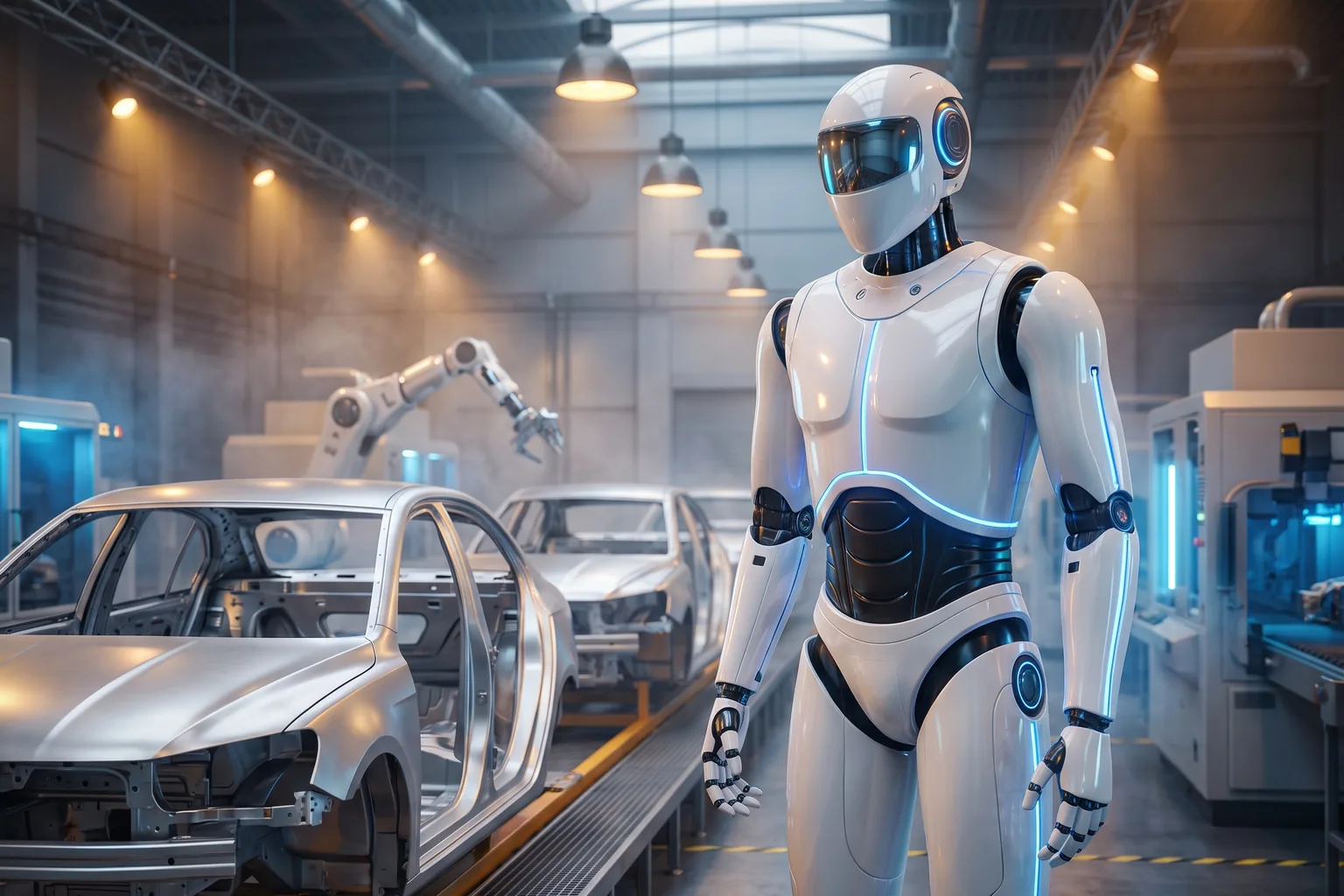
On 21 September 2026, Boston Dynamics opened a dedicated Atlas centre inside Hyundai's Savannah plant in Georgia. This is not a polished demonstration, nor another prototype shown in a video. It is the first permanent robot behaviour factory installed alongside a real automotive line, and it changes the nature of the humanoid debate.
What was opened, and where
The centre is called the Robotics Metaplant Application Center (RMAC). It sits on the site of the Hyundai Motor Group Metaplant America (HMGMA) in Bryan County, Georgia, roughly ten kilometres from Savannah. Boston Dynamics describes it as a permanent site dedicated to data collection and application testing, "in close coordination with the plant."
Zack Jackowski, Boston Dynamics' Chief Product & Technology Officer, framed the problem without hedging: until now, deployments were time-boxed, designed to extract lessons from a large-scale presence. The RMAC marks the end of that learning phase and the start of the operational question: what are the operational realities of deploying Atlas in a working factory?
The word permanent does the heavy lifting in that sentence. A time-boxed deployment is an experiment with a scheduled end date: robots are brought in, something is learned, and the team leaves. A permanent facility implies the opposite — a site that runs continuously, accumulates data and carries the running cost like any other piece of production infrastructure. The question that follows is not whether a humanoid can be useful, but whether a humanoid operation can be run the way a plant is run, shift after shift.
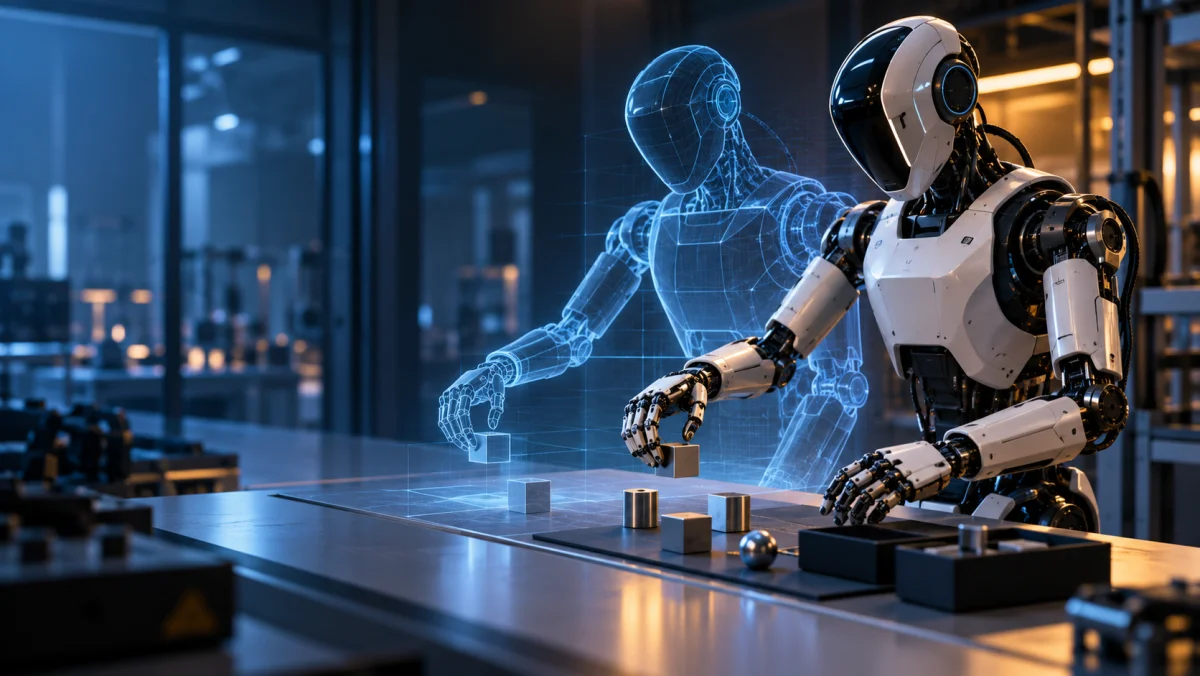
The core idea: a behaviour factory
The term Boston Dynamics uses is "Robot Behavior Factory". The reasoning is industrial rather than academic:
- a quadruped or an industrial humanoid does not learn from web data, but from motions performed on real parts;
- producing that data requires parts, fixtures, work cells and trained human operators;
- the data then feeds an improvement cycle (a "Data Flywheel") that improves the model, which improves data quality, and so on.
The first two bullets are the expensive part. A robot can be simulated, but a simulation does not contain the specific friction of a real production line: the way a part sits half a centimetre off, the grease on a fixture, the glare that changes what a camera sees, the pause a human operator would insert at a step that looks trivial on paper. Capturing those cases requires physical parts, fixtures and skilled people willing to demonstrate the motion, repeatedly, and to label what went wrong when the robot fails.
The flywheel is what turns that raw effort into an advantage. Better behaviour data produces a better model; a better model succeeds more often, so operators spend less time intervening and more time on the difficult, genuinely new cases; the resulting data is cleaner and more informative. A company that starts that loop earlier accumulates a compounding advantage — which is why the location of the data, rather than the price of the robot, is what competitors will be watching.
It answers a very concrete objection: a humanoid can be brilliant in a carefully prepared demonstration and freeze the moment a part is not exactly where it should be. Industrial behaviour data is what allows that gap to be closed.
What the centre does day to day
The stated role of the RMAC at this stage is training, data collection and testing, with teleoperation — not production output. Teleoperation means a human operator is in the loop, demonstrating or supervising motions directly, so that the robot's failures generate usable training material rather than simply damage or downtime.
It also means the centre's first deliverable is a dataset, not a car part. The output of the 2026 phase is a robot that has seen enough of a real line to attempt the 2028 milestone.
The published industrial timeline
The deployment schedule that has been communicated is gradual and dated:
| Stage | Deadline | Nature |
|---|---|---|
| RMAC opens, training campaign | 2026 | Data, teleoperation, tests |
| Parts sequence in the HMGMA plant | 2028 | First shop-floor tasks |
| Parts assembly | 2030 | More complex tasks |
| Extension to Hyundai and Kia plants worldwide | Undated | Gradual rollout |
The numbers to treat with caution
This is the most important part of the story. Two widely repeated figures appear in no official Boston Dynamics release:
- 25,000 Atlas units deployed across Hyundai and Kia plants worldwide;
- a capacity of 30,000 robots per year on US territory.
Both numbers come from secondary press (Manufacturing Dive on 22 September, TechRadar and Gadget Review on 28 September). They even disagree on the deadline — some articles tie the 25,000 to 2028, others to 2030. We therefore present them as targets reported by the press, not as a commitment from Hyundai or Boston Dynamics.
Conversely, here is what the announcement does not say and should be flagged:
- no published task success rate;
- no shift length or hourly cadence disclosed;
- no safety record or incident history;
- no unit price;
- no count of robots actually on site today.
Hyundai is therefore not announcing a fleet in service. It is publicly building, with dated steps, the infrastructure that would make such a fleet possible. That is a difference in kind, and it is what makes the announcement credible.
The gap between the two numbers and the absence of the five disclosures is the whole story. A company that had actually ordered 25,000 units would have a fleet plan, a unit cost, a service contract, a shift pattern and a safety record — and any of those would be a strong story on its own. None of them is available. What exists instead is a building, a schedule and a statement of intent, which is a legitimate thing to announce and a much smaller thing to headline as a deployment.
Why it matters
Three reasons, in order of importance.
1. A leading player has publicly dated its move to industrial scale for the first time. Most humanoid deployment announcements stay in the conditional: a pilot, a partnership, a "planned deployment in the coming years". Here there are years, and there are distinct tasks. The parts sequence and the parts assembly are different jobs with different difficulty, and separating them into 2028 and 2030 is more informative than a single undated milestone — because it implicitly concedes that the harder task is two years further away.
2. Behaviour data becomes a strategic asset. Whoever owns the industrial motions, and the data recording them, owns the advantage. That is precisely what the RMAC industrialises. It is also why the site is co-located with a plant: the constraint on the data is physical proximity to the process.
3. It shifts the conversation towards evidence. After such an announcement, the legitimate question is no longer "does it work?" but "at what success rate, over how many hours, at what cost". That is a good question, and it is measurable. The absence of those five disclosures today is not a criticism of the announcement — it is a description of where the programme actually is. The 2028 milestone is the first date on which any of them can be answered.
What it is not
- It is not a mass deployment: the training phase has only just begun.
- It is not proof that Atlas is more advanced than Optimus or Figure: a quantitative comparison is not yet possible.
- It is not an answer to whether humanoids can hold down a factory in five years.
What to watch
To place this announcement in the 2026 landscape, see our analysis of the industrial humanoid field and the file on humanoids in factories and safety. To understand how a humanoid of this type actually works, our explanation of humanoid robotics.
✔ How we checked this
Checked on 1 October 2026 against the Boston Dynamics announcement carried by The Robot Report (21 September 2026), an interview with Zack Jackowski (Chief Product & Technology Officer), and secondary coverage from Manufacturing Dive (22 September) and TechRadar (28 September). The 25,000 and 30,000 robots-per-year figures come exclusively from secondary press: they appear in no official Boston Dynamics release and are flagged as such.
Information verified as of the publication or update date shown. Technology moves fast — check the sources below.
Sources
- Boston Dynamics Opens Metaplant Application Center to Train Atlas Humanoid Robots — The Robot Report
- Boston Dynamics and Hyundai Motor Group open Robotics Metaplant Application Center in Georgia — Boston Dynamics
- Hyundai, Boston Dynamics open U.S. robot training center in Georgia — Manufacturing Dive
- Boston Dynamics Atlas goes to work: Hyundai opens Georgia facility — Gadget Review