MRV satellite servicer launches: what it must prove
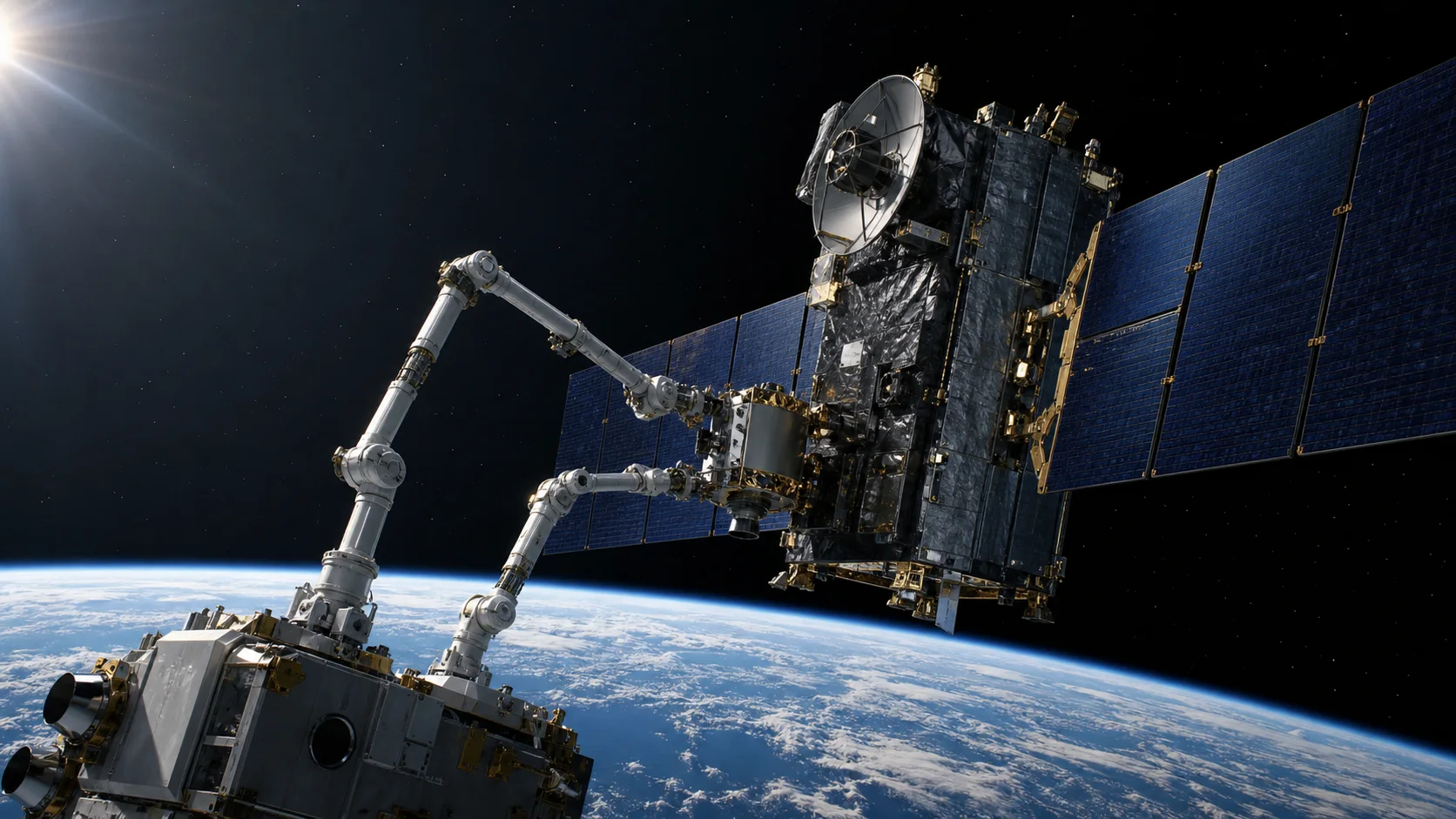
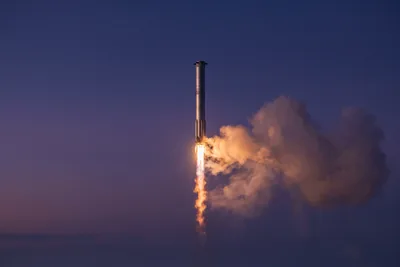
A spacecraft with two robotic arms is now travelling toward some of the most valuable satellites above Earth. SpaceLogistics’ Mission Robotic Vehicle, or MRV, launched on July 21, 2026 aboard a Falcon 9 carrying the DARPA-funded Robotic Servicing of Geosynchronous Satellites payload. Its purpose is to approach ageing spacecraft, inspect them and install compact propulsion modules that can extend operations.
The launch is real; the repair economy is not proven yet. MRV is spending roughly a year using electric propulsion to reach geosynchronous orbit, about 36,000 kilometres above Earth. Its first client work is expected in 2027. No robotic attachment has yet been completed by this vehicle.
What is confirmed
- MRV and three mission-extension pods launched on July 21, 2026;
- SpaceLogistics, part of Northrop Grumman, owns and operates the servicing vehicle;
- DARPA funded the RSGS payload, with twin dexterous arms developed with the U.S. Naval Research Laboratory;
- NASA contributes simulation, software-performance analysis and flight-robot operators;
- the vehicle is transferring toward geosynchronous orbit;
- installation on client satellites remains a future operation.
DARPA describes RSGS as the first privately owned operational robotic in-space servicing mission of its kind. “Operational” refers to the mission and commercial architecture, not to a completed repair. That distinction matters because launch, rendezvous, capture, manipulation and release are separate risk gates.
Why GEO satellites are worth servicing
In geosynchronous orbit, a spacecraft matches Earth’s rotation and can continuously serve the same region. Communications, weather and national-security satellites there are expensive and difficult to replace. Their payload may still work when onboard propellant becomes too scarce to maintain position.
A mission-extension pod acts as an external propulsion unit. MRV is designed to collect one, approach a client, manipulate the hardware and attach the pod. The module can then help control the satellite’s orbit. Associated Press identifies SES and Optus as customers for the first three pods.
Northrop Grumman has already demonstrated a simpler business with Mission Extension Vehicles that dock and provide propulsion as one combined stack. MRV adds a reusable robotic platform: one servicer is intended to visit several clients and install separate modules rather than remain permanently attached.
The arms are only one part of the challenge
The spectacular hardware is the pair of articulated arms, but the most demanding sequence starts earlier. MRV must navigate near a satellite that was not necessarily designed for robotic handling, estimate relative motion, avoid solar arrays and antennas, and establish a safe capture geometry.
At geosynchronous altitude, human operators cannot physically intervene. Communication delay is manageable, but every command must account for dynamics and contact forces. NASA says its support includes dynamic simulation, software analysis and specialists who will assist flight procedures.
Once contact begins, a small error can create rotation, structural loads or debris. The system therefore needs compliant control, force monitoring and abort modes. A clean launch video does not test those behaviours. Only the first rendezvous and installation will.
Repair, refuelling and upgrade are not the same claim
Mission descriptions sometimes group inspection, relocation, repair, refuelling and upgrades under the broad label ISAM— in-space servicing, assembly and manufacturing. The GAO lists these as a spectrum of capabilities, each with different maturity and interfaces.
MRV’s first commercial task is narrower: installing propulsion pods. The RSGS arms were designed for more varied manipulation, but this launch does not prove universal satellite repair or fluid transfer. Replacing an arbitrary failed electronic box is much harder than attaching a prepared module.
That is why this article complements rather than competes with our overview of commercial stations after the ISS. Stations concern human destinations; MRV is infrastructure maintenance for existing uncrewed satellites.
The economic test
Servicing creates value only if the remaining satellite can generate more revenue or public service than the cost and risk of the intervention. Operators must evaluate payload health, insurance, licensing, cyber security, orbital slot value and the price of a replacement satellite and launch.
The reusable-servicer model also depends on cadence. A vehicle that performs several successful jobs can spread its development and launch cost. A long transfer, failed capture or limited compatibility can undermine the equation. Published mission material does not provide a universal service price.
There is also a strategic dimension. Technology capable of approaching and manipulating a cooperative satellite can raise concern when used near an uncooperative one. Transparency, consent, tracking and norms for proximity operations will matter alongside engineering.
What success will look like
The first meaningful milestone is safe arrival and commissioning in GEO. Then MRV must rendezvous with a pod, capture it, reach the client, install it and depart without damaging either spacecraft. Telemetry showing forces, precision, intervention and time would offer stronger evidence than promotional animation.
Longer term, success means repeatability: several clients, different geometries, predictable scheduling and a price lower than premature replacement. Inspection or anomaly-resolution work would expand the business only after safe demonstrations.
RoboFutur verdict
MRV is an important transition from satellites as disposable objects toward orbital assets that can receive limited maintenance. The launch combines a commercial spacecraft, government-funded robotics and NASA operational expertise in a concrete mission rather than a laboratory arm.
But it has launched, not repaired. Its year-long transfer and first 2027 operations separate a credible spacecraft from a proven servicing service. The key story is no longer whether two arms can move in a clean room. It is whether they can create a repeatable, insurable and economically useful interaction with a valuable satellite in orbit.
✔ How we checked this
Checked on August 26, 2026 against NASA and DARPA launch notices, the GAO’s ISAM assessment and independent Associated Press reporting. Launch and architecture are confirmed; the first robotic attachment in GEO remains a planned 2027 operation.
Information verified as of the publication or update date shown. Technology moves fast — check the sources below.
Sources
- Robotic Servicing Mission Launches with NASA Support — NASA
- Robotic Servicing of Geosynchronous Satellites lifts off — DARPA
- In-Space Servicing, Assembly, and Manufacturing — U.S. Government Accountability Office
- Mission launches to extend life of aging satellites in orbit — Associated Press