Jetson Orin Nano 2: twice the robot AI, but no product to buy yet
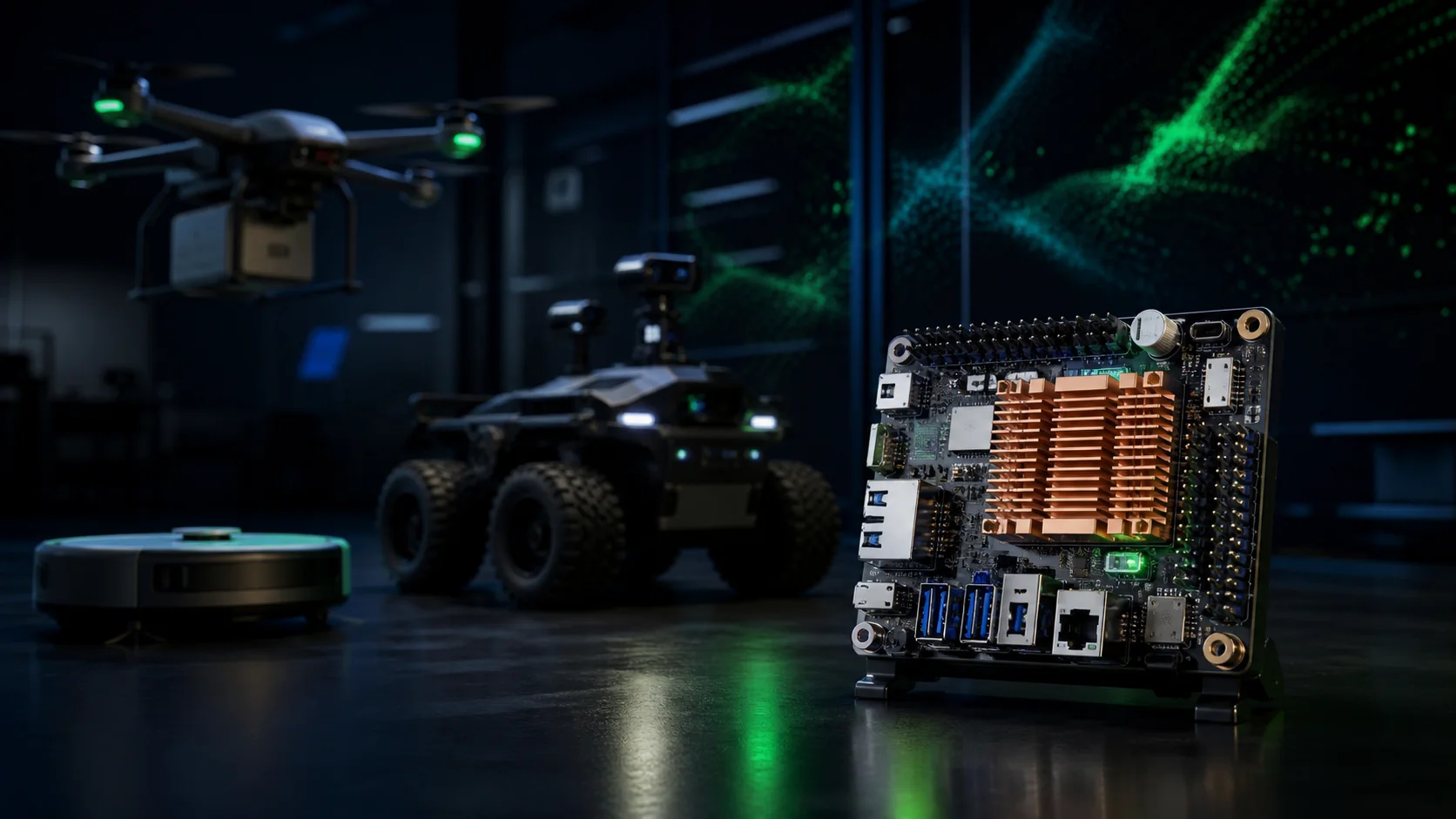
NVIDIA has announced a more powerful compact computer for robots, not a finished robot and not a device that ships today. Jetson Orin Nano 2 is specified at 78 trillion operations per second of AI compute, with 8 GB of memory and an eight-core Arm processor. NVIDIA says it can deliver twice the inference performance of Jetson Orin Nano Super in the same form factor.
The headline is attractive because perception and language models increasingly run inside drones, inspection machines and home robots. Local inference can reduce network delay and keep some sensor data on the machine. But the important date is in the final paragraph of NVIDIA’s announcement: the module and developer kit are only expected in the first half of 2027. Price, complete developer-kit interfaces and independent benchmarks have not been published.
What NVIDIA has actually announced
- 78 TOPS of advertised AI compute;
- 8 GB of memory and an eight-core Arm CPU;
- twice the inference performance of Jetson Orin Nano Super, according to NVIDIA;
- the same compact form factor as the previous generation;
- 40% lower power at equal performance in a specified 15-watt comparison;
- expected module and developer-kit availability in the first half of 2027;
- no announced price as of August 26, 2026.
TOPS is a theoretical throughput measure, not a universal robot speed score. It does not reveal how many video streams a system can process, how quickly a vision-language model answers, or how reliably a robot navigates. Those results depend on model precision, memory bandwidth, software optimisation, thermal limits and the sensors connected to the board.
Why more edge compute matters
A robot has to turn camera, microphone and range-sensor data into decisions under strict timing and energy constraints. Sending everything to a remote server introduces latency, connectivity dependence and privacy questions. A compact computer can instead run object detection, mapping, speech and some generative models locally.
That does not make a machine autonomous by itself. Motors still need real-time controllers; navigation needs safe recovery states; and a generative model should not directly bypass force, speed or geofencing limits. Jetson is the computing layer between sensors and applications, not a safety certification.
This distinction also prevents cannibalisation with our article on Gemini Robotics 2. Gemini is a model family; Jetson Orin Nano 2 is announced hardware on which selected models may run. One is software intelligence, the other is the embedded platform that must power and cool it.
Reading the “twice as fast” claim correctly
NVIDIA attributes the gain to improved Tensor Cores and higher memory bandwidth. The company compares Nano 2 with Jetson Orin Nano Super and states that, in 15-watt mode, the new system consumes 40% less power while delivering the same performance.
Those are meaningful engineering claims, but they remain supplier measurements. NVIDIA has not yet provided retail hardware for reproducible tests covering sustained temperature, memory pressure, camera pipelines and mixed workloads. “Twice inference performance” should therefore be written as an announced result, not as an independent conclusion.
The energy wording also matters. NVIDIA does not say every robot will use 40% less electricity. It describes an equal-performance point in a particular power mode. A developer who spends the efficiency gain to run a larger model may see more capability rather than lower consumption.
Which machines are attached to the announcement
NVIDIA says Matic is adopting Nano 2 for conversational interaction, gesture detection, semantic mapping and autonomous cleaning. Cognex and Doosan Bobcat are also named among early adopters or evaluators. Alphabet’s Wing currently uses Jetson Orin Nano Super and plans to evaluate Nano 2 for delivery-drone perception.
These names show target markets, not completed deployments. “Adopting,” “exploring” and “plans to evaluate” describe different levels of commitment. None proves fleet-scale reliability. The first useful reports will specify intervention rates, thermal behaviour, model latency and power draw inside an actual product over weeks.
For home cleaning, more compute could help a robot distinguish cables, shoes and furniture rather than treating the floor as a simple map. Our guide to household robots explains why manipulation and dependable task completion remain harder than recognition.
What is still missing before purchase
The most obvious unknown is price. NVIDIA calls the platform entry-level but gives no module or developer-kit price. A complete robotics computer also requires storage, carrier-board interfaces, cooling, cameras, power conversion and software support. The board price is therefore only one part of the deployed cost.
Availability is another limit. A first-half 2027 target is an announcement, not stock in distribution. Specifications, partner designs and software compatibility may change before shipment.
Finally, 8 GB of memory creates a practical ceiling. Quantised language and vision-language models can fit, but model size competes with camera buffers, mapping and application code. Developers will need workload-level tests rather than assuming every model named in a launch presentation runs with useful speed.
RoboFutur verdict
Jetson Orin Nano 2 is a credible sign that more AI inference is moving from data centres into machines. The announced balance—78 TOPS, a compact format and a better efficiency point—could be valuable for drones, mobile robots and smart cameras.
It is nevertheless a 2027 hardware promise. No price has been disclosed, the performance numbers come from NVIDIA and partner statements do not equal mass deployment. The right buying decision is to wait for production hardware, complete interfaces, independent benchmarks and the actual cost of a cooled, sensor-ready system.
The breakthrough will not be a larger TOPS number on a slide. It will be a robot that performs the same useful task for longer, with fewer cloud calls, fewer interventions and a bill of materials that still makes commercial sense.
✔ How we checked this
Checked on August 26, 2026 against NVIDIA’s announcement and embedded-systems page, then cross-checked with The Robot Report. All performance figures are vendor claims; the module and developer kit are expected in the first half of 2027 and no price has been announced.
Information verified as of the publication or update date shown. Technology moves fast — check the sources below.
Sources
- NVIDIA Announces Jetson Orin Nano 2 — NVIDIA Newsroom
- Jetson embedded systems and modules — NVIDIA
- Jetson Orin Nano 2 doubles inference performance for robotics on the edge — The Robot Report