Gemini Robotics 2: what Google actually released
Gemini Robotics 2 is not a new Google robot. It is a family of artificial-intelligence models built to understand a physical environment, plan a task and then control different robot bodies. The component developers can actually access today is Gemini Robotics ER 2, available in public preview through Google AI Studio and the Gemini API. The model that directly outputs motor actions, Gemini Robotics 2 VLA, remains in private preview.
That distinction prevents two common misreadings. Google has not put a household humanoid on sale, and it has not opened its complete control stack for arbitrary hardware. The July 30, 2026 release is still important: one high-level “brain” can watch a task unfold on video, call tools, coordinate several machines and delegate execution to an appropriate lower-level controller.
Key points
- The family contains Gemini Robotics 2, Gemini Robotics ER 2 and Gemini Robotics On-Device 2.
- ER 2 is available through an API; the main VLA remains private and Google says it is working with more than 100 trusted testers.
- Google presents control across dual-arm robots and full humanoids, but every hardware platform still requires integration and validation.
- Dexterity and task-tracking results are Google’s own evaluations, not independent field trials.
- Google has announced no consumer robot price, household release date or broad hardware availability.
Three models, three jobs
| Model | Reported role | Access on August 16, 2026 |
|---|---|---|
| Gemini Robotics 2 | VLA: converts vision and language into motor commands | Private preview, early-access waitlist |
| Gemini Robotics ER 2 | Spatial reasoning, planning, video progress tracking and tool use | Public preview in AI Studio and the Gemini API |
| Gemini Robotics On-Device 2 | Lightweight VLA optimised to run locally on robot hardware | No general access documented on the public page |
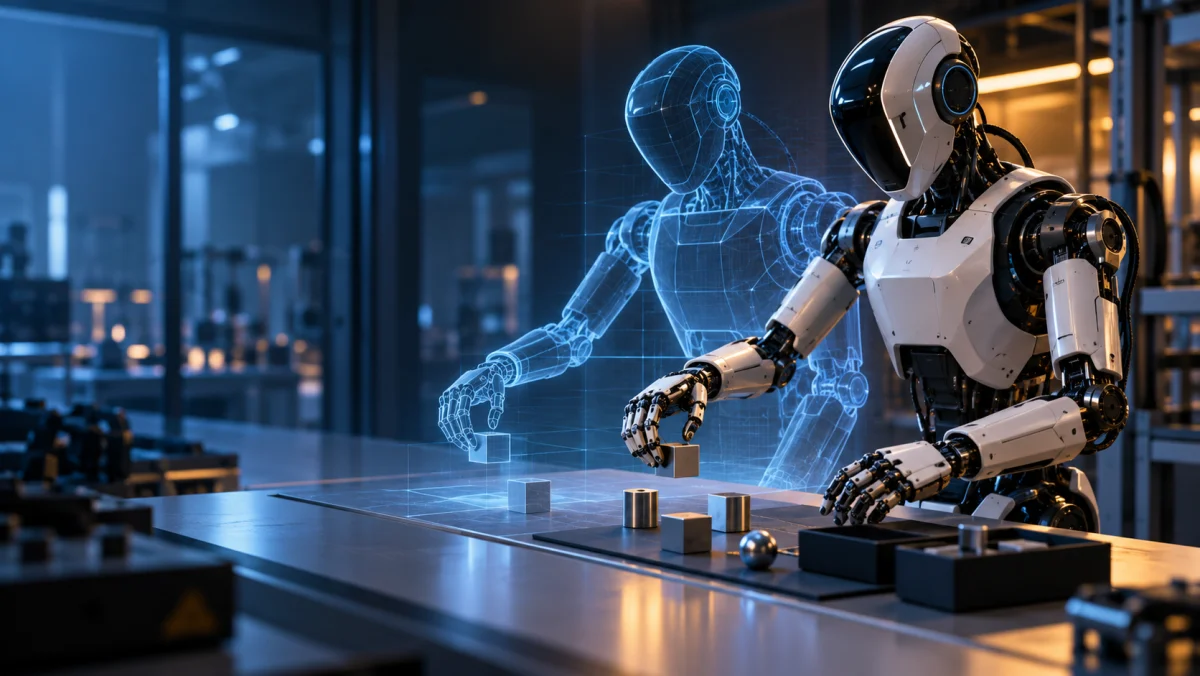
A vision-language-action model connects what a machine sees and what a person requests to actions its body can perform. ER 2 operates one level above: it divides the mission into steps, selects tools, observes progress and decides when to continue or retry. The arrangement resembles a conductor working with specialist musicians. A team can change the arm, quadruped or humanoid without necessarily rebuilding the mission logic from scratch.
Our explainer on how humanoid robots work covers the path from sensors and perception to control and learning.
What Gemini Robotics 2 actually adds
Google first emphasises whole-body control. It says the VLA can command a humanoid from feet to fingertips, accounting for balance as the robot bends, reaches or steps. The same model family is intended to work with complex hands, parallel grippers and dual-arm systems.
The second change is continuous reasoning during action. ER 2 accepts text, image, video and audio, then produces text or tool calls. Through the Live API, it can analyse a stream while a controller executes the previous step. The objective is to replace a rigid stop-think-move cycle with ongoing progress checks and corrections.
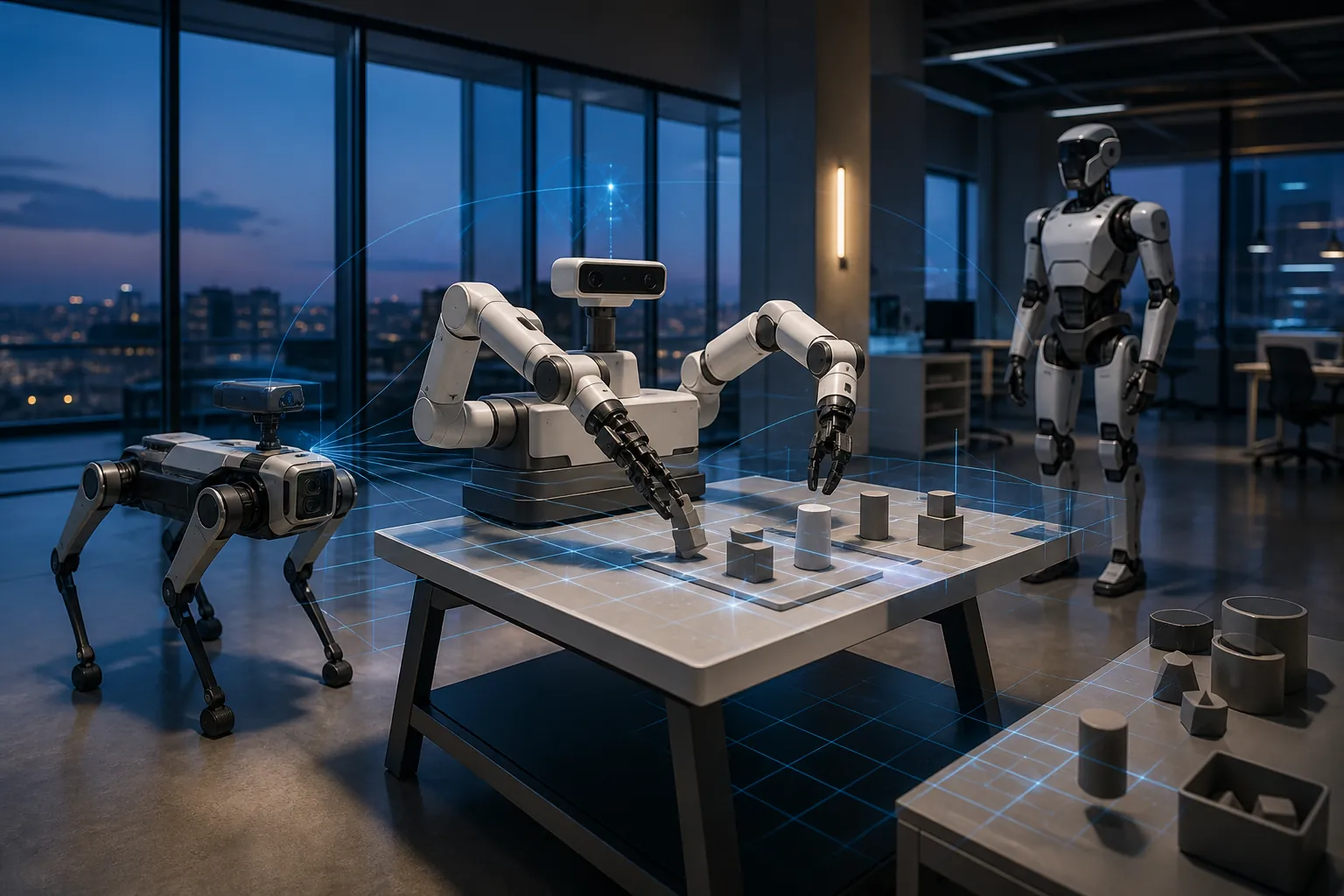
The third change is multi-robot collaboration. Google demonstrates different machines dividing a workflow according to their physical strengths. That is more credible for many industrial settings than one universal robot: a quadruped can inspect a passage, a fixed arm can manipulate a part and a humanoid can work at a station originally designed for people.
Precise numbers that are still vendor results
Google publishes detailed results, which are useful as long as they are not treated as universal performance. On Apollo with Sharpa hands, the VLA page reports a 92% success rate for unscrewing a light bulb, but 36% for screwing one in, 44% for tying a trash bag and 32% for using a dustpan. That spread is more informative than a polished demonstration: dexterity changes dramatically with the motion.
For ER 2, Google reports 57.4% accuracy when classifying task progress into five stages. Its moment-finding evaluation—the ability to identify the critical event in a video—reaches a reported 91.3% accuracy and a 0.96-second mean absolute distance. Google also claims four-times-faster execution for that evaluation. The protocol and charts are published on the model page, but the supplier produced them.
Those scores do not tell us how many hours a robot runs without intervention, how much an accepted task costs, or how performance changes around reflections, deformable objects, dust, people and unstable networks. Our humanoid robot proof checklist lists the operating evidence buyers should request before mistaking a demo for a deployment.
What developers can try now
ER 2 can be called from Google AI Studio and the Gemini API. Google’s official repository provides starter notebooks and an example using Boston Dynamics’ Spot. In that demonstration, ER 2 orchestrates existing navigation and manipulation interfaces to fetch an object from a natural-language instruction.
An API key does not make arbitrary hardware autonomous. The integrator must expose low-level functions, define their parameters, restrict zones, manage stops, control permissions and provide safe recovery. The reasoning model chooses among the tools it is given; it does not replace a real-time controller, system certification or risk analysis.
Google names Agile Robots, Apptronik and Boston Dynamics as research partners. It says more than 100 trusted testers are helping deploy and assess the models, while the VLA page offers an early-access waitlist. That is a research and enterprise programme, not a retail catalogue. The robots involved still follow their manufacturers’ own contracts and schedules. Our overview of Atlas, Apollo 2 and AgiBot A3 separates those platforms by their actual commercial evidence.
Limits that matter more than the spectacle
The first risk is the gap between semantic planning and physical safety. A plausible plan can become a dangerous movement if an object is mislocated, a person enters the area or a tool accepts an overly broad command. Mechanical limits, speed, force, forbidden zones and emergency stops must be enforced below the generative model.
The second risk is dependence on video and external services. ER 2 can call Search or user-defined functions. Every connection adds data handling, permissions, delay and another failure surface. On-Device 2 partly addresses demand for local execution, but Google does not yet document broad access that would allow outsiders to compare its hardware cost and limitations.
Finally, “any type of robot” is an architectural ambition, not a universal certification. Google says the VLA can be adapted to a dual-arm robot in a few hours. That does not establish immediate operational safety or equal performance on unfamiliar hardware.
Verdict
Gemini Robotics 2 matters because it brings planning, temporal tracking, tool use and control of multiple embodiments into one model family. The part that is open today is primarily the high-level ER 2 brain. General motor control remains private, and the public evidence is still dominated by Google’s evaluations.
The next decisive signal will not be another video. It will be third-party integrations reporting task success, intervention rates, incidents, latency and cost over several weeks. Until then, Gemini Robotics 2 is a promising development platform—not yet universal software that turns any robot into an autonomous assistant.
To compare software layers rather than model names alone, read about Isaac ROS and development agents and MoveIt after the PickNik acquisition. The World Labs Atlas dossier examines 3D worlds separately from physical robot performance.
✔ How we checked this
Checked on August 16, 2026 against Google DeepMind’s model pages, Google’s launch post and Google’s published code samples. Scores, speed and capability claims remain vendor-reported until comparable independent reproductions are public.
Information verified as of the publication or update date shown. Technology moves fast — check the sources below.
Sources
- Gemini Robotics 2 model family, capabilities and access — Google DeepMind
- Gemini Robotics 2 VLA status and reported results — Google DeepMind
- Introducing Gemini Robotics ER 2 — Google
- Gemini Robotics ER 2 model information and availability — Google DeepMind
- Official Gemini Robotics ER samples — Google Gemini