Qualcomm buys PickNik, the steward of MoveIt, and promises to keep it open source
On September 23, 2026, Qualcomm Technologies announced an agreement to acquire PickNik Inc., the company that created MoveIt. The news was presented as a financial transaction. The fact that actually matters sits elsewhere: Qualcomm has pledged to keep MoveIt 1 and MoveIt 2 open source under the existing license, and to continue third-party hardware support. Two executives, Dave Coleman at PickNik and Nakul Duggal at Qualcomm, put that commitment into the announcement.
That is the part of the deal that needed verifying. It is also the only part that changes anything for the community.
What PickNik actually is
The company was founded in 2015 and is based in Boulder, Colorado. It built MoveIt inside the ROS project, at Willow Garage. That origin explains a lot: MoveIt was not born as a commercial product, but as one component of an open research project.
First customer: Google. The company later came out of the Amazon Picking Challenge, the competition that shaped much of the research in object manipulation for several years.
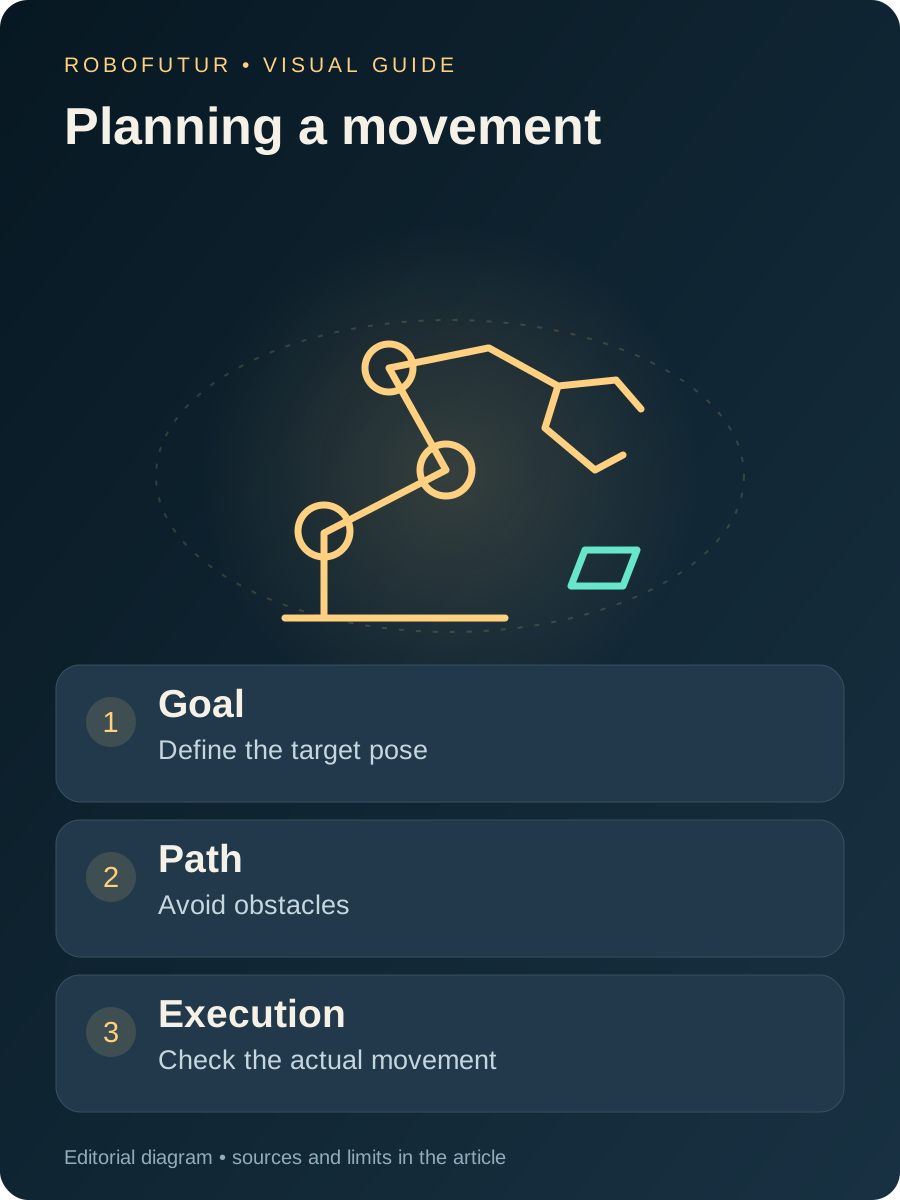
That pedigree matters in the context of the announcement. PickNik is not a software vendor among others. It is the team that holds the manipulation layer for much of ROS robotics, the layer that decides how an arm plans a movement, avoids an obstacle and grasps an object.
The commitment that settles the story
The risk in a deal of this kind is well known. Open-source software that becomes the property of a large semiconductor group eventually closes doors: restricted features, withdrawn modules, a license change, abandoned older sensors.
The announced commitment defuses that objection on four points:
- MoveIt 1 stays free under the existing license;
- MoveIt 2 stays free under the existing license;
- third-party hardware support is maintained;
- both parties commit publicly, through their respective executives.
The last point is the most important, and the most fragile. A public commitment is not a legal guarantee. But it changes the burden of proof: MoveIt users no longer have to demonstrate that they can keep using it, and Qualcomm would have to justify any future restriction.
And as long as versions 1 and 2 keep shipping under the same license, the dependency stays reversible.
MoveIt in 2026: from MoveIt Studio to MoveIt Pro 9.0
The product has changed a great deal since it was created. Three moments structure the recent trajectory:
| Period | Event |
|---|---|
| Creation | MoveIt is developed inside the ROS project, at Willow Garage |
| 2024 | MoveIt Studio is renamed MoveIt Pro |
| 2026 | MoveIt Pro 9.0 released |
| 2026 | Partnership with Motiv Space Systems for NASA's Fly Foundational Robotics mission |
Version 9.0 is presented with strengthened perception-to-motion, redesigned teleoperation and training data collection. That trio deserves a word. It describes a shift in the product: MoveIt is no longer only a trajectory planner, but a chain that runs from sensor to control policy and produces training data in return.
That is exactly the kind of layer robotics needs to move from a robot that repeats a sequence to one that learns a task. We covered that transition in our file on how humanoid robots work.
The partnership with Motiv Space Systems on NASA's Fly mission adds a dimension: manipulation software is no longer only a product component, it is also part of a space mission. That is a credibility argument few robotics software vendors can make.
Why the deal is structural
Qualcomm's context matters as much as the transaction. In January 2026 the company introduced a general-purpose physical-AI architecture stack capable of supporting VLM and VLA style models. In April it joined MassRobotics on the Dragonwing project.
The direction is consistent. Qualcomm sells silicon. To sell higher-value robotics silicon, it needs to control the software layer that turns sensors into decisions. MoveIt is that layer, and one of the most standardised in the world.
The shift in value is visible across the whole region. Hardware becomes commoditised, standardised, and cheaper. What stays expensive is autonomy: reading a scene, planning an action, correcting the action when it fails. The onboard compute that makes it possible is becoming commoditised too. Autonomy is not.
Buying the vendor of the dominant manipulation layer means positioning exactly where value is moving. The same logic applies to open-source robotics: free code is no longer only a stance, it is an asset that large groups buy in order to control the layer above hardware, as we saw with Microduck.
What the announcement does not say
The open-source commitment is explicit. The rest is much less so.
The financial terms. They are not disclosed. No price, no structure, no closing schedule.
The license. Qualcomm refers to the existing license. This is therefore not a new licensing model, nor a dual license that is free for research and proprietary for industry. The commitment covers the status quo.
The team. No public information on retaining headcount or on the product roadmap after the deal.
Software neutrality. The commitment covers the governance of MoveIt. It says nothing about any possible alignment between the open-source code and Qualcomm's hardware offer. As long as that separation holds, the situation stays healthy.
What to watch
Three signals, not one.
The first release under the new owner. If MoveIt 1 and 2 keep receiving releases at the same pace and under the same license, the commitment held. The first license change, however small, would be a warning signal.
The fate of third-party hardware support. This is the most exposed part of the commitment. Maintaining support for sensors and robots that are not Qualcomm products costs money and patience. It is the first line to cut under pressure.
The separation between open-source software and Qualcomm's offer. As long as MoveIt stays neutral towards Qualcomm chips, the community has no reason for concern. The day the free software also becomes the best route to a proprietary chip, the question becomes legitimate.
To size the stakes, keep in mind that the global industrial robot fleet counts several million units, a large share of which depends on a manipulation software component. That this tool stays free is not a community detail. It is a condition for research reproducibility.
✔ How we checked this
Checked on October 1, 2026 against Qualcomm's official release of September 23, 2026 and its coverage by The Robot Report. The open-source commitment for MoveIt 1 and 2 is the point explicitly stated by both cited executives. Financial terms are not disclosed. The announcement is Qualcomm's official release of September 23, 2026. Qualcomm's newsroom is a JavaScript application whose deep press-release URL could not be resolved to a stable link, so it is cited through the verified Robot Report write-up. The MoveIt and GitHub entries point to their public repositories.
Information verified as of the publication or update date shown. Technology moves fast — check the sources below.
Sources
- Qualcomm to acquire PickNik Robotics and keep MoveIt open-source — The Robot Report
- MoveIt documentation and code repositories — MoveIt / PickNik AI
- MoveIt 2 open-source repository — GitHub
- PickNik AI: company and products — PickNik AI