300 robots in a theme park: China puts the humanoid into public service
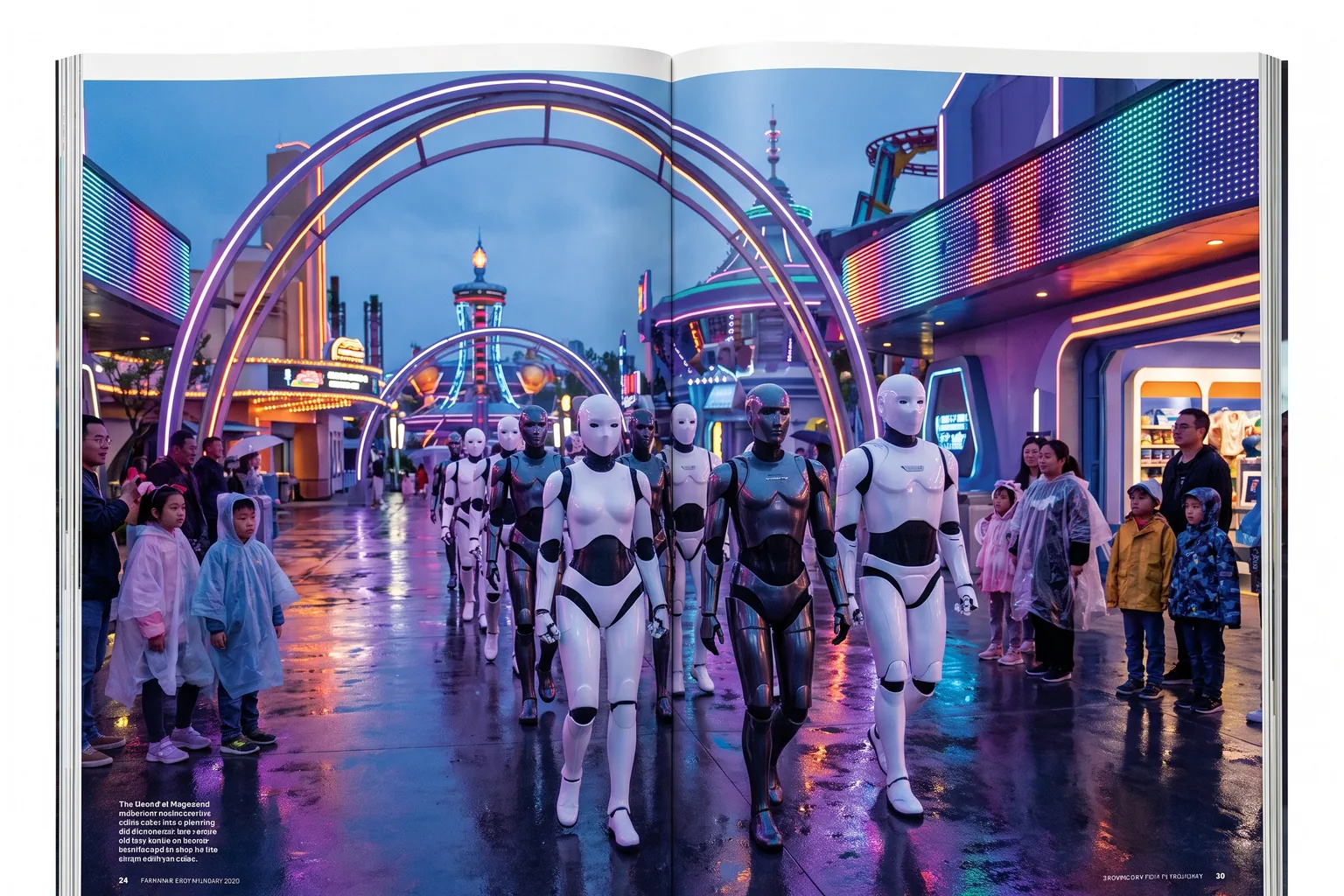
On 24 September 2026, more than 300 AGIBOT humanoid robots began working at the Chimelong Spaceship Park, in Zhuhai, in the Hengqin area. The deployment does not stop at the attractions: it also covers hotel operations on the site.
As far as we know, this is the first large-scale, revenue-generating, public-facing humanoid deployment announced this year. The other major 2026 announcements concern factories. This one concerns a place where families pay to be served by robots.
What was deployed
| Item | Detail |
|---|---|
| Operator | AGIBOT |
| Site | Chimelong Spaceship Park, Zhuhai / Hengqin |
| Volume | More than 300 robots |
| Entered service | 24 September 2026 |
| Scope | Theme park and hotel operations |
| Context | High-traffic tourist site |
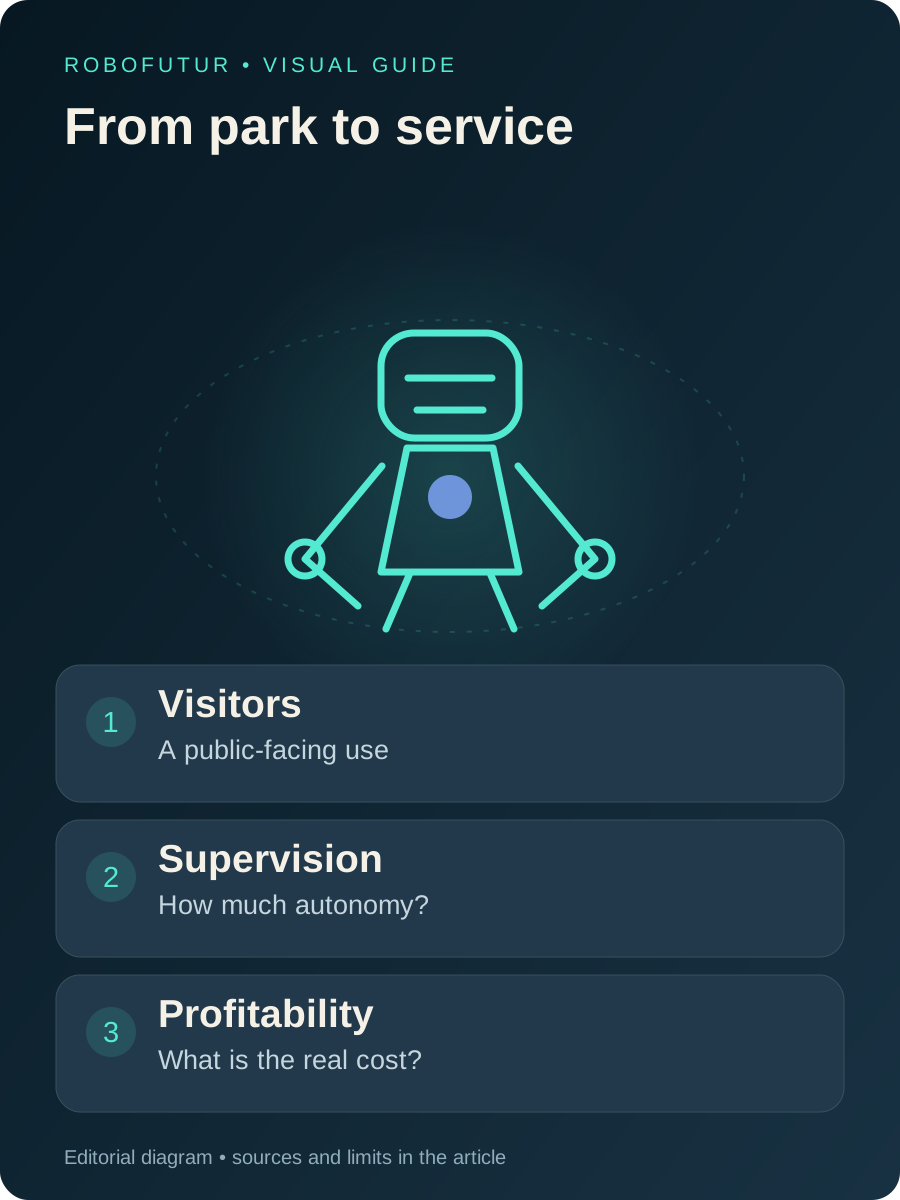
The choice of site is significant. A theme park imposes three constraints a laboratory does not: an unpredictable flow of visitors, a density of people where a misstep is immediately visible, and a profitability constraint. A robot that fails in front of a parent and child costs more than a robot that fails in a test cell.
Each of those three constraints is a different kind of stress. A test cell can be reset between attempts; a theme park cannot — a robot that stops on a crowded plaza stays stopped until somebody clears it. A laboratory has no customers to disappoint; a theme park has people who paid for the day and will say so loudly. And a factory can absorb a slow quarter by shipping from inventory, whereas a service operation has to justify its cost on the day it runs.
That is why a deployment in this setting is a genuinely different category of evidence from a factory pilot. A factory is where humanoids are expected to work. A theme park is where they are being judged in public, by people who did not choose them and are not being trained to use them.
The industrial milestone: the 20,000th robot
On 30 September 2026, six days after the opening, Pandaily reported that AGIBOT had delivered its 20,000th robot — at the exact moment when more than 300 units were starting work at the park.
That production figure must be read with the same caution as every other volume number in this sector: it is a cumulative total since the company was founded, not an annual rate. It points to genuine industrial capacity, which is rare among young humanoid manufacturers, but it says nothing about the success rate of those robots in real conditions. A company can build twenty thousand robots and deploy none of them to a paying customer; the two numbers measure different things, and the sector has a habit of presenting them as one.
Why AGIBOT rather than someone else
AGIBOT is one of the few Chinese humanoid manufacturers with a profile that combines the three dimensions that matter: production (20,000 units delivered), market volume (first place per IDC in the first half of 2026, ahead of Unitree) and a visible public deployment.
It is that third dimension that makes the difference here. A company can ship 20,000 robots to research centres and experimental units without a single one of them ever having served a paying customer. AGIBOT has just done the opposite, on the most demanding site there is after the factory.
The financial dimension complicates the picture rather than completing it. If humanoid revenue is a meaningful share of the business, then the same question applies to AGIBOT as to its competitors: how much of it repeats, and how much of it is a one-off public event that a competitor could win next year by being the operator that had the better contract? The Chimelong deployment answers the first question — the service is real, the site is paid, the robots are working — and leaves the second open.
For market context, see our analysis of worldwide humanoid shipments. For the financial dynamics of the Chinese sector, our reporting on the tightening of humanoid IPOs.
What this deployment does not prove
It is worth being precise here, because enthusiasm comes easily.
- No task success rate has been published for this deployment.
- No detail on supervision: are these robots autonomous, or assisted by operators backstage? The available sources do not document it. In a laboratory this would be a reasonable omission; in a public venue, where staff are present anyway, it is the single most useful missing number.
- No profitability figure: we do not know whether the operation is profitable, or at what running cost.
- The fleet's distribution is unknown: we do not know how the 300 robots are split between the attractions and the hotel.
None of these gaps makes the deployment less impressive. It makes it a data point rather than a verdict — and it identifies exactly which disclosures, the moment they arrive, would turn it into the first hard evidence of a revenue-generating humanoid service at scale.
Why it is still an event
Because it moves the conversation onto ground that matters to a non-specialist reader. A humanoid in a factory lends itself less to discussion than a humanoid on productivity. A humanoid in a theme park is a directly readable promise: will this improve my experience, or will it stop me eating at 2pm.
And China is answering that question three years earlier than expected, with several hundred units. For the rest of the file, see also humanoids in factories and our 2026 humanoid overview.
✔ How we checked this
Checked on 1 October 2026 against AGIBOT's announcement and coverage from Pandaily (20 and 30 September 2026), Global Times, Fast Company (29 September), GadgetMatch (25 September) and TechRepublic (25 September). The figure of more than 300 robots and the opening date of 24 September come from official communications and Pandaily.
Information verified as of the publication or update date shown. Technology moves fast — check the sources below.