Helix 2.5: Figure AI puts its robot inside 30 homes it had never seen
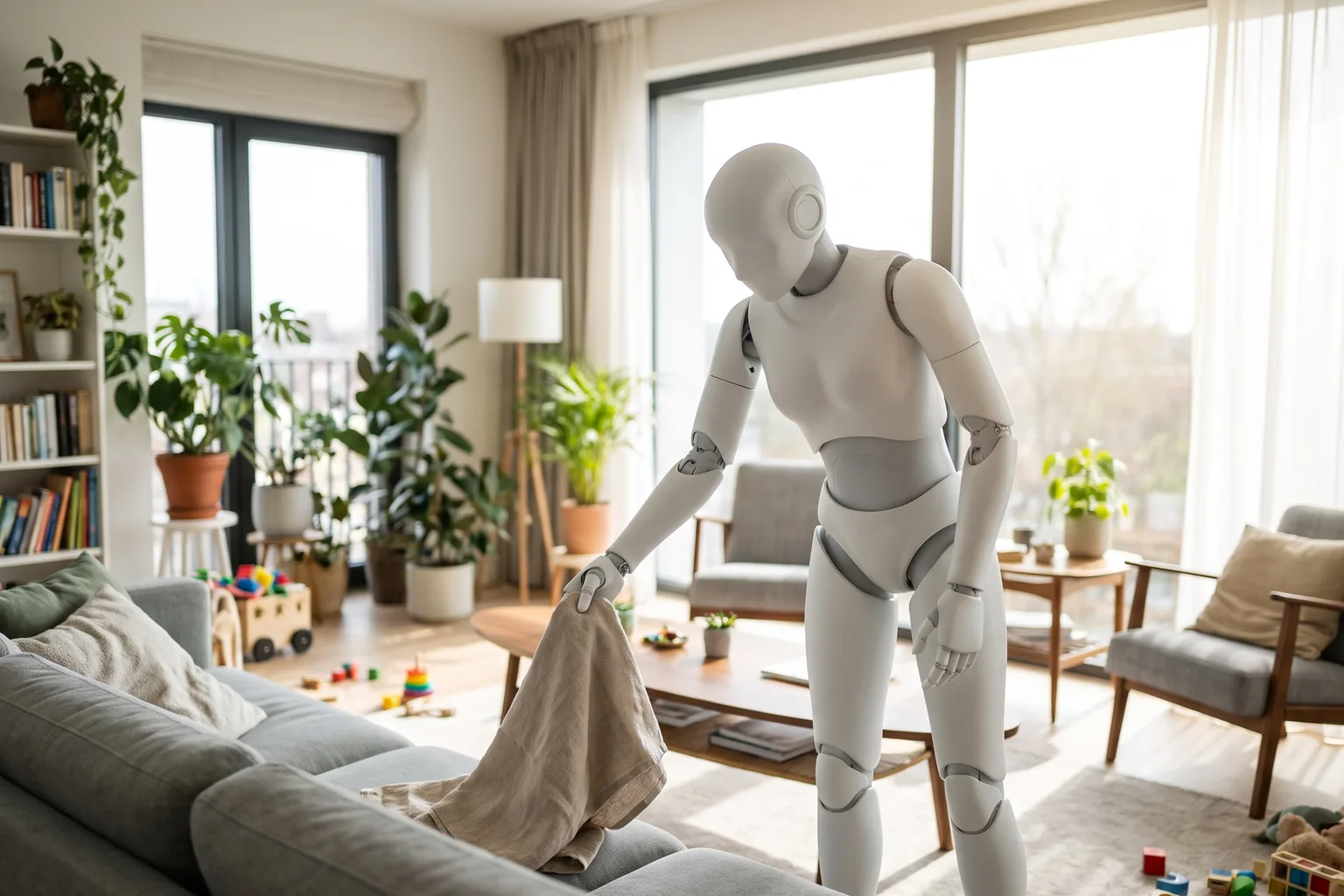
On 17 September 2026, Figure AI introduced Helix 2.5, which it describes as the most advanced neural network it has built and as the first humanoid to demonstrate zero-shot whole-body generalization in 30 real homes across the San Francisco Bay Area. The detail that matters is not how many rooms it walked through. It is that no data was collected in those apartments, no fine-tuning was applied, and nothing was adapted in advance to that furniture or those objects.
Two words that should not be diluted
"Zero-shot" means the model had never seen the task in the environment where it was finally executed. Figure says the 30 homes were ordinary dwellings rather than prepared sites, and that no human intervention was needed to adapt the robot to what it found there.
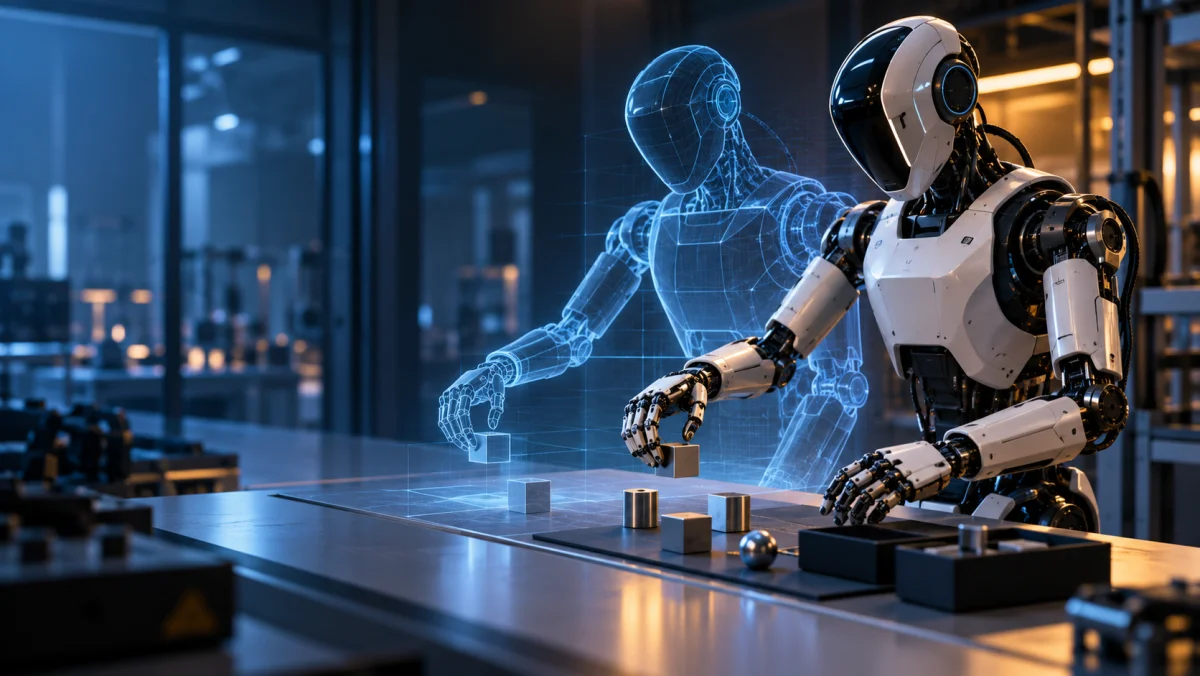
"Whole-body" means a single motor policy spans locomotion and manipulation in one model: Figure lists walking, rigid-object grasping, deformable-object handling, bimanual coordination and active perception. That is not a stack of specialised scripts bolted onto a humanoid chassis. The announcement describes a single foundation model, pretrained on Index, the company's human behaviour dataset.
Three long-horizon behaviours are shown: tidying living rooms, folding towels, making beds. Those are exactly the tasks our home robot evidence review identified as the current line between demonstration and service, and the reason why the move from lab to living room is harder than a video edit suggests.
Data did almost all of the work
The most important number in the announcement is not 56%. It is the gap between 9% and 56%. With architecture, task data, training and evaluation held strictly constant, adding pretraining on Index alone moved the zero-shot success rate from 9% to 56%.
| Measure reported by Figure | Value | What it means |
|---|---|---|
| Zero-shot success without Index pretraining | 9% | The model on its own does not improvise in an unseen home |
| Zero-shot success with Index pretraining | 56% | The gain comes from human data, not a new architecture |
| Task-specific data (Helix 2.5) | Half that of a representative Helix 02 behaviour | Less task-specific data over a wider scope |
| Coverage | 30x wider than a behaviour spec that cost 2x less | Specifying a new skill no longer scales with scope |
| Demonstration scope | 30 homes, San Francisco Bay Area | Unseen homes, not a lab |
The message is structural rather than anecdotal. In home robotics, generalization is becoming a training data volume problem, not a scene perception problem. It is the same logic that moved Gemini Robotics 2 from a demonstration to a transferable base model, which we covered in our Gemini Robotics 2 analysis. Figure applies it to a real humanoid body, which makes the comparison interesting and the result harder.
A scaling law presented as a prediction
Figure also argues that repeatedly doubling Index data improves action prediction loss with enough regularity to predict the loss of the largest training run to four decimal places. If that regularity held across other tasks and other bodies, it would not deliver a finished robot. It would deliver a method for sizing the next training step.
The caveat matters. All of these are company claims. The evaluation protocol, the definition of a successful attempt and the exact number of attempts per home are not published. A scaling law observed on a single family of tasks can collapse as soon as you change the robot, the scene or the success criterion. We cannot reproduce it independently today, so we will not present it as an established result.
Context sets the scale. Helix 02 had already run a logistics task autonomously for 200 hours. That is a genuine endurance record, but in a single repeatable setting. Thirty apartments is the opposite.
Why 56% is not yet a product
A 56% success rate means the system fails in close to half of all attempts. For a lab robot, that is a remarkable demonstration. For a device in someone's home, it is something you switch off.
Three things are missing, and none of them is a data problem. Safety: what happens when an unpredictable person walks into the room at the wrong moment. Error recovery: picking up from its own failure without help. And longitudinal exposure: running for weeks of real use, with wear, dust and laundry that gets folded badly twice in a row.
On cost, Figure says specifying a behaviour cost half as much over a scope thirty times wider. That is good news for rolling out a growing number of skills. It says nothing about what a robot costs in a home, which remains an open question.
A credible third-party evaluation would have to publish at least four things: how many attempts were run per home, what counts as success for a long-horizon behaviour, how often a human intervened, and whether the robot recovered from its own failures. None of that is available today. Until it is, the 56% figure should be read as an upper bound produced by the team that built the system, not as a field average.
What this shifts for the rest of the field
The achievement is that it moved the argument. As long as the debate was about grasping one object, any lab could win with custom hardware. Here the trial lasts for the whole behaviour, the settings change, and the outcome depends on a corpus accumulated over years. That is a data advantage, therefore a consistency advantage, therefore a higher barrier to entry for newcomers.
It does not mean domestic work is solved in 2026. It means the order of the problems has inverted: in the Bay Area, perception is no longer the main bottleneck. Data is. For the machines themselves, our 2026 humanoid shortlist remains the most direct comparison.
The number to keep is simple: 9% to 56% by changing training alone. Anyone reading it should hold two ideas at once. Generalization is moving fast, and 56% is still a failure roughly every other time.
✔ How we checked this
Checked on 30 September 2026 against Figure AI's announcement of 17 September 2026, cross-checked with Forbes reporting of 21 September 2026. Every performance figure (9%, 56%, the scaling claim) is a manufacturer claim that has not been independently replicated; no third-party evaluation is public.
Information verified as of the publication or update date shown. Technology moves fast — check the sources below.
Sources
- Helix 2.5 — zero-shot whole-body generalization in 30 homes — Figure AI
- Helix 02 dishwasher demonstration — Figure AI
- Helix 02 tidies a bedroom and makes a bed — Figure AI